Category:
Book Reviewsجریانهای پنهان خانوادگی: تاریخ شخصی
Prices can sometimes be lower on bigger marketplaces, but this link helps independent bookstores and local reading communities.
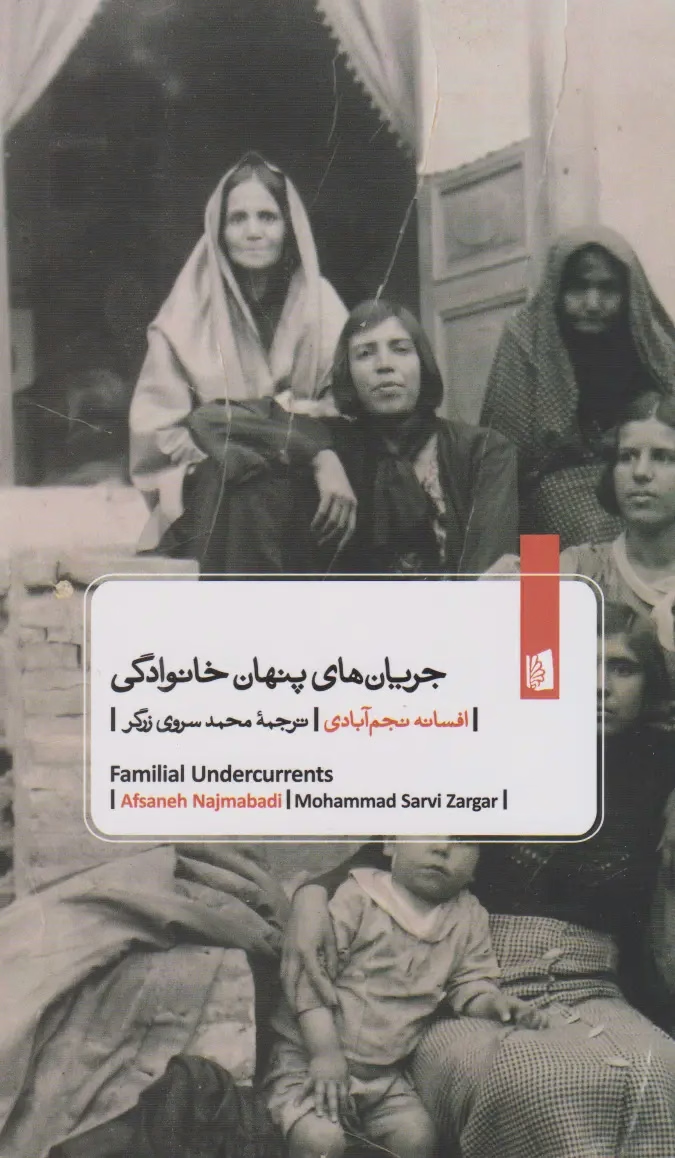
Afsaneh Najmabadi's جریانهای پنهان خانوادگی (Hidden Family Currents) arrives as something rare in Persian scholarship: a work that refuses the comfortable distance between researcher and subject. Instead, Najmabadi transforms a family secret—the discovery that her father maintained a hidden second marriage and family—into a sweeping investigation of how Iranian marriage itself fundamentally transformed across the twentieth century. This is not a detached academic exercise. It's personal history weaponized as intellectual inquiry.
The Central Tension That Makes This Book Matter
The most divisive aspect of جریانهای پنهان خانوادگی isn't its subject matter—it's Najmabadi's unflinching refusal to protect the privacy of living family members in service of historical truth. She confronts this ethical minefield head-on in her introduction, acknowledging the paradox: how can a scholar justify excavating intimate secrets that people actively wish to keep buried? This tension doesn't resolve. It lingers throughout the book, and frankly, that's what makes it essential reading. Najmabadi doesn't pretend the problem doesn't exist; she forces you to sit with the discomfort.
The book argues that mid-twentieth-century Iran experienced a seismic shift in what marriage meant. The transition from polygamy as a socially acceptable practice to monogamy as an ideological imperative didn't happen overnight—and it didn't happen equally. Among Tehran's emerging middle class, the romantic marriage based on love and individual choice became the aspirational norm. Yet this transformation created a profound hypocrisy: men like Najmabadi's father who couldn't abandon the old system were forced to hide it. Polygamy didn't disappear; it simply became shameful.
What Najmabadi Actually Does Here
جریانهای پنهان خانوادگی operates as material history in the most literal sense. Rather than relying solely on conventional historical documents, Najmabadi examines love letters, family photographs, wedding dresses, and the architectural transformation of Tehran itself. She reads domestic spaces as texts. She treats a wedding dress as historical evidence. This methodology—what some reviewers call "the high art of gossiping"—yields insights that traditional historical frameworks miss.
The book traces how the ideal of companionate marriage rooted in romantic love infiltrated Persian culture through novels, newspapers, and theatrical works. Najmabadi demonstrates that this wasn't an organic cultural evolution but a deliberate ideological shift, particularly visible in the literature and media of the era. The concept of "choosing your spouse for love" became the marker of modern, civilized society—which meant everything preceding it became retroactively illegitimate.
What's particularly astute is how Najmabadi connects architectural change to social practice. As Tehran modernized and housing patterns shifted from multi-generational compounds to nuclear family apartments, the physical infrastructure for maintaining multiple wives essentially disappeared. You couldn't hide a second family in a modern Tehran apartment the way you could in a traditional household. Urban design became destiny.
The Writing: Narrative Over Apparatus
Najmabadi's prose style prioritizes narrative momentum over scholarly apparatus. She's a storyteller first, which means جریانهای پنهان خانوادگی reads with genuine page-turning quality despite its academic ambitions. The personal narrative anchors the historical investigation; you never forget that this scholarly project emerged from intimate betrayal and discovery.
However, this narrative strength creates a methodological vulnerability. Because the book is so compelling, readers can drift into treating specific conclusions as universal truths rather than observations limited to Tehran's middle class. Najmabadi repeatedly acknowledges these limitations—this is a study of upwardly mobile urban families, not rural populations or the poor—but the elegance of her argument sometimes obscures these boundaries. A reader not paying close attention could emerge with an overgeneralized picture of "modern Iranian marriage."
The translation into Persian (from the English original) presents another complication. Some reviewers have noted that the translator worked from the English version rather than original sources, and that certain quotations don't precisely match their originals. Given that Najmabadi's archive—the monumental "World of Women in the Qajar Era"—sits readily available, this secondary translation introduces an unnecessary layer of mediation.
What Works Brilliantly
The book's greatest strength lies in its refusal of false objectivity. By making herself and her family the subject, Najmabadi models a different kind of historical consciousness. She asks: whose story gets told? Who decides what counts as history? By treating her father's hidden marriage as a legitimate historical problem rather than a personal scandal to suppress, she elevates ordinary domestic experience to the status of historical significance.
The material culture approach is genuinely innovative. Wedding dresses, love letters, family photographs—these become primary sources that reveal how Iranians actually experienced the transition from one marriage system to another. The analysis of how the semantics of marriage shifted (from "household formation" to "romantic partnership") captures something real about cultural transformation that conventional political or legal history might miss.
The book also succeeds in demonstrating that the monogamous, love-based marriage wasn't inevitable or natural—it was constructed, promoted, and eventually enforced through cultural production. That insight alone justifies the book's existence.
What Doesn't Quite Land
The causal logic sometimes feels underdetermined. Najmabadi shows that men who embraced the romantic marriage ideal often violated it through infidelity or second marriages, but the book doesn't fully resolve whether this represents hypocrisy, the inadequacy of the ideal itself, or simply the persistence of older patterns under new ideological pressure. The question of whether romantic monogamy was ever truly a male aspiration—or whether it was primarily a female fantasy imposed on unwilling men—hovers over the analysis without clear resolution.
Additionally, the book's scope, while deliberately limited, sometimes creates interpretive problems. By focusing on Tehran's middle class, Najmabadi necessarily excludes how working-class families, rural populations, and the urban poor experienced these same transitions. The resulting picture is historically precise but culturally partial. Readers seeking a comprehensive account of marriage transformation across all of Iranian society will find this too narrow.
The ethical questions Najmabadi raises in her introduction—about the right to expose family secrets—never fully resolve. She acknowledges the problem but proceeds anyway. This honesty is admirable, but it leaves readers with an unresolved discomfort about whether scholarship justifies such exposure.
Who Should Read This
Perfect for: Scholars of Iranian history, gender studies researchers, anyone interested in how cultural ideals transform over time, readers who value narrative-driven scholarship, those curious about how material objects reveal historical change, and anyone interested in the intellectual history of the Middle East.
Will frustrate: Readers seeking a comprehensive, pan-Iranian history of marriage (this is deliberately limited), those uncomfortable with the blurred lines between memoir and scholarship, readers who prefer traditional academic distance and objectivity, and anyone seeking definitive answers rather than productive questions.
The Verdict
جریانهای پنهان خانوادگی is a genuinely important book that refuses easy categorization. It's part family history, part intellectual history, part material culture analysis, and part ethical meditation on what scholars owe to the people they study. Afsaneh Najmabadi's جریانهای پنهان خانوادگی review-worthy precisely because it provokes rather than resolves.
Is it worth reading? Yes—but not because it provides comfortable answers. It's worth reading because it models a different relationship between personal experience and historical knowledge, because it takes ordinary domestic life seriously as a site of historical change, and because it refuses to pretend that scholarship can maintain pristine distance from the messiness of actual human relationships.
The book's 3.7/5 rating reflects this productive ambiguity. It's not a book everyone will love. Some will find it too personal, others not rigorous enough, still others uncomfortable with its ethical implications. But that very divisiveness indicates a work doing something genuinely new—asking questions that matter, using methods that reveal hidden dimensions of historical change, and refusing the false comfort of false objectivity.
Final Score: 8/10
A significant work that prioritizes intellectual honesty over comfortable scholarship, though methodological limitations and unresolved ethical questions prevent it from being definitive.