Category:
Book ReviewsYoung Man in a Hurry Review: Candid Politics Meets Personal Vulnerability
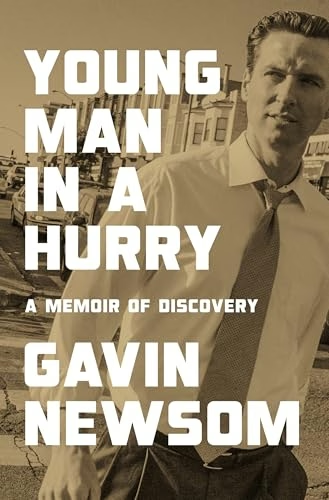
Prices can sometimes be lower on bigger marketplaces, but this link helps independent bookstores and local reading communities.
Quick Verdict
Young Man in a Hurry: A Memoir of Discovery by Gavin Newsom is a surprisingly introspective political memoir that transcends typical politician autobiography. Rather than a polished victory lap, Newsom delivers genuine vulnerability alongside ambition—making this both compelling and occasionally uneven. The book earns its place on the memoir shelf not through political bombast, but through honest reckoning with family trauma, dyslexia, and the gap between privilege and identity.
What This Memoir Actually Delivers
Gavin Newsom's memoir traces an unconventional political origin story rooted deep in San Francisco soil. His great-great-grandfather walked a beat as a cop in 1860s San Francisco; his grandfather built neighborhoods overlooking the Pacific; his father became an appellate court judge and confidant to oil heir Gordon Getty. Yet this dynasty backdrop crumbles when Newsom's parents divorce when he's five—leaving him straddling two irreconcilable worlds: his mother working three jobs to survive, his father embedded in San Francisco's moneyed elite.
This is where the memoir gains traction. Rather than celebrating inherited advantage, Newsom excavates the dissonance of growing up between classes. He writes candidly about struggling with dyslexia, a learning disability that made childhood feel like perpetual failure despite every material advantage. The paper route wasn't just a job—it was a way to pedal faster, to prove something.
The narrative arc follows his unlikely path from San Francisco restaurateur and businessman to Mayor, Governor, and national political figure. But the political chapters—his controversial decision to turn San Francisco City Hall into an "altar of gay marriage" as a newly-elected mayor, his navigation of the pandemic, California's climate crises, and his positioning as a vocal Trump antagonist—feel less revelatory than the family history.
Writing Style: Reflective but Uneven
Co-written with acclaimed journalist Mark Arax, the memoir carries a conversational, reflective tone that makes it accessible rather than pompous. Newsom doesn't hide behind political rhetoric or spin. The prose moves smoothly through personal anecdotes, though the pacing occasionally stumbles when transitioning between intimate family moments and policy recounting.
The strongest sections are deeply personal: his account of his divorce and the scandal that followed reads with genuine remorse and self-awareness. His reflections on fatherhood and marriage to Jennifer Siebel Newsom ground the narrative in something more universal than political ambition. These moments—not the policy achievements—are what linger.
The weaker sections feel like obligatory political biography. Chapters devoted to his governorship during overlapping crises (pandemic, wildfires, drought) read more like a press release than memoir. We get policy positions and crisis management rather than the internal conflict or doubt that made earlier chapters compelling.
What Works: The Vulnerability Angle
Unlike most political memoirs, this book refuses the hagiography trap. Newsom explicitly discusses his failures, regrets, and shortcomings. His willingness to examine his own ambition without self-flagellation or false modesty is refreshing in a genre typically defined by strategic self-presentation.
The generational family history—tracing Irish immigrant roots through six generations of San Francisco evolution—provides genuine historical texture. You understand not just Gavin Newsom the politician, but the specific American mythology that shaped him. The California Dream isn't abstract; it's embedded in his family's actual trajectory.
His treatment of his father's influence is particularly nuanced. Rather than simple hero-worship or rebellion, Newsom grapples with a distant, privileged parent who nonetheless shaped his values. This complexity—the refusal to flatten family relationships into simple narratives—elevates the memoir beyond typical political biography.
What Doesn't Land: The Political Sections
The book's critical weakness emerges when Newsom pivots from personal history to political achievement. His discussion of marriage equality advocacy as San Francisco mayor feels rushed, stripped of the moral wrestling that made earlier chapters compelling. We get the what, rarely the why or how he truly felt.
His governorship chapters—covering the pandemic, climate disasters, and democratic threats—read like compiled speeches rather than memoir. There's little sense of private doubt, internal conflict, or the personal cost of these decisions. For a book marketed on "intimate" and "candid" accounts, the political sections feel surprisingly guarded.
The book also struggles with contemporary political commentary. Sections on Trump and "autocratic threats" feel dated and preachy rather than reflective. Newsom occasionally lapses into the exact political rhetoric the earlier chapters seemed designed to escape.
Who Should Read This (And Who Won't)
Perfect for: Readers interested in California political history, those fascinated by how family trauma shapes public figures, memoir enthusiasts who value vulnerability over victory narratives, and anyone curious about the personal cost of political ambition. If you appreciated books like Becoming by Michelle Obama or The Splendid and the Vile by Erik Larson for their blend of personal and historical narrative, this delivers similar rewards.
Will disappoint: Readers seeking traditional political biography or policy deep-dives. Those expecting a 2028 presidential campaign manifesto will find instead a man still working through his childhood. Partisan readers—either hostile or devoted to Newsom—may find the book's moderate tone frustrating. Those who value tight, focused narratives over sprawling family sagas will find the structure occasionally meandering.
Comparison to Similar Memoirs
Unlike John McCain's Faith of My Fathers, which used family history primarily as backdrop for military achievement, Newsom's memoir genuinely prioritizes personal excavation. The family material isn't decorative—it's central. However, compared to Sheryl Sandberg's Lean In, which balanced personal narrative with clear ideological positioning, Young Man in a Hurry sometimes feels uncertain whether it's a family memoir or political manifesto.
The book works best when it remembers it's fundamentally a story about belonging and identity, not a political platform.
The Real Question: Is It Worth Reading?
Yes, with qualifications. The first half—roughly 60% of the book—is genuinely worth your time. If you're interested in how family dysfunction, learning disabilities, and inherited privilege intersect to create ambition, this delivers. The memoir's exploration of dyslexia, in particular, feels underrepresented in political biography and adds genuine value.
The second half, while competent, reads more like obligation. If you're purely seeking political insight, you'll find more substance in California political journalism. But if you want to understand the man beneath the political positioning—his vulnerabilities, his regrets, his ongoing struggle with identity—the investment pays off.
The 3.79/5 average rating makes sense: readers divide between those who prize the personal vulnerability (4-5 stars) and those expecting deeper political analysis (2-3 stars). Few readers fall in the middle because the book genuinely is two different books spliced together.
Final Verdict
Gavin Newsom's Young Man in a Hurry is a memoir that succeeds most when it abandons political ambition and leans into personal reckoning. The family history is genuinely compelling, the vulnerability is refreshing, and the writing carries real emotional weight. The political chapters feel like necessary duty rather than genuine exploration. It's a book worth reading for its first half, worth skimming for its second, and worth discussing for what it reveals about how politicians construct identity. Not every memoir needs to change your mind—sometimes it just needs to change your understanding of the person behind the position.
Rating: 7/10 — A genuinely vulnerable political memoir undermined by its own reluctance to fully interrogate power.