Category:
Book ReviewsWho Is Government? The Untold Story Review
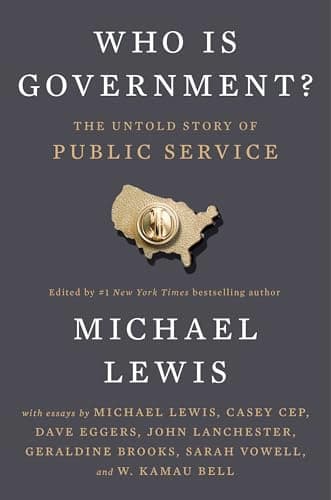
Prices can sometimes be lower on bigger marketplaces, but this link helps independent bookstores and local reading communities.
Michael Lewis's Who Is Government? The Untold Story of Public Service arrives at a cultural moment when Americans desperately need a reality check about their own government. This isn't another cynical takedown of bureaucratic incompetence. Instead, Lewis has assembled a collection of essays that fundamentally challenges the stereotype of the faceless, incompetent government worker—and it does so with such genuine warmth and narrative skill that you'll find yourself genuinely moved by stories about mine safety standards and cemetery administration.
The book's central premise is deceptively simple: Lewis invited some of America's finest writers to profile federal employees doing consequential work that almost nobody knows about. What emerges is a portrait of government not as a monolithic villain, but as a collection of deeply committed individuals solving problems most of us don't even know exist.
What This Book Actually Delivers
This isn't a civics textbook pretending to be literature. Lewis's Who Is Government? reads like a collection of narrative journalism pieces—each essay stands alone as a compelling human-interest story before it ever functions as an argument about the value of public service.
The standout profiles include Ronald Walters of the National Cemetery Administration, who transformed a creaking bureaucracy into what readers describe as potentially the best-run public organization in the entire country. There's John Koopman, an IRS agent who functions as a real-life cybercriminal hunter. And perhaps most memorably, there's the story of a former coal miner who returned to graduate school, conducted research on mine roof collapses, and eventually set federal standards that have literally eliminated an entire category of workplace death.
Each story operates on two levels simultaneously. On the surface, they're riveting profiles of interesting people doing important work. Beneath that, they're implicit arguments about what government actually does and why it matters.
The Writing and Structure That Makes This Work
Lewis's editorial hand is evident throughout, but he's smart enough to let his contributors' voices shine. The collection includes varied writerly styles—some pieces lean toward thriller-like tension (the IRS cybercrime narrative), while others embrace a more meditative, character-study approach.
The book moves quickly. At roughly 1,000 words per essay, it's designed to be consumed in chunks or devoured in one sitting. This accessibility is strategic. Lewis understands that most readers won't pick up a 600-page academic tome about government institutions, but they might read eight compelling profiles about actual people.
What's particularly striking is how Lewis and his contributors resist the urge to editorializes. They don't perform outrage. They don't construct grand theories. They simply present the work and let readers draw conclusions.
Where This Book Succeeds Most
The greatest strength of this Who Is Government? review territory is how effectively it demolishes a specific stereotype. The book isn't arguing that all government workers are heroes—it's simply showing that many of them are doing vital work that deserves recognition.
Readers consistently report being surprised by how moving these stories are. There's something about encountering genuine dedication to public service that cuts through contemporary cynicism. In an era when government is treated as either a punchline or a villain in political discourse, these profiles feel genuinely countercultural.
The historical context matters here. Published during a period of intense political division and government dysfunction, the book serves as a reminder that government institutions contain multitudes. Behind the headlines about bureaucratic failure are thousands of people working within those same institutions to make things better.
The essay about archival digitization (featuring Pamela Wright of the National Archives) takes on particular resonance given contemporary concerns about historical erasure and institutional memory. Lewis's contributors recognize that the stakes of government work aren't always about dramatic life-or-death situations—sometimes they're about whether future generations will have access to the historical record.
What Doesn't Quite Land
The book's weakness is precisely its refusal to synthesize. Lewis deliberately avoids imposing a grand narrative or thematic framework. Some readers will find this refreshing; others will wish for more connective tissue between essays.
There's also a question of scope. Eight profiles, however well-crafted, can't possibly represent the full complexity of federal government. The book is necessarily selective, which means readers encounter a curated version of public service. The stories included are genuinely compelling, but their very compellingness might create an incomplete picture.
Additionally, the book doesn't deeply interrogate structural problems within government institutions. It celebrates individuals working within systems, but it doesn't ask harder questions about whether those systems themselves need fundamental reform. Some readers will see this as refreshing restraint; others will see it as a missed opportunity for deeper analysis.
Comparing to Similar Books
If you've read Michael Lewis's earlier work Fifth Risk (2018), which examined the Trump administration's apparent indifference to government institutions, Who Is Government? functions as a kind of counterargument. Where Fifth Risk documented what happens when government expertise is ignored, this new book celebrates the expertise itself.
Compared to something like Malcolm Gladwell's recent essay collections, this book is notably less interested in extracting universal principles or clever frameworks. Lewis's approach is more humble—he's content to let stories speak for themselves rather than force them into a predetermined thesis.
Who Should Actually Read This
This book is essential reading for:
- Civically engaged readers who want to understand how government actually functions beyond partisan talking points
- Anyone disillusioned with public institutions who might benefit from encountering dedicated public servants
- Narrative nonfiction enthusiasts who appreciate well-told human stories
- Educators looking for accessible ways to teach about government institutions
- People working in public service who deserve recognition for their work
Skip this if:
- You're looking for a comprehensive policy analysis or institutional critique
- You prefer books with strong thematic arguments and synthesized conclusions
- You're seeking exposés of government failure and incompetence
- You want deep dives into specific policy areas
The Verdict: Is This Worth Reading?
Who Is Government? is absolutely worth reading, and it's worth reading now. In a political environment where government is treated as either an enemy or an abstraction, Lewis offers something genuinely valuable: recognition of the actual people doing the work.
The book won't change your mind about every government institution or solve your frustrations with bureaucracy. But it will remind you that behind institutional names and acronyms are individuals who've devoted their careers to solving problems most of us never think about. In our current moment, that's a radical and necessary message.
Is this the most intellectually rigorous examination of American government? No. Is it the most comprehensive look at federal institutions? No. But it's something rarer: a book that uses narrative skill to make you care about people and work you'd never otherwise encounter. That's worth something substantial.
Final Score: 8/10
Compelling storytelling and genuine emotional resonance elevate this beyond typical civics lessons, though it sacrifices analytical depth for accessibility.