Category:
Book ReviewsWhen We See You Again Review: Devastating Memoir That Rewrites Grief
Prices can sometimes be lower on bigger marketplaces, but this link helps independent bookstores and local reading communities.
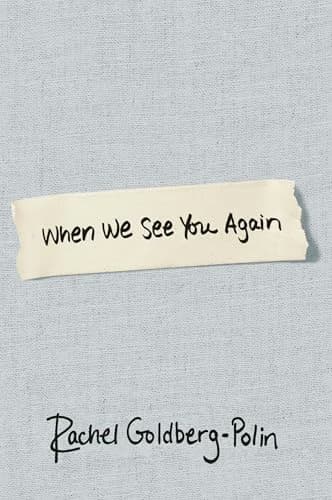
Rachel Goldberg-Polin's When We See You Again is not a comfortable book. It's not designed to be. This searing memoir documents the author's journey through unimaginable loss following the October 7th, 2023 attack on the Nova Music Festival, where her 23-year-old son, Hersh, was abducted and held captive for 328 days before being executed by Hamas. The work transcends typical grief literature by refusing to sanitize suffering or offer false redemption—instead, it presents raw emotional truth that lingers long after the final page.
This is a When We See You Again review that must begin with an uncomfortable verdict: this is one of the most important memoirs published in recent years, yet it's also one that will test readers' emotional resilience. Goldberg-Polin doesn't write to console; she writes to bear witness. Her prose oscillates between poetic meditation and visceral documentation, creating a reading experience that feels simultaneously intimate and monumentally significant.
What This Book Actually Is
Calling this a traditional memoir undersells what Goldberg-Polin has accomplished. When We See You Again functions simultaneously as personal testimony, political document, and spiritual reckoning. The narrative weaves between three timelines: the "Before"—a warm, ordinary life with her family; the 328 days of captivity when Goldberg-Polin became the public face of the hostage crisis, flying to the United Nations and appearing before world leaders; and the devastating "After" following her son's murder.
The genius of Rachel Goldberg-Polin's structure lies in its refusal to compartmentalize. Personal moments—a forgotten pizza dinner, a prescient nightmare—sit adjacent to geopolitical activism and descriptions of her son's physical suffering. This jarring juxtaposition mirrors the actual experience of trauma, where the mundane and catastrophic collide without warning.
The Writing: Poetic Precision in Darkness
Goldberg-Polin writes with the precision of someone who understands that language is inadequate to the task—and proceeds anyway. Her prose shifts registers deliberately. One moment she's crafting sentences of crystalline beauty; the next, she's documenting the clinical horror of her son's injuries with unflinching specificity. This isn't stylistic flourish; it's a formal choice that mirrors how trauma actually inhabits consciousness.
The audiobook format deserves particular mention. Goldberg-Polin's voice—measured, occasionally breaking—adds another dimension to the reading experience. Hearing her articulate her own words carries a weight that silent reading cannot fully replicate, though both formats are powerful.
Her metaphors are unexpected and devastating. She describes having "third-degree burns on her soul." She speaks of days when she "breaks completely," crying for entire stretches until she wonders if tears have a finite supply. These aren't flowery descriptions; they're precise language for imprecise emotional states.
What Works Extraordinarily Well
The book's greatest strength is its refusal to perform grief for an audience. Goldberg-Polin doesn't present herself as noble or inspirational—she presents herself as a woman experiencing incomprehensible loss while simultaneously becoming a public figure. This tension creates genuine dramatic power. She can discuss her activism at the UN in one chapter and her inability to leave her apartment in another, without resolving the contradiction.
The interwoven narrative of her son's experience—reconstructed from accounts by other hostages—is handled with remarkable sensitivity. Rather than exploiting trauma for emotional impact, Goldberg-Polin uses these sections to assert her son's humanity and individuality. Hersh emerges not as a symbol but as a specific person: a young man who loved experiences over possessions, who played rugby, who was severely injured yet continued to survive in unimaginable conditions.
The book also succeeds in capturing the particular horror of the October 7th crisis in ways that news coverage never could. By centering one family's experience, Goldberg-Polin illuminates the systemic nature of the trauma—the waiting, the uncertainty, the impossible calculus of hoping for a loved one's return while fearing what condition they might be in.
Furthermore, her exploration of how grief coexists with other emotions—anger, love, even occasional humor—rings true. She doesn't present grief as a monolith but as something that shifts hourly, sometimes minute to minute.
Where the Book Struggles
The primary challenge readers will face is pacing. The book's emotional intensity is relentless. There are few moments of relief or levity, which is arguably authentic to the experience but can make the reading experience feel punishing. Some readers seeking narrative arc or resolution may find the book's refusal to provide either frustrating rather than profound.
Additionally, while the political activism sections are important, they occasionally interrupt the intimate memoir narrative. The tension between personal testimony and public advocacy isn't always seamlessly integrated. A reader seeking primarily personal reflection might find the UN testimony sections feel like a different genre interrupting their reading.
The book also assumes significant reader familiarity with the October 7th events and their aftermath. Readers without this background may find themselves needing to do additional research to fully contextualize certain passages.
Who Should Read This Book
Perfect for: Readers interested in contemporary memoir, those seeking to understand the October 7th crisis beyond headlines, anyone who has experienced profound loss and wants to feel less alone, readers interested in Jewish literature and history, and those willing to sit with difficult emotions.
Goldberg-Polin's work belongs on the shelf alongside other significant grief literature—it invites comparison to works like The Year of Magical Thinking by Joan Didion or When Breath Becomes Air by Paul Kalanithi, though it operates in its own register entirely.
Difficult for: Readers seeking comfort or inspiration, those with active trauma responses to violence, readers preferring linear narratives with clear resolution, and those looking for a lighter reading experience. This is not escapist literature; it's confrontational in the best sense.
The Larger Significance
What makes this When We See You Again review ultimately matter is that the book exists at a specific historical moment. It documents not just personal tragedy but a particular catastrophe still unfolding. Goldberg-Polin writes "while still bleeding," as one reader noted—and this immediacy gives the work urgency.
The book also participates in a long tradition of Jewish literature concerned with annihilation and survival, from biblical Lamentations through Holocaust testimony to contemporary work. Goldberg-Polin adds her voice to this lineage not as a scholar but as a mother writing through devastation.
Is When We See You Again worth reading? Yes, absolutely—but with the understanding that "worth" here means challenging, important, and emotionally demanding rather than pleasant or uplifting.
Final Verdict
When We See You Again deserves the 4.73-star rating it maintains across thousands of readers. This is essential contemporary memoir that refuses easy answers or false comfort. Goldberg-Polin's prose moves between devastating specificity and luminous reflection, creating a work that feels both deeply personal and historically significant. It's a book that will sit with you long after reading, not because it provides resolution but because it insists that grief and love and rage and hope can coexist without canceling each other out.
The book's power lies not in making sense of tragedy but in bearing witness to it with unflinching honesty. That's a rare and necessary thing in literature.