Category:
Book ReviewsWhat I Ate in One Year Review: Charming but Uneven
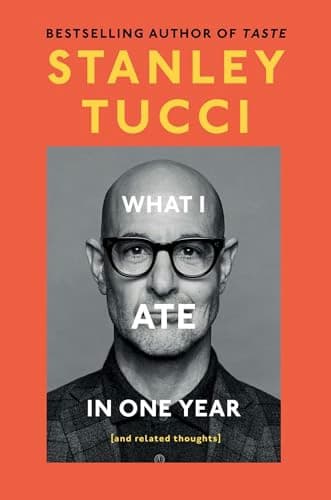
Prices can sometimes be lower on bigger marketplaces, but this link helps independent bookstores and local reading communities.
Stanley Tucci's What I Ate in One Year arrives as a curious hybrid—part food memoir, part celebrity diary, part philosophical meditation on aging and family. The award-winning actor and New York Times bestselling author has crafted something that defies easy categorization, which is precisely why this book divides readers so sharply. With an average rating hovering around 3.8 out of 5 stars across thousands of reviews, What I Ate in One Year reveals a fundamental tension: it's genuinely charming in moments, yet frustratingly sparse in others.
Let's establish the verdict upfront: this is a book that works brilliantly as an audiobook experience (Tucci's distinctive voice carries immense weight here) but struggles as a printed memoir. If you're drawn to intimate, reflective writing about food's role in marking time and mortality, you'll find genuine rewards. If you expect a traditional food memoir packed with sensory detail and culinary revelation, you'll likely feel disappointed.
What You're Actually Getting
This isn't the food memoir you might expect from someone with Tucci's culinary credentials and his acclaimed travel series Searching for Italy. Instead, it's structured as a literal diary spanning January 2, 2023, to January 2, 2024—a full year of entries documenting what Tucci ate across various settings: film sets, restaurants, his home in England, and while traveling internationally.
The concept is deceptively simple. Each entry records meals consumed, ranging from haute cuisine in Rome to airplane food to his children's favorite pasta with butter and cheese. But here's where the book's identity crisis emerges: these entries are frequently brief, sometimes amounting to little more than ingredient lists with minimal context or sensory description. You'll encounter repeated mentions of wines he can't remember, dishes he's consumed before, and meals that blur together across the year.
What Actually Works
When Tucci commits to storytelling, the writing soars. A visit to Guy Ritchie's English estate stands out as the book's finest chapter—here, Tucci captures the kinetic energy of cooking with a friend, Ritchie's obsessive attention to culinary detail, and the primal joy of eating fresh-grilled fish with bare hands. This sequence demonstrates precisely what the book could have been throughout: evocative, intimate, and genuinely immersive.
Tucci's humor also carries significant weight. His cantankerous observations about subpar airline food, pretentious restaurant experiences, and the absurdities of celebrity life provide consistent entertainment. He's self-aware enough to mock his own pickiness, which softens what could otherwise feel like insufferable complaining.
Moreover, the book succeeds as a meditation on aging, loss, and family. Tucci weaves reflections on his children growing up in England, his lasting friendships, and how his relationship with food has evolved throughout his career. These moments—when food becomes a vehicle for examining mortality and connection—are genuinely moving. The book functions as a portrait of a specific moment in his life, captured with honesty and occasional poignancy.
Where It Falters
The fundamental problem is inconsistency. For every memorable anecdote, there are five entries that read like a restaurant reservation confirmation. "Pasta with butter and cheese" appears so frequently that it becomes almost comedic—and not in the intended way. A traditional food memoir demands either culinary revelation or vivid sensory description. Stanley Tucci's What I Ate in One Year often provides neither.
The structure, while conceptually clever, ultimately works against the narrative. A diary format necessitates brevity, but food writing—especially at this commercial level—requires space to breathe. Readers expecting the depth found in works like Ruth Reichl's Garlic and Sapphires or Anthony Bourdain's essays will find themselves frustrated by the book's surface-level approach to many meals.
Additionally, the celebrity guest list, while occasionally interesting, feels underutilized. Famous dinner companions appear and disappear without sufficient context or insight. Only toward the book's conclusion do these encounters gain real narrative weight—too little, too late for readers seeking connection and communion.
The Audiobook Advantage
This is crucial: What I Ate in One Year review discussions frequently note that the audiobook experience surpasses the printed version significantly. Tucci's narration—his pacing, his distinctive voice, his ability to inject humor and warmth into mundane entries—transforms the listening experience. What reads as perfunctory on the page becomes charming when delivered by the author himself. If you're considering this book, strongly consider the audio format.
Who Should Read This
This book is perfect for: devoted Stanley Tucci fans who relish his voice and personality; readers who enjoyed Searching for Italy and want more intimate access to his food philosophy; people interested in how accomplished individuals structure their days around meals; anyone seeking a reflective meditation on family, aging, and the rituals that anchor our lives.
Avoid this book if: you expect detailed recipes or cooking techniques; you want vivid, sensory-rich food writing; you're seeking a traditional narrative arc; you're looking for deep culinary education or restaurant criticism; you prefer memoirs with sustained storytelling momentum.
The Bigger Picture
In the landscape of celebrity food memoirs, What I Ate in One Year occupies an interesting space. It's less ambitious than Bourdain's philosophical explorations, less technically detailed than professional chef memoirs, and less narrative-driven than traditional celebrity autobiography. It's fundamentally a book about presence—about paying attention to what we consume and what that consumption reveals about our lives.
That's a worthwhile project. The execution, however, remains uneven. Tucci clearly understands food's profound role in human connection and memory. When he allows that understanding to guide his writing, the results are touching and memorable. When he defaults to diary-style efficiency, the book becomes rote.
Final Verdict
Is What I Ate in One Year worth reading? Yes—but with caveats. Listen to the audiobook if possible. Approach it as a character study and philosophical reflection rather than a traditional food memoir. Appreciate it for what it is: an intimate, occasionally brilliant, sometimes frustratingly thin portrait of a specific year in one man's life. The best moments rival anything in contemporary food writing. The weaker sections feel like you're reading someone else's appointment calendar. The truth lies somewhere between these extremes—a charming, imperfect, ultimately rewarding experience that will delight Tucci devotees while leaving food memoir purists wanting more.
Rating: 6.5/10 — Tucci's voice and occasional brilliance elevate an inherently limited concept into something worth experiencing, though the uneven execution prevents this from becoming a modern classic.