Category:
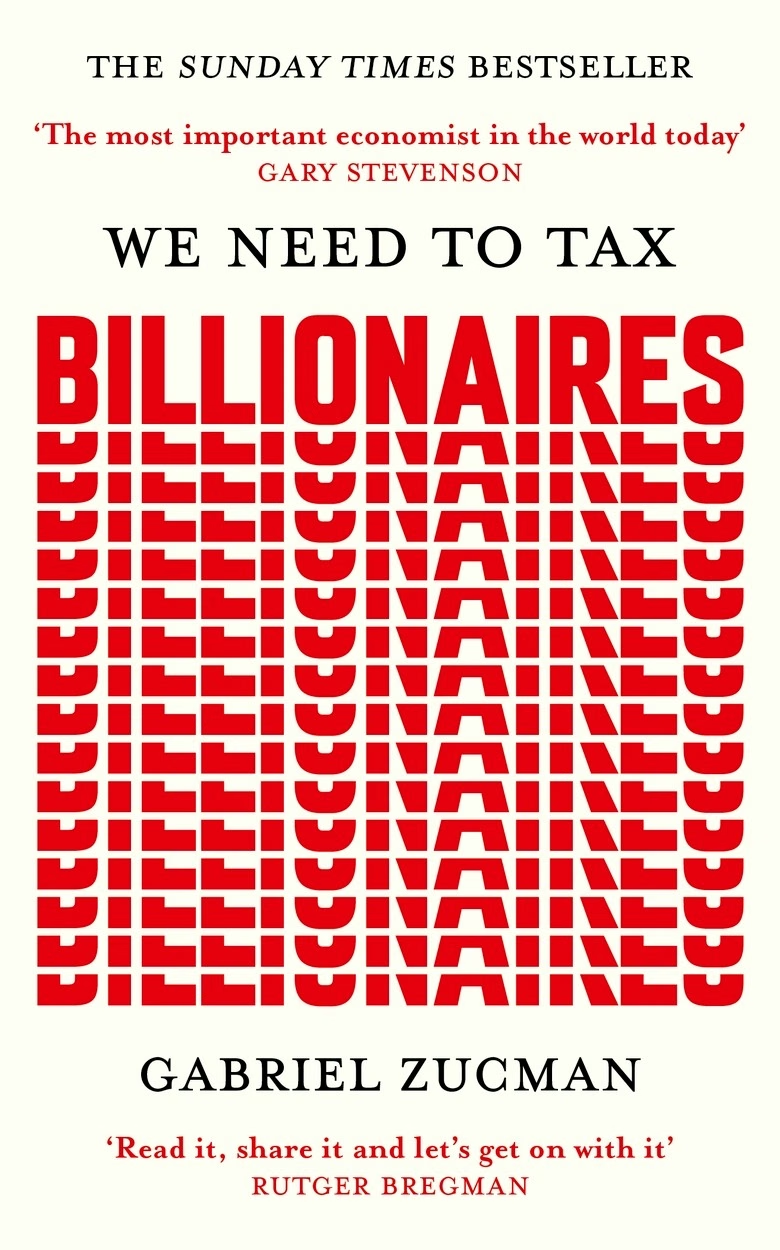
Book ReviewsWe Need to Tax Billionaires Review: Essential Reading
Prices can sometimes be lower on bigger marketplaces, but this link helps independent bookstores and local reading communities.
Gabriel Zucman's We Need to Tax Billionaires arrives at precisely the moment when wealth inequality has become impossible to ignore. This French economist doesn't waste time with academic throat-clearing—instead, he presents a deceptively simple thesis backed by rigorous data: billionaires pay virtually zero income tax while ordinary citizens shoulder roughly half their earnings to the state, and a 2% minimum wealth tax on ultra-high net worth individuals could fundamentally rebalance our broken tax system.
The book's real power lies not in its radical politics but in its radical clarity. At just 38 pages of core text, Zucman proves that sometimes the most important arguments don't require 400-page treatises. He's writing for people exhausted by complexity masquerading as sophistication—and that's precisely why this We Need to Tax Billionaires review matters.
What This Book Actually Argues
Zucman cuts through the noise immediately. The core problem: billionaires accumulate wealth primarily through company ownership and stock appreciation rather than salary. Under current tax structures, this means they pay income tax on virtually nothing. A CEO earning $1 billion in unrealized stock gains pays less tax than a nurse earning $80,000 annually.
His solution is elegantly straightforward—a 2% annual tax on total wealth for individuals with net assets exceeding €100 million. This isn't punitive; it's corrective. The proposal directly addresses the perverse mathematics where the ultra-wealthy pay a smaller percentage of their income in taxes than the middle class.
The book systematically dismantles the standard objections. "Billionaires will flee the country?" Zucman demonstrates that wealth concentration in major economies makes this practically unlikely—and that international coordination could prevent it anyway. "Wealth taxes have failed before?" He examines historical failures and explains why previous implementations weren't properly designed or enforced.
The Strength: Data Without the Tedium
What distinguishes Zucman's work is his ability to make economics accessible without dumbing it down. He throws specific figures at you—global billionaire wealth increased roughly 81% since 2020, a staggering acceleration that most people remain entirely unaware of. These aren't abstract percentages; they're the mathematical expression of a system where wealth concentration has become obscene.
The We Need to Tax Billionaires review consensus from readers reflects genuine appreciation for this precision. Zucman doesn't preach to the already-convinced; he methodically builds his case using the language of data. He explains why the current system exists, how billionaires exploit it, and what specifically would change under his proposal.
The book's conciseness is also its greatest strength. In an era of bloated non-fiction, Zucman respects your time. He makes his argument and exits, leaving you with a concrete vision rather than padding.
The Weakness: Accessibility Gaps
Here's where this review must be honest: the book occasionally assumes economic literacy that many readers simply don't possess. Certain statistical explanations move quickly, and some terminology isn't adequately defined for newcomers. Readers without economics background may find themselves flipping back to re-read sections or wishing for more granular explanation of how wealth accumulation actually functions in practice.
Additionally, while Zucman addresses the French and European context extensively, readers seeking deep analysis of how this would function in their specific country (UK, US, Spain, Nordic nations) will find themselves wanting more. The book is necessarily broad, but that breadth sometimes feels like incompleteness when you're trying to apply the argument locally.
There are also occasional editorial rough patches—typos and grammatical inconsistencies that suggest the manuscript could have benefited from another revision pass. These are minor but noticeable in a book about such important policy.
Writing Style: Methodical and Urgent
Zucman writes like someone who understands that clarity is a form of respect. His prose is direct, sometimes almost terse, but never cold. There's an underlying urgency—this isn't academic exercise, it's a blueprint for political action.
The structure moves logically: problem identification → current mechanisms → proposed solution → objection handling. It's the architecture of persuasion, and it works. You're not wandering through a labyrinth; you're being guided along a deliberate path.
Who Should Read This
This book is essential for anyone genuinely interested in tax policy, inequality, or progressive economics. It's perfect for readers tired of vague complaints about "the rich" and wanting concrete policy proposals. If you've ever wondered why billionaires pay less tax than teachers, this is your answer.
It's also ideal for policymakers, political candidates, and activists seeking evidence-based arguments. The book provides ammunition—not rhetorical flourishes, but actual data and specific mechanisms.
However, this isn't a book for readers seeking nuance about conservative economic arguments. Zucman's tone is sympathetic to progressive taxation from the outset. If you're looking for a "both sides" examination, you won't find it here. He engages with counter-arguments, but not with equal weight. This is advocacy dressed as analysis, which is fine—just know what you're getting.
Readers without any economics background might find themselves occasionally lost. The book isn't deliberately obscure, but it assumes certain baseline knowledge about how wealth and taxation function.
Comparison to Similar Works
Unlike Thomas Piketty's Capital in the Twenty-First Century—which is comprehensive but demands serious intellectual commitment—Zucman's book is a sprint, not a marathon. It's closer in spirit to Malcolm Gladwell's approach of making complex ideas digestible, though Zucman's prose is less flashy and more rigorous.
Compared to more recent inequality critiques, We Need to Tax Billionaires stands out for its specificity. It's not content to identify problems; it offers implementable solutions. That's rare in contemporary political writing.
The Verdict
Is We Need to Tax Billionaires worth reading? Absolutely, particularly if you're interested in how policy could actually address wealth concentration. This is one of those rare books where the title perfectly captures the content, and the argument is both intellectually sound and politically urgent.
The book doesn't break new theoretical ground—progressive taxation isn't a novel concept. But Zucman's contribution is clarifying why the current system is mathematically indefensible and demonstrating that alternatives aren't radical fantasies but practical necessities. In an era where billionaire wealth explodes while ordinary people face stagnating wages and cost-of-living crises, that clarity matters.
The main criticism is fair: more expansive treatment of specific national contexts and slightly more accessible economic explanations would strengthen the work. As it stands, this is a focused intervention rather than comprehensive analysis.
But sometimes focused interventions are exactly what we need. Zucman doesn't try to solve all of economics; he identifies one specific problem and proposes one specific solution. That clarity is refreshing and, frankly, more persuasive than broader treatises that try to do everything at once.