Category:
BiographyVanderbilt Review: Gilded Excess Meets Family Reckoning
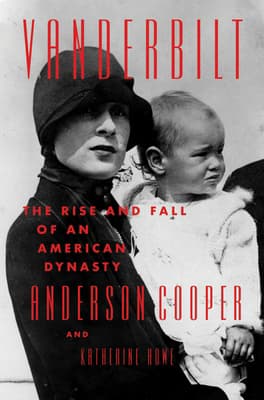
Prices can sometimes be lower on bigger marketplaces, but this link helps independent bookstores and local reading communities.
Anderson Cooper's Vanderbilt: The Rise and Fall of an American Dynasty is a masterclass in insider storytelling that transforms genealogy into gripping narrative—but only after you wade through nearly 300 pages of meticulous historical groundwork. Written with historian Katherine Howe, this New York Times bestseller traces the Vanderbilt empire from a Dutch farmer's modest beginnings in 1600s New Amsterdam to the family's spectacular financial collapse by 2018. Cooper's verdict is delivered with the precision of a journalist and the emotional weight of a great-great-great-grandson: his ancestors built an empire on ruthlessness and lost it to complacency.
What This Book Actually Delivers
This isn't a typical celebrity memoir. Cooper largely removes himself from the narrative, choosing instead to resurrect the voices of his ancestors through meticulously researched letters, journals, and documents—many discovered while sorting through his mother Gloria Vanderbilt's belongings after her death. The result reads like a historical novel masquerading as biography, complete with dramatic character arcs, moral complexity, and the kind of intimate family dysfunction that tabloids dream about.
The opening chapters establish the Commodore—Cornelius Vanderbilt—as the architect of American ruthlessness. Beginning at age eleven ferrying supplies in New York Harbor, Cornelius built two empires (shipping and railroads) that left him with an estimated $100 million fortune (roughly $2 billion in today's dollars). Cooper and Howe don't shy away from his pathological obsession with money and power, portraying a man who dominated not just his business competitors but his own children through fear and manipulation.
The Pacing Problem Nobody Mentions
Here's where the Vanderbilt review conversation gets interesting: the book's structure is deliberately weighted. For the first 70% of the narrative, Cooper methodically chronicles generations of Vanderbilt accumulation and social positioning. This section reads like a carefully annotated family tree brought to life—historically rigorous but emotionally distant. Readers seeking dramatic narrative momentum will find themselves grinding through extensive chapters on business dealings, society marriages, and inheritance disputes that, while factually fascinating, lack the human drama that makes biography sing.
The book transforms entirely when Gloria Vanderbilt enters the story. Suddenly, the abstract concept of "generational decline" becomes visceral. Little Gloria's custody battle, her mother's financial predation, her emergence as an artist and independent woman—these chapters crackle with the tension that the earlier sections promise but don't deliver. It's as if Cooper finally allows emotion to compete with documentation.
Structural Choices That Divide Readers
Certain editorial decisions feel oddly weighted for a family history. An entire chapter devoted to Truman Capote's downfall, for instance, feels like it belongs in a different book. Yes, Capote was friends with Gloria, but his inclusion—complete with extensive coverage of his betrayals and social humiliation—reads more like Cooper settling a literary score than advancing the Vanderbilt narrative. Similarly, the detailed treatment of the 1915 RMS Lusitania sinking and the 1934 World Cup yacht race, while historically connected to specific Vanderbilt men, could have functioned as passing references rather than full set pieces.
These digressions raise a question about authorial intention: Is this a Vanderbilt history or a Cooper family memoir? The book oscillates between these two projects without fully committing to either.
What Works Brilliantly
Cooper's insider perspective is the book's greatest asset. He writes with the authority of someone who inherited not just wealth (briefly) but family mythology, complicated relationships, and access to primary sources most historians never see. His collaboration with Katherine Howe creates a productive tension—her historical rigor anchors his personal observations, preventing the narrative from sliding into mere gossip.
The book excels at interrogating American capitalism's foundational myths. The Commodore emerges not as a hero of industry but as a cautionary figure whose legacy demonstrates how dynastic wealth, without corresponding values or purpose, becomes a liability. Subsequent generations didn't fail the family fortune through incompetence; they simply couldn't justify maintaining it through the same ruthlessness that built it.
The Newport sections—particularly the description of The Breakers and the Vanderbilt social apparatus—are genuinely evocative. Cooper captures the peculiar anxiety of maintaining status through consumption, the exhausting performance of wealth that eventually bankrupted the family's emotional reserves long before their bank accounts emptied.
Who Should Actually Read This
Perfect for: History buffs interested in American capitalism, readers fascinated by how dynastic wealth functions across generations, anyone who enjoyed The Gilded Age or similar period narratives, and people curious about how Anderson Cooper became Anderson Cooper. Also essential for anyone interested in the mechanics of social decline—this book is a master class in how empires collapse not through dramatic failure but through generational atrophy.
Skip it if: You want a fast-paced narrative arc (at least for the first half), you're seeking juicy celebrity gossip without historical context, or you prefer biography that centers the author's perspective. If you found Educated or The Glass Castle compelling specifically because of their emotional immediacy, this book's measured tone may frustrate you.
The Verdict on Reading Vanderbilt
Is Vanderbilt: The Rise and Fall of an American Dynasty worth reading? Yes—but with caveats. The book is worth reading as a work of historical documentation and as a meditation on what happens when inherited wealth loses inherited meaning. It's not worth reading if you expect it to move at the pace of a thriller. Cooper and Howe have written something more deliberate: a genealogical investigation that doubles as a critique of American capitalism's founding mythology.
The real achievement here is that Anderson Cooper has written a book about his family that's fundamentally uninterested in defending them. He documents their rise with precision and their fall with what reads like relief. That honesty—the willingness to let the historical record indict his own ancestors—elevates this above typical family saga territory.
Compare this to similar works like The House of the Spirits for family mythology or Barbarians at the Gate for corporate ruthlessness—Vanderbilt occupies its own space, merging the intimate scope of family history with the analytical distance of institutional critique. It's a book that trusts its readers to draw their own conclusions about whether dynasties should survive at all.