Category:
Book ReviewsV13 Review: Carrère's Masterwork on Justice
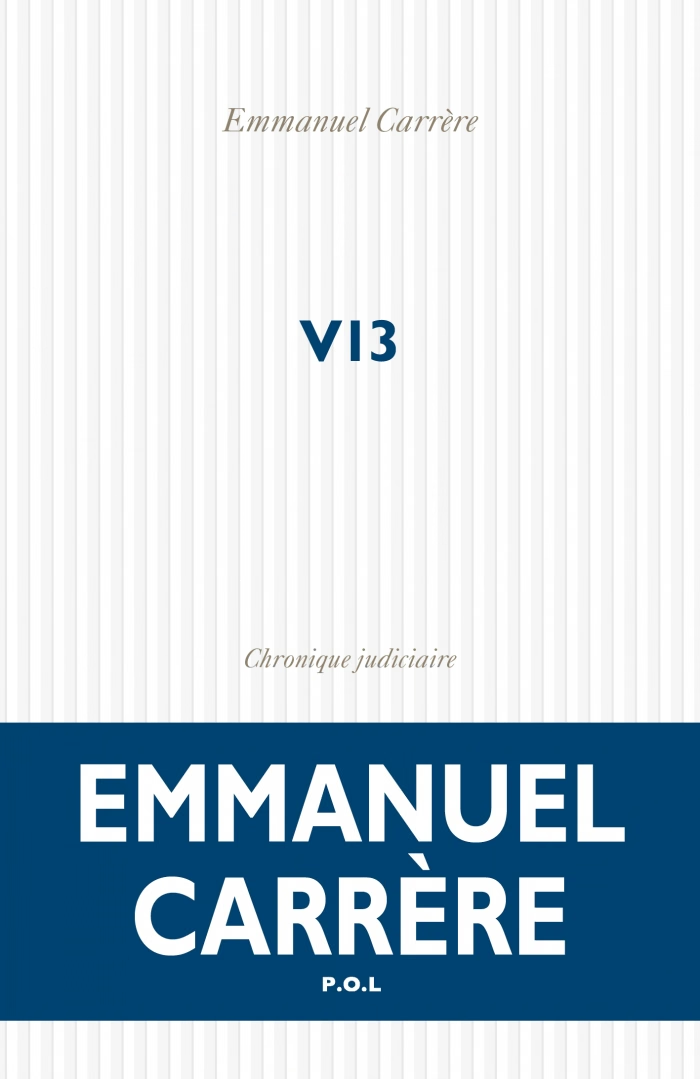
Prices can sometimes be lower on bigger marketplaces, but this link helps independent bookstores and local reading communities.
Emmanuel Carrère's V13 is a work of such singular power that it demands to be read not as a book about tragedy, but as a meditation on how societies process collective trauma through the machinery of law. This is journalism elevated to literature—a ten-month courtroom chronicle that transforms the November 13, 2015 Paris attacks into something far more complex than a true crime narrative.
The book's central achievement lies in what Carrère refuses to do: he never sensationalizes the attacks themselves. Instead, he trains his unflinching gaze on the trial that began in September 2021, six years after 130 people were killed at the Bataclan concert hall, outside the Stade de France, and in neighborhood restaurants. That temporal distance matters. V13 isn't written in the heat of immediate aftermath; it's written by a journalist who has had years to think about what justice actually means when faced with mass atrocity.
What This Book Actually Is
Based on weekly dispatches Carrère filed for L'Observateur during the trial, V13 reads as expanded reportage—roughly a third longer than the original newspaper columns. But calling it reportage undersells what Carrère has achieved. This is literary nonfiction in the tradition of Norman Mailer or Truman Capote, where the author's consciousness becomes part of the subject matter.
The trial itself becomes a character study of competing narratives. There are fourteen defendants: Salah Abdeslam, the sole surviving attacker, sits behind bulletproof glass; others are accused of logistical support or radicalization. Around them orbit victims' families, survivors haunted by survivor's guilt, lawyers arguing points of law that feel simultaneously crucial and absurd, and a society trying to understand how to punish ideology.
The Writing: Precision Meets Emotion
Carrère's prose style in this V13 review-worthy work is deceptively simple. He writes with surgical precision about procedural details—courtroom layouts, the mandatory face masks worn during COVID protocols, the exact timing of testimony—yet never lets technical accuracy overwhelm emotional truth. This balance is extraordinarily difficult to maintain, and most writers fail at it.
What distinguishes Carrère's approach is his refusal to hide his perspective. He explicitly states his sympathies lie with victims and survivors. He acknowledges the horror. But he also includes a devastating passage about Western military interventions in Syria, Iraq, and Afghanistan—the bombing campaigns that kill civilians with the same indifference that the attackers showed. This isn't moral relativism; it's moral complexity. It's asking readers to hold multiple truths simultaneously: the attacks were monstrous and the West's foreign policy has created conditions for such monsters to emerge.
The book's most haunting moment—which appears in multiple reader responses—involves a woman named Nadia, who lost her daughter at the Bataclan. Three years after the attacks, she returns to Cairo, where she'd last been with her daughter. A police officer tells her the park is closing. Instead of leaving, Nadia tells him in Arabic what happened to her child. The officer listens without interrupting, then tells her: "Your daughter and the others are the martyrs... not the assassins." That scene encapsulates what Carrère does throughout the book—he finds the humanity that persists even in the presence of inhumanity.
Where This Book Excels
The structural brilliance of V13 lies in how Carrère resists creating false dramatic arcs. Trials aren't inherently dramatic; they're repetitive, procedurally bound, often tedious. Rather than fighting this reality, Carrère uses it. The accumulation of testimony, the return to similar questions, the legal arguments that circle back on themselves—all of this becomes a kind of rhythm that mirrors how trauma actually works in collective memory. It doesn't arrive as a climax; it accumulates.
Carrère also excels at capturing the strange theater of the courtroom. He notes the performative aspects—how defendants present themselves, how lawyers craft narratives, how the physical space itself (a bunker-like room built specifically for this trial) shapes what happens inside it. This isn't cynicism about the justice system; it's an honest acknowledgment that justice is always partially theater.
The book also includes what might be called "the anti-victims"—people who falsely claimed to have been at the Bataclan or to have lost loved ones. Carrère examines these fraudsters with curiosity rather than contempt, wondering what psychological need drives someone to appropriate others' suffering. It's a strange tangent, but it works because it reveals something true about how trauma spreads through society.
What Doesn't Quite Work
At nearly 400 pages, V13 occasionally feels padded. Some courtroom exchanges are reported in their entirety when paraphrasing would serve better. There are sections where Carrère's weekly column format becomes apparent—transitions that feel suited to newspaper readers but awkward in book form.
More significantly, some readers may find the book's political asides—particularly regarding Western military intervention—feel like they're pulling focus from the trial itself. Carrère is arguing that we cannot discuss the Paris attacks without discussing the geopolitical context that produced the attackers. This is a valid argument, but it's also one that could derail readers looking for a more straightforward account of the trial.
The book also doesn't provide much insight into the attackers' psychology beyond what emerges in testimony. If you're looking for deep character study of the perpetrators, you won't find it here. Carrère deliberately keeps them at a distance, which is partly the point—they're not the focus; the society's response to them is.
Who Should Read This
V13 is essential reading for anyone interested in how justice systems function under extraordinary pressure, how communities process collective trauma, or how journalism can transcend its usual boundaries. It's also remarkable simply as prose—Carrère is one of France's finest writers, and this book demonstrates why.
This book is perfect for readers who appreciated works like In Cold Blood by Truman Capote or The Executioner's Song by Norman Mailer—literary nonfiction that uses true events as a lens to examine larger questions about society and human nature.
Who might struggle with V13? Readers seeking straightforward true crime narrative will find it frustratingly indirect. Those uncomfortable with authorial presence and political commentary embedded in reportage may find Carrère's approach intrusive. And readers looking for a quick, satisfying resolution will be disappointed—the trial ends with guilty verdicts, but the book doesn't pretend this "solves" anything.
The Verdict
Is V13 worth reading? Absolutely. This is one of the most important works of literary journalism published in recent years. It's a book that respects readers' intelligence, refuses easy answers, and demonstrates that the best writing about tragedy doesn't exploit it—it illuminates it.
Carrère has created something that functions simultaneously as historical document, courtroom drama, philosophical inquiry, and prose masterpiece. The fact that it's based on real events and real suffering makes it all the more remarkable that it achieves such literary power without ever feeling exploitative.
This is the rare book that will matter in five years, in ten years. It's the kind of V13 review-worthy work that belongs on shelves alongside the great works of literary nonfiction. Read it.