Category:
Book ReviewsTropesick Review: A Brilliant Mess That Can't Stick the Landing
Prices can sometimes be lower on bigger marketplaces, but this link helps independent bookstores and local reading communities.
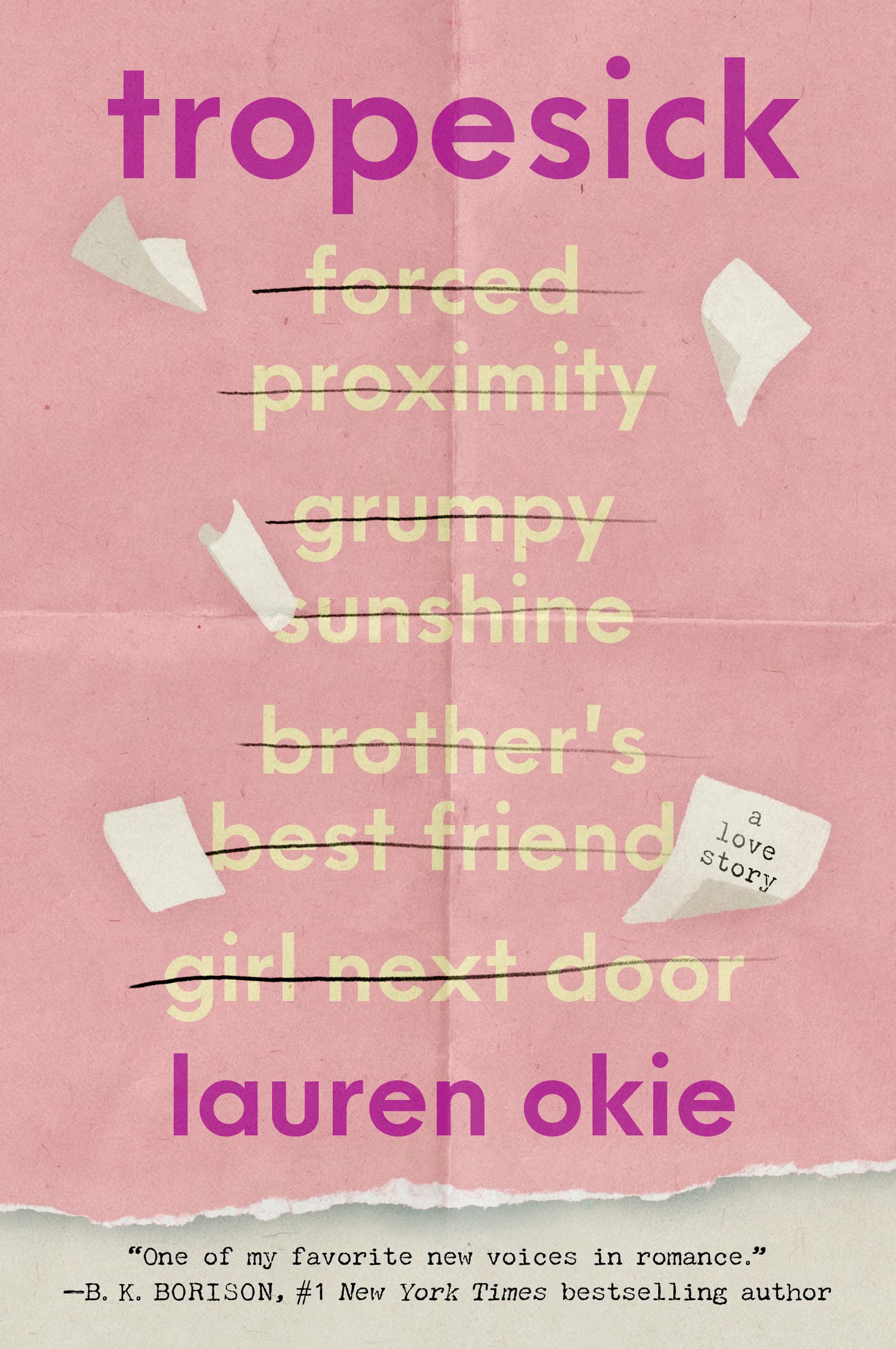
Lauren Okie's debut novel Tropesick arrives with an irresistible premise: two writers forced to co-author a romance while their own unfinished love story mirrors the tropes they're crafting on the page. It's a meta-romantic fantasy that should work flawlessly. For roughly the first half, it does. Then something fractures, and what begins as an emotionally intelligent exploration of second chances devolves into a frustratingly uneven narrative that leaves readers divided between "this ruined me" and "this ruined itself."
The Setup: Promising Territory
Katie Caruso and Tyler McNally share a bond forged in tragedy. Eight years ago, Katie's brother—a promising MLB pitcher—died of an overdose, and Tyler, his best friend, vanished from her life entirely. Now sober, tattooed, and Ivy League-educated, Tyler resurfaces as Katie's writing partner for the summer. They're tasked with ghostwriting a romance novel for reclusive bestselling author Meredith Bradford at her isolated Southampton estate.
The forced proximity is immediate. The unresolved history is palpable. The irony is delicious: as Katie and Tyler write romance tropes into their fictional novel, those same tropes—grumpy/sunshine dynamics, best friend's sibling tension, slow-burn longing—begin manifesting in their actual lives. It's the kind of high-concept setup that made readers fall in love with Emily Henry's work, and Okie clearly understands the assignment.
What Works: The First Half's Brilliance
The opening fifty percent of Tropesick is genuinely exceptional. Okie demonstrates a sophisticated understanding of how romance tropes function, not as lazy shortcuts but as emotional architecture. She doesn't just deploy "forced proximity"—she interrogates what it means when two people with genuine reasons to avoid each other are locked in a room together.
The character work is meticulous. Katie isn't a manic pixie dream girl; she's a woman who's spent eight years performing normalcy after trauma, glitter and sequins as emotional camouflage. Tyler carries the weight of sobriety, of survivor's guilt, of the impossible task of being the person Katie needs him to be. Their dialogue crackles with specificity—there's genuine wit here, genuine chemistry.
The book-within-a-book concept elevates what could have been standard contemporary romance. By having Katie and Tyler write romance while living it, Okie creates productive tension between artifice and authenticity. Readers get to watch two writers grapple with the same question the book itself poses: can real life match the emotional intensity of fiction?
Where It Unravels: The Second Half's Collapse
Then, somewhere around the sixty-percent mark, the narrative momentum stalls. Chapters begin ending abruptly, cutting scenes off mid-beat as though Okie lost confidence in her own pacing. More problematically, the dynamic between Katie and Tyler shifts in ways that feel unmotivated by character development.
Katie becomes the pursuer—desperately, repeatedly, exhaustingly so. Tyler, meanwhile, remains passive, reactive, frustratingly uncommitted. This wouldn't be a structural problem if the text acknowledged it as such, but it doesn't. Instead, readers are asked to accept Katie's relentless chasing as romantic rather than painful. When Katie finally says, "Do you realize how humiliating it is to love someone like you?"—meant as a vulnerable confession—it reads as an indictment of the narrative itself.
The pacing becomes increasingly erratic. What should be a slow burn becomes a slow drag, then suddenly lurches into a resolution that feels less like a climax and more like Okie decided to end the book mid-scene. The final act introduces a major emotional turn that arrives with no setup, no foreshadowing, just sudden narrative whiplash.
The Tone Problem: Romance vs. Realism
A Tropesick review can't ignore the fundamental tension at the book's core: it's unclear whether Okie wants to celebrate romance tropes or interrogate them. When the book works, it does both simultaneously—tropes become tools for exploring real emotional complexity. But as the narrative deteriorates, Okie seems to default to trope fulfillment over character authenticity.
The forced proximity works when both characters are fighting it. It becomes tedious when one character stops fighting and the other keeps chasing. The second-chance romance feels earned when both parties have grown and changed; it feels hollow when one person does all the emotional labor.
Who Should Read This
Perfect for: Readers who loved the emotional depth of Emily Henry's Book Lovers or Christina Lauren's work. If you crave slow-burn romance with literary ambitions and don't mind some structural messiness, the first half alone might be worth the investment. Audiobook listeners may fare better, as the narration can smooth over some of the jarring transitions.
Skip it if: You're sensitive to unequal relationship dynamics or frustrated by passive male leads. If you've grown tired of romance novels that prioritize trope fulfillment over character consistency, this book will likely irritate you. Readers who demand tight pacing and earned emotional payoffs should look elsewhere.
The Verdict
Tropesick is a book of two halves that never quite reconcile. Lauren Okie's Tropesick demonstrates genuine understanding of romance as a genre and real skill with character voice and dialogue. But it's undermined by pacing problems, an unresolved power imbalance between its leads, and an ending that feels more like surrender than resolution.
Is Tropesick worth reading? Conditionally. If you're willing to love the first half and forgive the second, there's something here—a book that understands romance deeply enough to break its own rules. But if you're looking for a complete, satisfying narrative arc, this ambitious debut doesn't quite deliver. It's a romance about writing romance that ultimately proves why tropes exist: they provide structure when execution falters.
Final Score
6.5/10 — A promising debut with a brilliant premise that can't maintain its own emotional logic through to the end.