Category:
Book ReviewsTrad Wife Review: Disturbing Yet Unputdownable
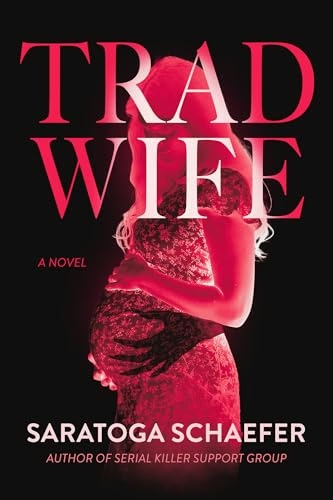
Prices can sometimes be lower on bigger marketplaces, but this link helps independent bookstores and local reading communities.
Quick Verdict
Trad Wife by Saratoga Schaefer is a grotesque, darkly satirical horror novel that works precisely because it refuses to let you look away. This isn't a book that aims to be liked—it aims to provoke, disgust, and make you complicit in Camille Deming's catastrophic choices. If you survived Rosemary's Baby and Nightbitch, you'll recognize the DNA here, but Schaefer's Trad Wife pushes into territory that's far messier, more contemporary, and considerably more nauseating.
What This Book Actually Does
The premise sounds like a fever dream pitched at a horror convention: a tradwife influencer, desperate for engagement and motherhood, discovers a mysterious well on her property, makes a wish, and gets impregnated by a demonic creature. But reducing Trad Wife to its plot does the novel a disservice. This is social commentary wrapped in visceral horror—a scalpel disguised as a sledgehammer.
Camille Deming isn't a sympathetic protagonist. She's a woman so obsessed with curating the perfect domestic aesthetic for her followers that she's willing to rationalize increasingly disturbing physical changes as "angelic visitations." Her marriage is deteriorating, her followers demand content, and somewhere in that toxic intersection of validation-seeking and gender performance, she makes a choice that can't be unmade.
What makes Schaefer's approach brilliant is that she never lets you feel superior to Camille. The novel doesn't wink at you; it doesn't position you outside the nightmare. Instead, it asks uncomfortable questions about how social media incentivizes women to perform impossible versions of femininity, how motherhood is simultaneously valorized and exploited, and how desperation can masquerade as choice.
The Writing: Grotesque Precision
Schaefer's prose is deliberately unsettling. She doesn't shy away from bodily horror—the rapid pregnancy, the cravings for raw meat, the physical deterioration—but she presents it with clinical precision rather than gratuitous detail. This restraint somehow makes it worse. You're not being bludgeoned with gore; you're being slowly, methodically shown something fundamentally wrong.
The pacing is relentless. Trad Wife doesn't linger in exposition; it moves with the momentum of a woman spiraling. Chapters are tight. Dialogue crackles with tension. The social media posts Camille shares with her followers create an unsettling counterpoint to the horror unfolding behind closed doors—the gap between her curated online persona and her actual descent is where the real terror lives.
Where It Excels
The social commentary lands with precision. Schaefer captures the cognitive dissonance at the heart of the tradwife influencer movement—women building lucrative careers through social media while promoting anti-feminist ideology, benefiting from the very freedoms and economic opportunities they rhetorically reject. Camille embodies this contradiction perfectly: she's simultaneously a victim of patriarchal expectations and complicit in perpetuating them.
The body horror works. The pregnancy doesn't follow natural rules. The cravings escalate. The physical impossibility of what's happening creates mounting dread that never fully resolves into comfort. You're waiting for Camille to acknowledge something is catastrophically wrong, and when she doesn't, the horror deepens.
The ending is absolutely not for the squeamish. Without spoiling it, Schaefer commits to the darkness she's established. She doesn't flinch. She doesn't offer redemption or escape. The final pages deliver the visceral payoff the novel has been building toward, and it's genuinely disturbing in ways that linger.
What Doesn't Quite Land
The predictability issue that some readers mention is valid, though I'd argue it's not necessarily a flaw. If you've read Rosemary's Baby or similar body-horror narratives, you'll sense where this is heading. But knowing the destination doesn't diminish the dread of the journey—it intensifies it. You're watching Camille make increasingly terrible decisions while understanding exactly where they lead.
Camille's husband Graham feels underdeveloped. He's present enough to create marital tension, but his perspective remains frustratingly opaque. A fuller exploration of his complicity or his own desperation might have added another layer to the novel's critique of gender dynamics. Instead, he functions primarily as a mirror for Camille's choices rather than a fully realized character.
The supporting characters—Camille's followers, her mother, other tradwife influencers—are sketched rather than fully drawn. They serve the satire, but they don't always feel like people. This is partly intentional; Schaefer seems more interested in systems and performance than in individual psychology. Still, a bit more specificity in these peripheral figures might have deepened the social commentary.
The Divisiveness Factor
This Trad Wife review needs to address why readers have such polarized responses. Some find the novel unputdownable despite—or because of—hating nearly every character and event. Others find it gratuitously gross without sufficient emotional weight to justify the grotesqueness.
The difference comes down to what you want from horror. If you want catharsis, psychological insight, or a protagonist to root for, Trad Wife will frustrate you. If you want a novel that makes you uncomfortable, that asks difficult questions about complicity and performance, and that refuses easy answers, this delivers. The disgust you feel isn't a bug; it's the feature.
Comparison Points
If you've read Rosemary's Baby, you know the template: a woman's reproductive autonomy violated, her reality gaslit, her body weaponized. Schaefer's innovation is that Camille chooses the violation. She makes the wish. She rationalizes the signs. She prioritizes her social media presence over her physical safety. This inverts Polanski's narrative and makes it contemporary—it's about how we willingly participate in systems that harm us when they promise visibility and validation.
Nightbitch is the other obvious comparison. Both novels use domestic horror to critique the performance of motherhood and femininity. But where that novel finds dark humor and eventual empowerment, Trad Wife is bleaker. There's no transformation or escape—only escalation and consequence.
Who Should Read This
Perfect for: Readers who loved Rosemary's Baby, Nightbitch, or Mexican Gothic. Horror fans interested in social commentary. Anyone curious about the tradwife phenomenon and its contradictions. People who don't need their protagonists to be likeable. Readers who appreciate body horror as metaphor.
Skip if: You need redemptive arcs or sympathetic characters. Graphic depictions of pregnancy and bodily violation disturb you. You want horror that resolves neatly. You're looking for a cozy domestic fantasy. You prefer subtle social commentary to direct critique.
The Verdict
Trad Wife by Saratoga Schaefer is a genuinely unsettling novel that uses horror to interrogate contemporary contradictions—the gap between curated online personas and lived reality, the pressure on women to perform impossible versions of femininity, the way social media incentivizes self-harm, and the complicity embedded in choosing victimhood.
Is Trad Wife worth reading? Yes, but with caveats. It's worth reading if you can tolerate discomfort, if you appreciate horror that functions as social critique, and if you're willing to sit with questions that don't have clean answers. It's not worth reading if you need to like your characters or if graphic body horror leaves you unable to engage with the themes.
The novel's strength is precisely its refusal to be palatable. Schaefer doesn't soften Camille's choices or offer redemption. She presents a woman making terrible decisions in a system designed to reward terrible decisions, and she makes you complicit in watching it unfold. That's the opposite of comfortable, which is exactly the point.
Final Score
7.5/10 — A visceral, unflinching horror novel that uses genre conventions to deliver sharp social commentary, though some characters deserve more depth and the predictability occasionally undermines the dread.