Category:
Book ReviewsTidal Wave Review: History Too Wild to Believe
Prices can sometimes be lower on bigger marketplaces, but this link helps independent bookstores and local reading communities.
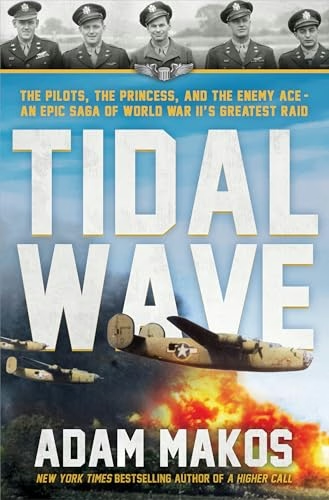
Adam Makos's Tidal Wave: The Pilots, the Princess, and the Enemy Ace does something rare in contemporary military history: it tells a true story so audacious, so perfectly plotted with human drama and geopolitical intrigue, that you'd swear it was invented by a novelist with an overactive imagination. Yet every page is meticulously researched, every character real, every impossible moment documented. This is the book that justifies why we keep reading World War II narratives—because sometimes reality outpaces our capacity to imagine it.
What It's About
Tidal Wave centers on Operation Tidal Wave, the August 1, 1943 bombing raid on the Ploesti oil refineries in Romania—Hitler's primary fuel supply and the most dangerous low-altitude bombing mission of the entire war. But Makos doesn't just chronicle the raid itself. He weaves together four interconnected narratives that transform a military operation into an intimate human drama.
There's Lieutenant Ernie Poulson, a twenty-two-year-old B-24 pilot from Utah who finds himself at the controls of America's most advanced bomber. There's Constantin "Bâzu" Cantacuzino, Romania's most decorated fighter ace, caught between duty to his nation and disgust with Nazi occupation. There's Princess Catherine Caradja, walking an impossible tightrope between survival and conscience. And there's King Michael of Romania, just twenty-one years old, secretly plotting to seize control of his country's destiny before the Nazis consume it entirely.
When Poulson's bomber crashes on Princess Catherine's estate, these lives collide. What unfolds is a story of downed pilots, underground networks, and an act of defiance that would eventually save over a thousand Allied prisoners of war.
Writing & Style: Cinematic Intensity Meets Scholarly Rigor
Makos's signature approach—which earned Spearhead (2019) its reputation as one of the most readable military history books in recent memory—is on full display here. He doesn't write like an academic grinding through archives. He writes like a screenwriter who's done the research, structuring scenes with dramatic tension, dialogue that breathes, and pacing that keeps you reading past midnight.
The prose moves between perspectives fluidly, never feeling fragmented or confusing. You're in Poulson's cockpit one moment, watching tracers light up the Romanian sky. The next, you're in King Michael's palace, listening to whispered conversations about treason and survival. This isn't dry recitation of facts—it's immersive storytelling built on a foundation of extensive research.
What's particularly effective is how Makos handles the technical details without letting them bog down the narrative. Readers learn about B-24 specifications, Romanian military hierarchies, and Nazi occupation policies not through exposition dumps, but through the lived experience of his characters encountering these realities.
What Works: The Unexpected Humanity
The genius of Tidal Wave lies in what Makos does after the bombing raid concludes. Most military histories would end there—mission accomplished, heavy casualties, strategic victory achieved. But Makos understands that the real story is what happens next: the survival, the escape, the moral choices made under impossible pressure.
Princess Catherine emerges as the emotional core of the narrative. She's not a one-dimensional hero or a convenient plot device. She's a woman navigating the specific horrors of occupied Europe—German officers billeted in her home, her country's resources stripped for a war she didn't choose, and suddenly, American pilots who've crashed into her life and her conscience. The moral calculus she faces feels genuinely complicated, and Makos refuses to simplify it.
The relationship between Constantin and the Allied pilots introduces another layer of complexity that elevates this beyond typical war narrative. Here are men who should be enemies—a Romanian fighter pilot and American bomber crews—finding common cause against Nazi tyranny. It's the kind of human connection that gets buried in official histories but reveals the truth about how wars are actually experienced by those fighting them.
The historical context Makos provides about Romania's precarious position during WWII is invaluable. Unlike Germany or Japan, Romania's alignment with the Axis was coerced and reluctant. The nation had been pressured into the alliance partly to reclaim territory lost to the Soviet Union after World War I—a detail that adds crucial nuance to understanding why the population and even military figures like Constantin chafed against Nazi control. This geopolitical backdrop transforms the narrative from a simple good-versus-evil framework into something more historically honest.
What Doesn't Quite Land
If Tidal Wave has a weakness, it's occasional pacing inconsistency in the middle sections. There are moments where the narrative lingers on secondary characters or historical context when the primary storylines demand momentum. It's a minor flaw in an otherwise tautly constructed book, but readers accustomed to breakneck pacing might notice it.
Additionally, some readers may find the romantic elements feel slightly underdeveloped, particularly given how much screen time they receive. Makos clearly wants to explore the emotional connections forged between characters, but occasionally these threads feel more sketched than fully realized.
Who Should Read This
Perfect for: Anyone who loved Spearhead, The Boys in the Boat, or Devotion. Readers who appreciate narrative nonfiction that prioritizes human stories over dry historical recitation. People interested in Eastern European history during WWII, a perspective often marginalized in mainstream accounts. Those who want to understand how ordinary people made extraordinary moral choices under totalitarian pressure. History readers tired of books that treat war as abstract strategy rather than intimate human experience.
Might struggle with: Readers seeking a purely military-tactical account of Operation Tidal Wave will find this too character-focused. Those who prefer academic historical writing may find Makos's cinematic approach occasionally prioritizes drama over nuance. Anyone looking for a quick, light read—this demands engagement and emotional investment.
The Verdict
Tidal Wave is absolutely worth reading. It justifies why we continue exploring WWII narratives: because there are still stories this profound, this human, this stranger-than-fiction waiting to be told. Makos proves again that he's among the finest practitioners of narrative military history working today. This isn't just a book about a bombing raid or an escape. It's a meditation on courage, conscience, and the possibility of humanity persisting even in history's darkest hours.
The question "Is Tidal Wave worth reading?" answers itself once you start. You won't want to stop.
Final Score
9/10 — A meticulously researched, emotionally gripping narrative that proves true stories can outpace any novelist's imagination.