Category:
Book ReviewsThink Again Review: Brilliant Premise, Uneven Execution
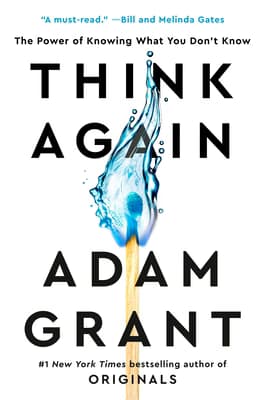
Prices can sometimes be lower on bigger marketplaces, but this link helps independent bookstores and local reading communities.
Adam M. Grant's Think Again: The Power of Knowing What You Don't Know arrives at a cultural moment when intellectual humility feels increasingly rare. The book promises to teach us how to embrace doubt, challenge our convictions, and develop the cognitive flexibility that separates innovative leaders from dogmatic ones. It's an ambitious project that tackles one of our most pressing cognitive blind spots—yet the execution reveals why this particular insight remains so difficult to operationalize.
Let's be direct: this Think Again review addresses a book with a genuinely valuable core thesis buried beneath layers of motivational scaffolding and research that doesn't always hold up to scrutiny. Grant's central argument—that our greatest competitive advantage in a rapidly changing world is the willingness to rethink our positions—deserves serious consideration. The problem is that the book often feels more like a TED talk stretched to book length than a rigorous exploration of intellectual flexibility.
What This Book Is Actually About
Grant structures Think Again around a deceptively simple observation: we're trapped in mental prisons of our own making. He identifies three archetypal mindsets that sabotage genuine thinking—the preacher (convinced of absolute truth), the prosecutor (focused on discrediting others), and the politician (seeking approval rather than truth). These personas resonate immediately because we recognize them in ourselves and others.
The book's three-part architecture examines why individuals struggle to rethink, how we can help others do the same through "argument literacy," and finally, how institutions systematically fail to cultivate rethinking cultures. This structure is logical, and Grant's writing flows with the accessibility that made Originals his breakout work.
The underlying research Grant references—particularly the Dunning-Kruger Effect and studies on cognitive flexibility—points toward something real: the least knowledgeable people tend toward the most confidence, while genuine experts often exhibit humility about the limits of their understanding. This paradox deserves exploration, and Grant recognizes its importance.
Where Think Again Succeeds
Grant excels at identifying the psychological mechanisms that lock us into rigid thinking. His discussion of how we slip into preacher, prosecutor, and politician modes feels genuinely illuminating—most readers will recognize these patterns in their own arguments and relationships. The book makes a compelling case that intellectual flexibility is a learnable skill, not an innate trait, which is both encouraging and actionable.
The section on helping others rethink through Socratic questioning and genuine curiosity offers practical value. Grant's emphasis on asking "What would change your mind?" rather than launching into counterarguments provides a concrete framework readers can actually implement in conversations. This represents the book's strongest contribution.
His argument against "grit" as an unqualified virtue is refreshingly contrarian. The suggestion that persistence without periodic rethinking can trap us in unproductive paths challenges the prevailing wisdom in self-help literature. This nuance deserves credit.
The Significant Weaknesses
Here's where a Think Again review must confront the book's fundamental problem: the research supporting Grant's claims often feels cherry-picked or poorly designed. One reader notes that Grant claims "no pollster had Trump as a frontrunner in the Republican primary," when polling data from 2015-2016 clearly showed Trump leading in numerous surveys. This isn't a minor error—it's the kind of factual mistake that should make readers question what other claims might be selectively presented.
The book's first third essentially argues that being open-minded is good. For readers already predisposed to that view (which is most of Grant's audience), this section feels redundant. For those genuinely resistant to rethinking, the motivational framing probably won't penetrate. The book struggles to bridge this gap effectively.
Grant's prescriptions for institutional change in the final section feel vague and somewhat disconnected from the personal and interpersonal insights that precede them. The leap from individual rethinking to organizational culture reform isn't adequately bridged, leaving readers with platitudes rather than actionable frameworks.
There's also an implicit assumption throughout that most readers suffer from excessive confidence in their beliefs. For people in technical fields, those who regularly face failure, or those from marginalized backgrounds who are constantly second-guessing themselves, this premise rings hollow. Grant doesn't adequately acknowledge that the problem of overconfidence is unevenly distributed across populations and professional contexts.
The Comparison Problem
If you're evaluating whether Think Again is worth reading, consider Ray Dalio's Principles or Nassim Taleb's Skin in the Game—both books that explore uncertainty and belief revision but with more rigorous intellectual frameworks. Dalio's radical transparency approach and Taleb's emphasis on skin in the game provide more sophisticated mechanisms for actually implementing the kind of thinking Grant advocates. They're denser reads, but they reward that investment more substantially.
Grant's book occupies an odd middle ground: it's too accessible for readers seeking deep intellectual rigor, yet too focused on research and evidence for those wanting pure motivation and inspiration. It falls between genres without fully succeeding in either.
Who Should Actually Read This
This book is genuinely valuable for managers and leaders who operate in echo chambers, particularly those in corporate environments where challenging the boss's perspective is professionally risky. The frameworks for facilitating productive disagreement have real utility in those contexts.
It's also worthwhile for anyone in their first serious leadership role who hasn't yet developed the humility that experience typically teaches. The book's message that intellectual flexibility is learnable and valuable could prevent years of stubborn mistakes.
Skip this if you're an engineer, data scientist, or investor already operating in environments where constant evidence-seeking and hypothesis-testing are cultural norms. You'll find Grant's insights obvious rather than revelatory. Similarly, avoid it if you're looking for a rigorous philosophical exploration of epistemology or belief formation—Grant's approach is too popularized for that purpose.
The Honest Verdict
Think Again by Adam M. Grant tackles an important problem and occasionally illuminates genuine insights about how we think and change. The core observation—that intellectual humility correlates with actual expertise—deserves wider recognition. The book's accessibility means it will reach audiences who need this message.
But the execution undermines the ambition. Selective research presentation, redundant early chapters, and vague institutional recommendations prevent this from being the definitive work on rethinking it aspires to be. The book reads like Grant's ideas would work better as a series of focused articles or a shorter, more concentrated book.
Is Think Again worth reading? Yes, if you're a manager seeking frameworks for productive disagreement or someone early in a leadership journey. No, if you're seeking rigorous intellectual engagement or already operate in environments that value evidence-based rethinking. For most readers, it's a decent but not essential read—the kind of book that makes sense as a library checkout or audiobook for a specific professional moment, not a purchase for your permanent shelf.
Final Score: 6.5/10 — A book with genuine insights undermined by uneven research, redundant sections, and the gap between its important thesis and its somewhat shallow execution.