Category:
Book ReviewsThe World for Sale Review: Capitalism's Hidden Power Brokers
Prices can sometimes be lower on bigger marketplaces, but this link helps independent bookstores and local reading communities.
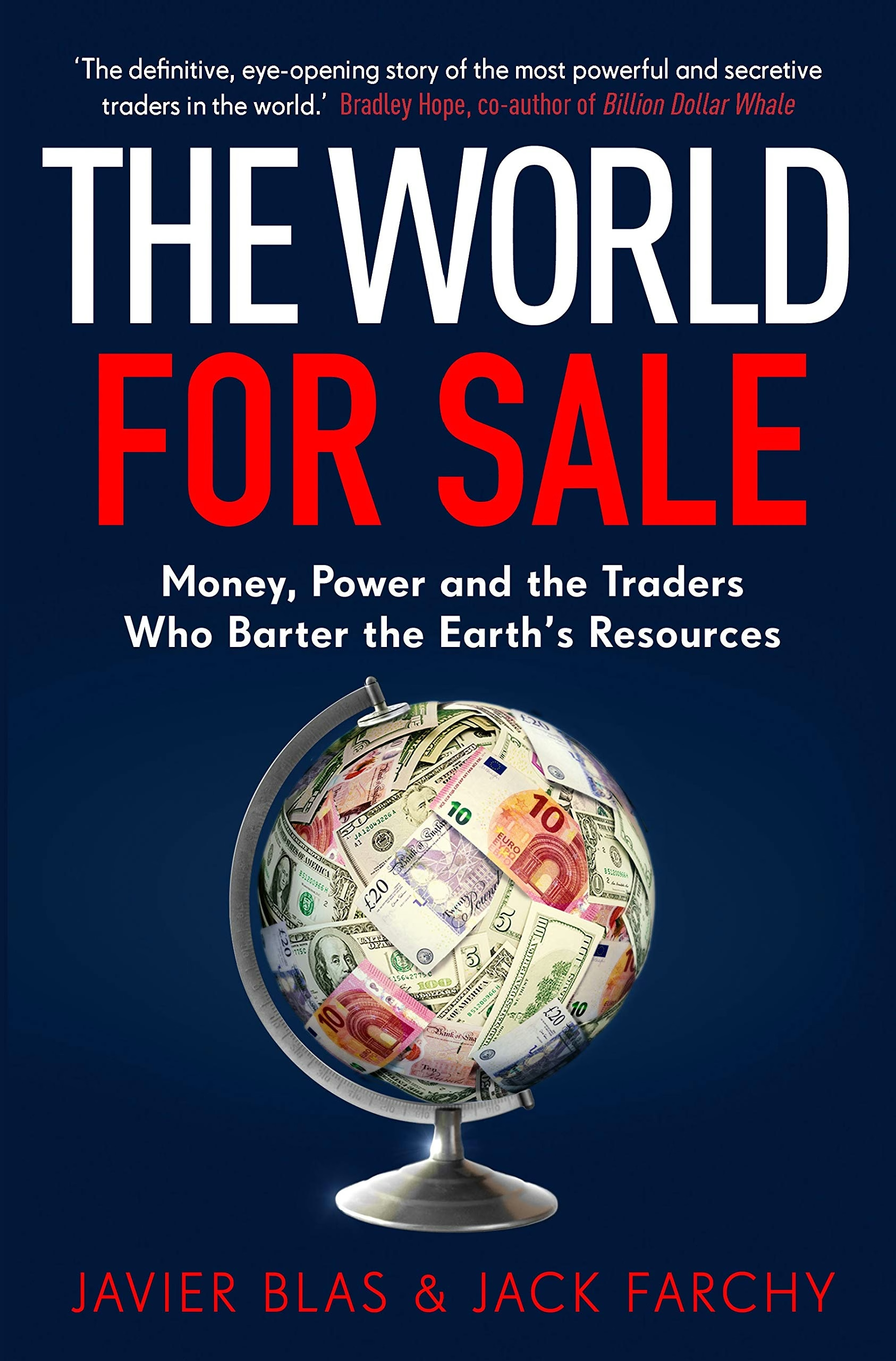
Javier Blas and Jack Farchy's The World for Sale is a meticulously researched exposé that shatters the illusion of regulated global markets. This isn't a book that politely explains how commodities flow through the world economy—it's a damning investigation into how a handful of amoral traders accumulated enough power to shape geopolitics, destabilize nations, and operate almost entirely outside public scrutiny. If you've ever wondered why commodity markets feel like a black box, this book reveals why: because powerful people deliberately keep them that way.
What This Book Actually Reveals
Unlike dry economics textbooks, The World for Sale reads like a corporate thriller because the stories are real and genuinely shocking. Blas and Farchy trace the rise of modern commodity trading from post-WWII grain deals through to contemporary oil sanctions evasion, following the trail of traders who made billions by connecting resource-rich countries—regardless of their political stability or corruption levels—with global financial centers.
The book's central argument is uncomfortable: these traders didn't just profit from the world's resources, they fundamentally reshaped it. When OPEC nationalized oilfields in the 1970s, it wasn't oil companies that adapted—it was traders like Marc Rich who stepped in, took enormous risks, and became indispensable. They financed production, managed logistics, and provided the intelligence networks that made international trade possible. But they did it with zero ethical guardrails.
The specific case studies are where Javier Blas and Jack Farchy's reporting becomes truly valuable. The authors document how traders helped Saddam Hussein circumvent sanctions, how they fueled Libyan rebel forces during the Arab Spring, and how they funneled capital to Putin's Russia despite supposed financial isolation. These aren't hypothetical concerns—they're documented transactions with names, dates, and paper trails.
The Narrative Strength
What separates this World for Sale review from generic business book criticism is the sheer narrative momentum. The authors don't overwhelm readers with data dumps. Instead, they weave together multiple storylines: the rise of Philipp Brothers, the controversial career of Marc Rich, the emergence of Glencore and Trafigura, and the brutal "aluminium wars" of 1990s Russia. Each thread illustrates a different dimension of trader power—whether financial innovation, geopolitical influence, or outright lawlessness.
The pacing works because the authors understand that readers need both the big picture and the telling details. A chapter might explain how traders use information asymmetries to forecast commodity prices, then pivot to a specific anecdote about a trader bribing officials in a war-torn nation. The contrast keeps you engaged.
Blas and Farchy also excel at historical context. They don't just explain what traders do; they explain why traders became necessary. As countries nationalized resources and the Seven Sisters oil majors lost their monopoly, someone needed to bridge the gap between producers and consumers. Traders filled that vacuum. Understanding this removes any temptation to view them as cartoonish villains—they were solving real logistical problems, just without any moral constraints.
Where the Analysis Falls Short
However, a critical World for Sale review must acknowledge where the book's ambition exceeds its grasp. While the authors excel at narrative and historical detail, their policy recommendations feel thin. The book powerfully demonstrates that commodity traders wield enormous influence with minimal oversight, but the solutions proposed—better regulation, transparency requirements, stronger sanctions enforcement—are generic and somewhat naive.
The authors also tend to attribute more intentional conspiracy to traders than the evidence sometimes supports. Yes, traders profited from geopolitical chaos. But did they actively create that chaos, or did they simply exploit inevitable market conditions? The book sometimes blurs this distinction, which weakens otherwise compelling arguments.
Another limitation: the book focuses almost exclusively on oil, metals, and agriculture. While these are the most consequential commodities, the analysis doesn't adequately address how trader power has evolved post-2008 financial crisis. The book ends roughly around 2015-2016, which means it predates major regulatory changes and doesn't fully grapple with how commodity trading has adapted to increased scrutiny.
Who Should Read This
This book is essential for anyone interested in how global capitalism actually functions beyond the textbook version. It's perfect for:
- Business and finance professionals who want to understand the shadow economy of commodity trading
- Political economy enthusiasts interested in how markets shape geopolitics
- Investigative journalism fans who appreciate meticulous research and narrative nonfiction
- Policy makers and regulators who need to understand what they're actually trying to regulate
However, this book will frustrate readers seeking:
- Simple moral clarity (the traders are amoral, but they're not cartoon villains)
- Concrete solutions (the policy recommendations are underdeveloped)
- Balanced perspectives from trader viewpoints (the authors rarely let traders defend themselves)
- Recent data (the book's analysis ends several years ago)
Comparison to Similar Works
If you've read Billion Dollar Whale by Bradley Hope and Tom Wright, The World for Sale operates in similar territory—exposing how financial systems enable corruption and crime. However, Blas and Farchy's book is more structurally ambitious, attempting to trace decades of history rather than focusing on a single scandal.
Compared to The Shock Doctrine by Naomi Klein, The World for Sale is less ideologically polemical and more journalistically rigorous. Klein argues that disaster capitalism is a coordinated neoliberal project; Blas and Farchy show how individual traders opportunistically profited from chaos without necessarily planning it.
Is The World for Sale Worth Reading?
Yes, unambiguously. This is one of those rare nonfiction books that genuinely changes how you understand the world. It's meticulously researched, narratively compelling, and addresses a genuinely important gap in public knowledge. The commodity trading industry shapes everything from geopolitics to food prices, yet remains almost completely invisible to most people. This book fixes that.
The weakness isn't in the reporting or storytelling—it's in the limited policy recommendations and the somewhat dated endpoint. But these are minor flaws in an otherwise excellent investigation.
The Verdict
The World for Sale is a masterclass in investigative nonfiction that reveals how a tiny group of traders accumulated staggering influence over global markets and politics. Blas and Farchy's research is thorough, their narrative is gripping, and their central argument is both compelling and well-supported. While the policy analysis could be deeper and the book would benefit from more recent data, these limitations don't diminish what is ultimately a crucial examination of how modern capitalism actually works—far from the sanitized version taught in business schools.
This is required reading for anyone who wants to understand the real infrastructure of global power.