Category:
Book ReviewsThe Witches of Cambridge Review: Hoffman's Uneven Magic
Prices can sometimes be lower on bigger marketplaces, but this link helps independent bookstores and local reading communities.
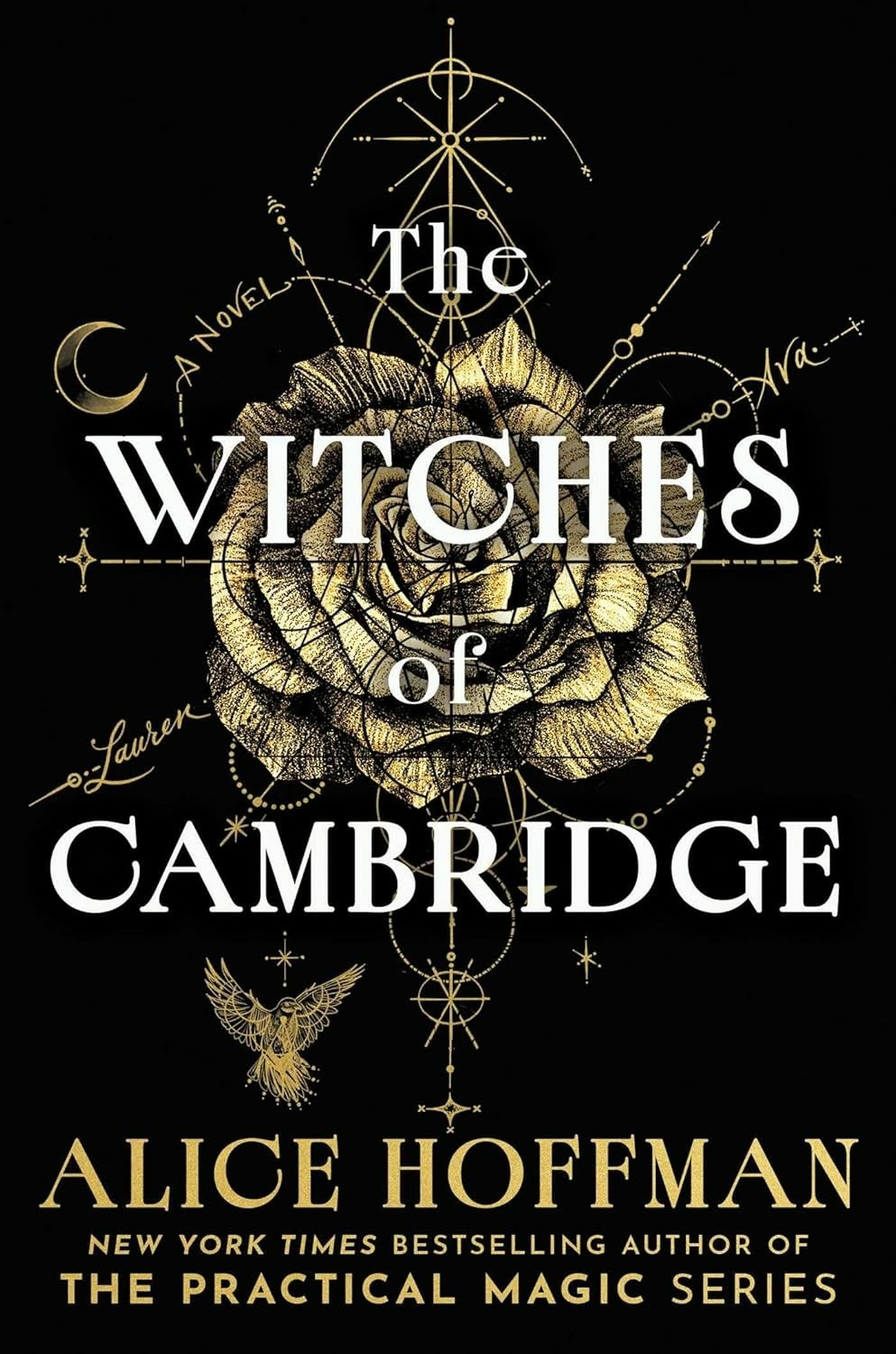
Alice Hoffman's The Witches of Cambridge arrives as the opening salvo of a new series, promising to blend 1950s historical fiction with contemporary dark academia aesthetics and supernatural intrigue. This is a book that divides readers sharply—some find it a transcendent exploration of female power and resistance, while others struggle with its pacing and narrative structure. The truth, as with most ambitious literary fiction, sits somewhere in between.
What It's About
Set in 1950s Cambridge, Massachusetts, The Witches of Cambridge follows two Radcliffe College students who discover membership in the Lilith Society, a secret organization of witches tracing their lineage back to colonial times. Ava Abbott, a scholarship student from rural Maine, carries both literal and metaphorical scars from a childhood steeped in isolation and parental control. Lauren, her opposite in every conceivable way, emerges from Cambridge wealth and privilege but harbors her own hidden wounds.
Their unlikely friendship forms the emotional core of the narrative, but the book's scope extends far beyond their personal connection. Hoffman weaves together three temporal threads: the girls' present-day college experience, the historical witch hunts of the 1600s, and the looming specter of McCarthyism—a particularly clever parallel that transforms the novel into something more than a simple fantasy romp.
When members of the Lilith Society begin disappearing, Ava and Lauren must confront whether the dangers facing them are supernatural, political, or disturbingly human.
The Strength of Hoffman's Character Work
Where Alice Hoffman's The Witches of Cambridge genuinely excels is in its portrayal of female agency and self-discovery. Hoffman has always possessed a gift for creating heroines who refuse the narrow boxes society constructs for them, and Ava and Lauren are no exception. Their characterization feels specific and earned rather than archetypal.
Ava's journey from a woman taught to fear her own existence to one who claims her power carries genuine emotional weight. The detail about her childhood—the extra finger removed, the warnings never to enter the woods, the bullying for being visibly different—creates a foundation that makes her transformation believable rather than convenient. Lauren's arc proves equally compelling, though approached from the opposite direction: privilege doesn't insulate her from the suffocating expectations placed on 1950s women, and watching her discover that wealth and status cannot purchase authentic freedom offers its own quiet revelation.
The Lilith Society itself functions as more than mere plot device. Named after Adam's first wife—the woman who refused to obey and was subsequently erased from mainstream religious narrative—the organization becomes a meditation on how history silences women's voices and how reclaiming that history becomes an act of rebellion. This thematic richness elevates the book beyond typical supernatural fiction.
Historical Layering and McCarthy-Era Parallels
Hoffman's decision to set this story during the McCarthy era reveals sophisticated thinking about persecution, fear, and the mechanisms of social control. The parallel between 1950s political witch hunts and actual historical witch hunts isn't subtle, but it's effective. Both periods weaponized fear. Both demanded conformity. Both punished those perceived as threats to the established order.
The 1950s setting also grounds the book's central tension: how do women claim power in an era when female intellectual ambition itself was viewed with suspicion? Female Radcliffe students were literally segregated from male Harvard students in lecture halls—a detail that feels almost too on-the-nose until you realize it's historically accurate. This context makes the Lilith Society's existence as a female-only space of intellectual and magical development feel urgent and necessary rather than merely exclusive.
Where the Narrative Struggles
Yet The Witches of Cambridge review discussions frequently circle around a fundamental structural problem: the book attempts to do too much, and the execution doesn't always justify the ambition. The temporal shifts between the 1950s present and the 17th-century past, while thematically resonant, sometimes feel narratively disruptive rather than illuminating.
The pacing, particularly in the first half, meanders. Hoffman lingers on atmospheric detail and character introspection—which can be beautiful—but occasionally at the expense of forward momentum. Readers expecting the propulsive plot mechanics of dark academia fiction may find themselves frustrated by sections that prioritize mood over action.
Moreover, the supernatural elements, while present, remain somewhat nebulous. What exactly can these witches do? What are the rules governing their power? The book deliberately keeps these questions partially unanswered, presumably for series purposes, but this choice creates a haziness that some readers find evocative and others find evasive. For a novel that hinges on magic, the magic itself remains surprisingly undefined.
The mystery of the disappearing society members—which should function as the plot's central engine—takes a backseat to character development and historical reflection. This isn't necessarily wrong, but it's a choice that will alienate readers seeking a more conventional narrative arc.
Writing Style and Prose Quality
Hoffman's prose remains elegant and precise, with particular strength in her descriptions of place and emotional landscape. Cambridge itself becomes a character—both sanctuary and prison depending on perspective. Her dialogue captures the era's speech patterns without feeling artificially period-specific.
However, the book occasionally slips into telling rather than showing. Passages that explain the significance of Lilith or elaborate on the historical context sometimes feel didactic rather than organic. A more trusting approach to reader intelligence might have strengthened these moments.
Who Should Read This Book
Perfect for: Readers who loved Practical Magic and crave more Hoffman; those interested in feminist retellings of history; fans of dark academia who appreciate character work over plot mechanics; readers seeking thoughtful exploration of female identity and power; anyone fascinated by the intersection of historical and contemporary witch narratives.
Likely to disappoint: Plot-driven readers expecting thriller-like pacing; those seeking clearly defined magical systems and rules; readers wanting a standalone novel rather than series commitment; those who find atmospheric prose prioritization frustrating; readers expecting the witchcraft elements to dominate the narrative.
The Verdict on Whether It's Worth Reading
The Witches of Cambridge is absolutely worth reading if you align with its intentions and approach. This is not a book trying to be The Secret History or Ninth House. It's a literary historical fantasy prioritizing character, theme, and atmosphere over plot velocity. That's a legitimate artistic choice, even if it won't satisfy every reader.
The novel succeeds most powerfully as a meditation on female resistance across centuries—how women have always found ways to claim power, community, and voice despite systematic attempts to silence them. Ava and Lauren's friendship, the Lilith Society's historical legacy, and the parallels drawn between different eras of persecution create something genuinely thought-provoking.
The weaknesses are real: structural choices that sacrifice momentum, magical elements that remain frustratingly vague, and a mystery plot that never quite achieves the urgency it promises. These aren't fatal flaws, but they prevent The Witches of Cambridge from reaching the heights Hoffman clearly intends.
Final Thoughts
Alice Hoffman's The Witches of Cambridge represents ambitious literary fiction that doesn't always land perfectly but deserves credit for attempting something substantial. It's a book about women refusing to be erased, told by an author who has built her career on that same refusal. The execution wavers, but the intention shines through.
If you're the kind of reader who values thematic resonance, character depth, and historical consciousness over breakneck plotting, this book will reward your investment. If you need plot to carry you through, you may find yourself frustrated by Hoffman's deliberate pacing choices. Neither response is wrong—they simply reflect different reading priorities.
Final Score: 7/10 — A thoughtful, character-driven exploration of female power and historical persecution that occasionally sacrifices narrative momentum for thematic depth, resulting in an uneven but ultimately worthwhile addition to Hoffman's body of work.