Category:
Book ReviewsThe Wide Wide Sea Review: A Masterful Reckoning with Cook's Legacy
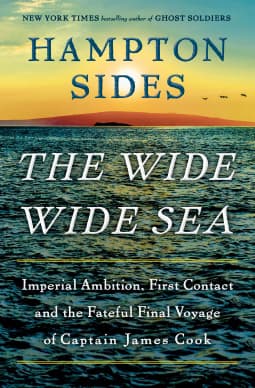
Prices can sometimes be lower on bigger marketplaces, but this link helps independent bookstores and local reading communities.
Hampton Sides' The Wide Wide Sea is a masterclass in revisionist historical narrative—and it's absolutely worth reading if you're prepared for a book that refuses easy answers. This is not a straightforward adventure tale celebrating a great explorer. Instead, Sides delivers a meticulously researched examination of Captain James Cook's final voyage that forces readers to grapple with the uncomfortable contradictions between Cook's humane ideals and the colonial machinery he ultimately served. The result is gripping, intellectually honest, and deeply unsettling in the best possible way.
What This Book Actually Is
The Wide Wide Sea focuses exclusively on Cook's third and final voyage, which departed Plymouth in July 1776 and ended tragically on Hawaii's Kona Coast in January 1779. This narrow chronological lens is crucial—Sides isn't attempting a comprehensive biography. Instead, he uses these thirty months to interrogate the central paradox of the Age of Exploration: how could a man renowned for respecting Indigenous cultures become complicit in their destruction?
The voyage itself was geographically staggering. Cook's two vessels, the HMS Resolution and HMS Discovery, traversed from Cape Town to Tahiti, up the western coast of North America, through the Bering Strait, and ultimately to Hawaii. The geographic scope mirrors the intellectual scope of Sides' investigation: he's charting not just ocean currents but the ideological currents that shaped European imperialism.
The Brilliant Central Tension
What makes this The Wide Wide Sea review essential reading is Sides' refusal to flatten Cook into a villain or hero. The book opens with Cook as a genuinely progressive figure for his era—a naturalist who collaborated with the renowned Joseph Banks, a captain who treated his crew with unusual humanity, and a man genuinely curious about the societies he encountered. Cook had a stated mission to return Mai, a Tahitian man who'd become a London celebrity, to his home islands.
But something shifted on this final voyage. Cook became erratic, resorting to the lash to enforce discipline with unprecedented severity. He ordered violent retaliation against native peoples for perceived theft. Most damningly, he carried secret orders to chart and claim lands for Britain before rival imperial powers could—orders that fundamentally corrupted his scientific mission into colonial conquest.
Sides argues this wasn't inevitable villainy but rather the collision of competing imperatives. Cook's overt mission (scientific exploration, cultural exchange) crashed headlong into his covert mission (imperial expansion, territorial acquisition). The tension between these missions—between the man Cook believed himself to be and the instrument of colonialism he became—is the beating heart of this book.
Where Sides' Writing Excels
The prose throughout is consistently excellent. Sides has built a reputation on narrative nonfiction that reads like thriller fiction, and The Wide Wide Sea confirms this talent. The famous passage describing Cook's final moments—where he stands frozen on a Hawaiian beach, seemingly unable to comprehend the danger despite explicit warnings—is rendered with almost unbearable tension. You know how this ends, yet Sides makes you feel the mounting dread anyway.
The research is genuinely staggering. Sides draws on primary sources including Cook's own journals, crew accounts, and Hawaiian oral traditions. He doesn't just tell us what happened; he shows us the documentary evidence. When he describes the ice flows of the Bering Strait or the tropical abundance of Tahiti, the details feel earned rather than invented.
The book also excels at making 18th-century maritime life visceral. You understand the scurvy, the storms, the claustrophobia of months at sea, the desperate hope of finding the Northwest Passage. Sides makes the physical reality of exploration tangible in ways that make Cook's decisions—both admirable and catastrophic—feel comprehensible rather than distant.
What Doesn't Quite Land
The book's psychological analysis of Cook occasionally strains credibility. Sides speculates extensively about Cook's mental state during the final voyage—was he depressed? Suffering from a breakdown? Losing his grip on reality? These passages are thoughtful, but they sometimes veer into speculation that the historical record simply cannot support. We're asked to inhabit Cook's interiority in ways that feel more novelistic than historical.
Additionally, some readers may find the pacing uneven. The voyage's middle sections—while geographically exciting—occasionally feel like catalog entries rather than narrative momentum. The book is at its most powerful when examining the Hawaii sequences and their implications, but it takes considerable time reaching that climax.
Finally, while Sides admirably refuses to exonerate Cook, some readers may wish for deeper engagement with Hawaiian perspectives. The book primarily filters Hawaiian agency through European accounts, which inadvertently reproduces some of the same colonial limitations it critiques.
Who Should Read This
This book is essential for anyone interested in the Age of Exploration, imperial history, or the ongoing reckoning with colonial legacies. If you loved books like 1491 by Charles C. Mann or The Conquest of New Spain by Bernal Díaz, The Wide Wide Sea review will confirm this belongs on your shelf.
It's also perfect for readers who appreciate narrative nonfiction that refuses easy moralizing. Sides doesn't ask us to condemn Cook or absolve him—he asks us to understand him as a complex historical figure trapped within systems larger than himself.
However, if you want a traditional adventure narrative celebrating exploration, this isn't your book. If you prefer your history books to offer clear heroes and villains, you'll find The Wide Wide Sea frustratingly ambiguous. And if you want Indigenous perspectives centered rather than mediated through European sources, you may feel the book's limitations acutely.
The Larger Significance
What makes Hampton Sides' The Wide Wide Sea particularly timely is its implicit argument about how we reckon with historical figures. Cook wasn't a monster or a saint—he was a man whose genuine scientific curiosity and humane instincts were weaponized by imperial structures he didn't fully acknowledge. That's a more uncomfortable historical truth than either pure condemnation or pure celebration.
The book's final achievement is making readers understand that the "discovery" narrative itself is colonial propaganda. The places Cook "discovered" were inhabited islands found centuries earlier by the people living there. The scientific knowledge he gathered was gathered at tremendous human cost. These aren't new arguments, but Sides makes them through narrative rather than polemic, which makes them far more persuasive.
Final Verdict
8.5/10 — The Wide Wide Sea is essential reading that combines impeccable research with genuinely gripping narrative to interrogate one of history's most consequential figures.
Is The Wide Wide Sea worth reading? Absolutely, especially if you're willing to be challenged. This is a book that respects its readers' intelligence while refusing to let anyone off the hook—not Cook, not the British Empire, and not ourselves.