Category:
Book ReviewsThe Wager Review: Grann's Masterpiece of Maritime Betrayal
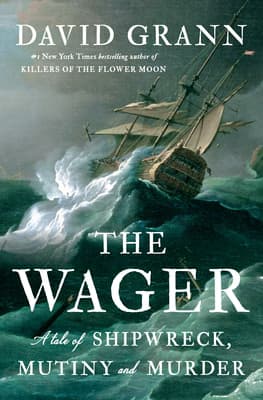
Prices can sometimes be lower on bigger marketplaces, but this link helps independent bookstores and local reading communities.
David Grann's The Wager: A Tale of Shipwreck, Mutiny and Murder is a triumph of historical narrative that transforms a forgotten 18th-century naval disaster into a gripping meditation on power, survival, and the lies we tell to justify ourselves. This is not merely a shipwreck story—it's a forensic examination of competing truths, where two radically different accounts of the same catastrophe force readers to confront uncomfortable questions about authority, class, and the violence embedded in imperial ambition.
Grann's previous works (Killers of the Flower Moon, The Lost City of Z) established him as a master of narrative non-fiction, but The Wager represents his most sophisticated achievement. The book reconstructs the 1740 voyage of HMS Wager, a warship dispatched as part of a secret British squadron tasked with intercepting Spanish treasure galleons during the War of Jenkins's Ear. When the Wager wrecks on a desolate Patagonian island, survival becomes a nightmare of starvation, disease, and psychological collapse. But the real story—the one that will haunt you long after finishing—emerges when two different groups of survivors tell radically opposing versions of what happened on that forsaken shore.
What It's Actually About
The premise alone is extraordinary: in 1742, a makeshift vessel carrying thirty survivors reaches Brazil. These men are celebrated as heroes who endured one of history's longest castaway voyages, traveling nearly three thousand miles through apocalyptic conditions. But six months later, another boat reaches the Chilean coast carrying three men who paint a completely different picture. They claim the thirty weren't heroes—they were mutineers. They accuse their captain, David Cheap, of tyranny, brutality, and incompetence. They describe a mutiny, a murder, and a conspiracy to conceal the truth.
The British Admiralty faces an impossible dilemma: one group is lying, and lying about mutiny in the 18th-century Navy meant hanging. So begins a legal and historical battle that Grann meticulously reconstructs through court-martial records, letters, journals, and the fragmented testimonies of men trying to save their own necks. The genius of The Wager is that Grann refuses to simply declare a winner. Instead, he walks readers through the evidence with the precision of a forensic investigator, revealing how power, class, trauma, and desperation can generate two equally plausible but mutually exclusive narratives.
The Research Is Staggering
Grann's research methodology elevates this book beyond typical historical adventure narratives. He didn't just consult archives—he traveled to the actual island where the Wager wrecked, examined the physical landscape, and reconstructed the geography that constrained the survivors' choices. The book includes 28 carefully selected illustrations: period portraits of the main characters, contemporary paintings of the Wager, maps showing the ship's trajectory, and even historical diagrams of 18th-century amputation techniques (a grimly relevant detail given the medical horrors the crew endured).
What distinguishes Grann's approach is his willingness to surface the social machinery of Georgian naval power. He reveals how the Navy recruited through press gangs—literally kidnapping men from streets and taverns—and how it mixed these desperate conscripts with upper-class boys as young as fourteen being groomed as future officers. John Byron, featured prominently in the narrative, exemplifies this class stratification; he was expected to master fencing, classics, and mathematics while learning to command. (Byron later became the grandfather of the poet Lord Byron, a genealogical detail that adds unexpected texture to the historical record.)
The conditions Grann describes are almost unimaginable: ships so filthy and disease-ridden that they functioned as floating death traps. Scurvy, dysentery, and typhus killed more sailors than combat ever did. The Wager's voyage became a nightmare of starvation and suffering before the ship even wrecked.
Writing & Style: Grann at His Peak
Grann writes with the narrative momentum of a thriller, but without sacrificing historical accuracy or moral complexity. Each chapter deepens the mystery rather than resolving it prematurely. He introduces characters with vivid specificity—you come to know these men not as abstractions but as individuals with contradictory motivations, fragile psychologies, and competing survival instincts.
The prose moves with genuine urgency. Grann understands pacing in a way many narrative non-fiction writers don't. He knows when to linger on a detail (the physical devastation of scurvy, the psychological toll of isolation) and when to accelerate toward confrontation. Readers frequently report finding the book difficult to put down—not because of sensationalism, but because the fundamental question (Who is telling the truth?) becomes genuinely compelling.
Unlike some of Grann's earlier works, which occasionally read more like fiction despite their factual grounding, The Wager maintains an almost juridical tone. This is appropriate given the subject matter: the book is structured partly as a trial, and Grann adopts the measured voice of someone presenting evidence to a jury of readers.
What Works Brilliantly
The book's central achievement is its refusal of easy moral clarity. This isn't a story where good men overcome adversity. It's a story where traumatized, desperate people construct competing narratives to survive—literally and psychologically. The mutineers (if they were mutineers) had endured unimaginable suffering. The captain (if he was tyrannical) was also a man trying to maintain authority in conditions designed to break human beings.
Grann's exploration of imperial violence is subtle but devastating. He shows how the machinery of empire—the press gangs, the class hierarchies, the secret missions to steal Spanish treasure—created the conditions for catastrophe. The Wager didn't wreck because of bad luck; it wrecked because Britain sent an undermanned, poorly provisioned squadron on an impossible mission driven by greed and geopolitical ambition.
The book also succeeds as a portrait of how trauma generates unreliable narrators. The survivors didn't lie cynically; they constructed stories that made sense of their suffering. Their conflicting accounts reveal not intentional deception but the human mind's desperate need to impose narrative coherence on chaos.
The Tensions That Divide Readers
Despite its acclaim, The Wager review discussions reveal some genuine fault lines. Readers seeking a clear resolution—a definitive verdict on who mutinied and who committed murder—sometimes find the book's ambiguity frustrating. Grann deliberately withholds final judgment, which is historically honest but narratively unsatisfying for some audiences.
The book's complexity also means it's denser than Grann's more straightforward narratives. Killers of the Flower Moon has a clearer moral architecture: the Osage were murdered for oil, and we know who did it. The Wager offers no such clarity. Some readers experience this as intellectual sophistication; others experience it as evasion.
Another point of division: the book's treatment of class. Grann doesn't shy away from showing how class shaped survival chances, but some readers wish he'd been more explicitly critical of the hierarchies that literally determined who lived and who died.
Who Should Read This (And Who Shouldn't)
Perfect for: Readers who loved In the Heart of the Sea or The Worst Hard Time—people drawn to historical narratives about human endurance in extreme conditions. Also ideal for anyone interested in legal history, naval history, or the psychology of competing testimonies. Book clubs will find The Wager enormously rewarding; the ambiguous central question generates genuine discussion.
Might frustrate: Readers seeking adventure narratives with clear heroes and villains. Also potentially challenging for those who prefer lighter historical reading—this book demands engagement with complexity and moral ambiguity. And if you need a definitive answer to "who was guilty?" you won't get one here.
Final Verdict
The Wager is worth reading—emphatically. It's a book that trusts its readers' intelligence and rewards that trust with one of the most compelling historical narratives published in recent years. Grann has created something rare: a work of meticulous scholarship that reads like a page-turner, while maintaining absolute fidelity to historical uncertainty. The book asks fundamental questions about truth, power, and survival, and it does so through a story so extraordinary that you'd dismiss it as fiction if it weren't meticulously documented.
Compared to similar works, The Wager is more intellectually complex than In the Heart of the Sea (which has a clearer narrative arc) but more grounded and less speculative than The Lost City of Z (which ventures into genuine mystery). It's Grann's most mature work—the one where his research, narrative skill, and moral seriousness align perfectly.
The book's only real limitation is that it demands active reading. You can't skim The Wager. But for readers willing to engage with its complexity, it offers something increasingly rare: a historical work that genuinely illuminates how human beings construct meaning, justify themselves, and survive catastrophe.