Category:
Book ReviewsThe Velvet Knife Review: Mystery Shines, Romance Derails
Prices can sometimes be lower on bigger marketplaces, but this link helps independent bookstores and local reading communities.
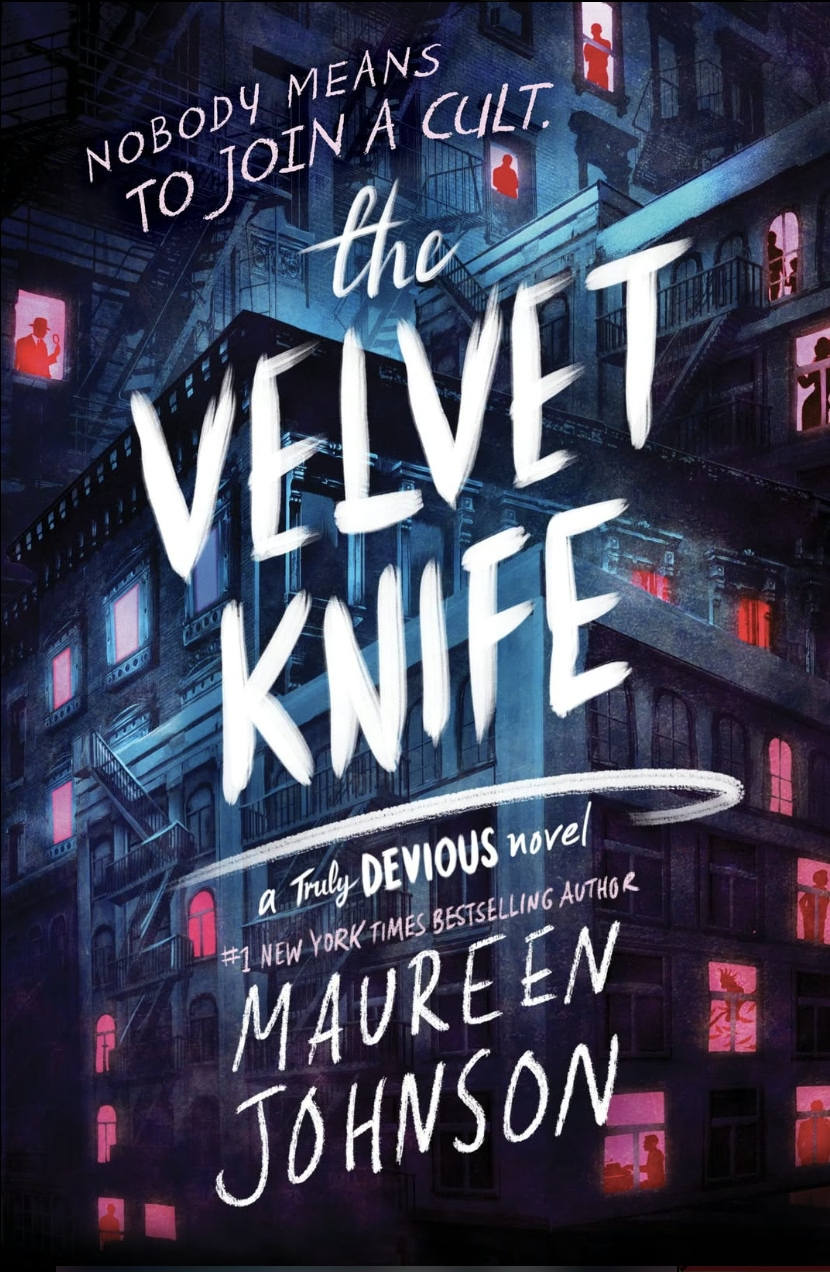
Maureen Johnson's The Velvet Knife is a masterclass in dual-timeline mystery construction that ultimately stumbles under the weight of unresolved romantic drama. This sixth entry in the Truly Devious universe proves Johnson remains one of young adult fiction's sharpest mystery architects—but also reveals the series' most glaring weakness: a love triangle that has completely hijacked the narrative momentum.
Quick Verdict
The Velvet Knife delivers exactly what longtime fans crave: intricate puzzles, clever plotting, and that addictive page-turning quality Johnson has perfected. But it also exposes a fundamental problem plaguing this series: the increasingly distracting personal melodrama surrounding Stevie Bell's romantic life threatens to overshadow the very mysteries that made readers fall in love with her character in the first place. The mystery itself is worth your time. The emotional baggage? Less so.
What's Actually Happening Here
The novel operates on two timelines, a structure Johnson has used to devastating effect throughout the series. In 1976, we meet Blue, an aspiring chef drawn into a dangerous commune led by the charismatic and manipulative Dean—essentially a Manson-era cult lurking inside an abandoned Manhattan house. The group finances themselves through pickpocketing expeditions across New York City, but what begins as bohemian escapism gradually reveals itself as psychological manipulation and control.
In the present day, Stevie travels to Manhattan to escape her complicated feelings about David (more on him later) and stays in an apartment provided by Nate's literary agent. When a body surfaces in the building's vicinity, Stevie finds herself pulled into yet another investigation—one that eventually connects to the decades-old disappearance and the remains discovered near an accident site.
The dual narrative structure works brilliantly. Johnson's ability to weave past and present into a satisfying collision point remains her greatest strength as a mystery writer. The 1976 timeline particularly shines, offering genuine psychological horror as readers watch Blue's gradual realization that her community has become a trap. It's The Secret History meets Helter Skelter, and Johnson handles both the intimacy and the menace with remarkable precision.
Where Johnson's Craft Excels
The mystery plotting here is genuinely impressive. Johnson constructs layered puzzles that reward careful readers without feeling contrived. The dual timelines don't just exist for atmosphere—they're essential to understanding what actually happened, and the reveal carries real weight because Johnson has earned it through meticulous setup.
Character work outside of the romance subplot remains excellent. Janelle continues to be the best friend any fictional detective could ask for: loyal, brilliant, creatively problem-solving, and refreshingly honest about calling Stevie out. Nate's presence feels earned rather than forced, and his supporting role as a fellow creative struggling with writer's block adds genuine texture.
The pacing is relentless. Johnson knows how to structure a mystery to keep readers turning pages. The Velvet Knife review from a pure plot mechanics perspective would score higher than the emotional execution ultimately allows. The investigation itself propels you forward, and the historical mystery involving Blue and Dean's commune is genuinely disturbing in ways that feel appropriate to the subject matter rather than exploitative.
The Problem That Won't Go Away
Here's where The Velvet Knife reveals the series' most persistent flaw: David. The character has become a narrative black hole, consuming emotional real estate that should belong to the actual mysteries. Readers' frustration isn't subtle—it's visceral and universal enough to dominate discussion of this book.
Stevie's romantic uncertainty, while theoretically relatable, has metastasized from character development into genuine plot obstruction. A heartbroken protagonist using murder investigations as emotional avoidance could be compelling material, but Johnson hasn't quite figured out how to balance Stevie's detective brilliance with her romantic confusion without the latter undermining the former.
The David situation in particular reveals a structural problem: Johnson has built romantic tension that she seems unable or unwilling to resolve. Instead, the character remains perpetually in a state of causing drama without facing meaningful consequences. For readers invested in Stevie as a protagonist, watching her emotional energy drain toward this character feels like punishment rather than character development.
This isn't a minor quibble. The reader consensus is clear: people are reading The Velvet Knife for the mysteries, not the romance. When the romance dominates, engagement drops. When the mysteries take center stage, the book soars.
The Comparison That Matters
If you've loved One of Us Is Lying by Karen M. McManus or A Good Girl's Guide to Murder by Holly Jackson, you'll recognize Johnson's approach: intelligent teen protagonists solving complex crimes with genuine stakes. Where Johnson differs is her willingness to layer multiple timelines and her superior character work in the supporting cast.
However, A Good Girl's Guide to Murder maintains tighter focus on its central mystery without the romantic subplot interference. That's not a criticism of Johnson's ambition—it's an observation about execution. Johnson is trying to do more, and sometimes that ambition works against her.
Who Should Actually Read This
Perfect for: Readers who've invested in the Truly Devious series and want to see where Stevie's story leads. Mystery lovers who appreciate dual-timeline narratives and can tolerate romantic subplots as long as the puzzles remain sharp. True crime enthusiasts interested in cult psychology, since the 1976 timeline explores that territory thoughtfully.
Skip it if: You're tired of David as a character (legitimate grievance). You want a pure mystery without emotional baggage. You've bounced off the series before and were hoping this entry would be different. You need a definitive romantic resolution—this isn't that book.
The Actual Writing
Johnson's prose remains accessible without being simplistic. She's mastered the art of making complex investigations comprehensible without dumbing them down. The dialogue crackles, particularly between Stevie and Janelle. The historical sections benefit from period detail that feels researched rather than performative.
What occasionally falters is the tonal balance. The book shifts between genuine menace (the commune sections), cozy mystery elements (Stevie and friends investigating), and teen romance melodrama. These tones don't always integrate smoothly, and the romantic elements often feel like they're operating in a different genre entirely from the mysteries.
The Verdict
The Velvet Knife is worth reading if you're already committed to this series, and genuinely good if you can accept that the mystery is the point and the romance is the price of admission. The 1976 timeline alone justifies picking this up. The present-day investigation satisfies in the way Johnson's mysteries consistently do.
But this Velvet Knife review must acknowledge that the series has reached a point where its romantic entanglements are actively damaging its mysteries. Johnson is too talented to let that continue. The question isn't whether The Velvet Knife is worth reading—it is. The question is whether Johnson will recognize that Stevie's detective work matters infinitely more than her love life, and structure future entries accordingly.
The mystery portion deserves a 9/10. The overall package, hampered by unresolved romantic drama, lands at a solid 7.5/10.