Category:
Book ReviewsThe Spin Review: Disturbing 60s Thriller Worth Your Time
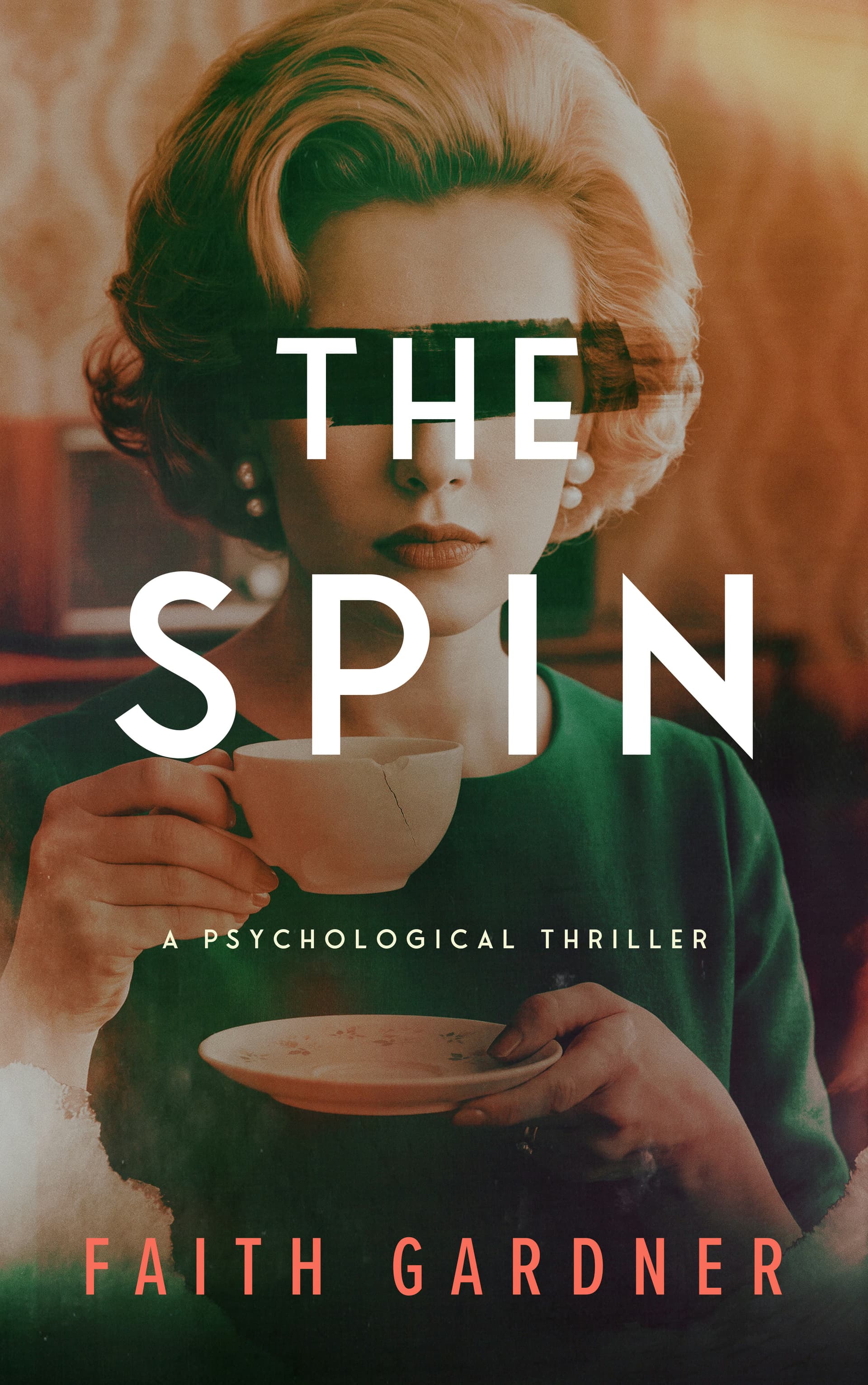
Faith Gardner's The Spin is a psychologically unsettling thriller that masquerades as a domestic mystery but actually interrogates something far darker: the weaponization of psychiatric institutions against women who knew too much. Set against the volatile backdrop of 1960s Los Angeles, this novel refuses to be a simple "is she crazy or isn't she?" narrative—instead, it builds a genuinely disturbing case that the real horror wasn't in Rose Crawford's mind, but in the systems designed to silence her.
This is not a comfortable read, and that's precisely its strength.
What You're Actually Reading
The Spin opens with what appears to be a conventional family drama: Leo Crawford, an ambitious advertising executive, and his wife Rose seem to have it all in 1960s suburban Los Angeles. They're expecting their second child. Leo's climbing the corporate ladder at Century advertising. Their teenage daughter Melinda is navigating adolescence during the Vietnam War era. Then Rose vanishes during a family vacation and returns fundamentally altered.
What begins as a mystery about Rose's mental breakdown becomes something far more sinister—an investigation into the intersection of corporate experimentation, psychiatric abuse, and the systematic erasure of women's autonomy. Gardner layers in historical context about involuntary hospitalizations and unethical consumer research studies conducted in the name of corporate profit, grounding the narrative in real historical horrors.
The narrative doesn't stay locked in Rose's perspective either. Gardner shifts focus between Leo's desperate attempts to understand his wife, Melinda's coming-of-age struggle amid family chaos and the draft, and even Leo's judgmental mother Harriet—whose rigid worldview becomes a mirror for the era's suffocating expectations of women.
Where Gardner's Writing Shines
The atmospheric rendering of 1960s America is genuinely exceptional. Gardner captures not just the aesthetic of the era—the television sets, the advertising culture, the nascent counterculture—but the texture of the period. The tension between the polished, corporate 1950s mentality still clinging to respectability and the emerging chaos of the late 60s creates a perfect pressure cooker for this story.
The pacing is deliberately controlled. Rather than rushing toward revelations, Gardner lets dread accumulate. A color television becomes a trigger. Mentions of "The Dream Box" recur with mounting menace. Leo's investigations into his wife's claims escalate from dismissal to horror as he uncovers connections between his own employer and the psychiatric center holding his wife.
The dialogue feels authentically period without becoming precious or overwrought. Characters speak like people from the 1960s without the dialogue reading like a history lesson. Gardner trusts readers to absorb context through action and environment rather than exposition.
Most impressively, Gardner refuses to make this simple. Rose isn't a passive victim, and Leo isn't a straightforward hero. The moral ambiguity—the ways Leo's complicity in corporate systems endangers his family, the ways Rose's breakdown might be genuine and deliberately induced, the ways institutional power corrupts everyone it touches—creates genuine psychological tension.
The Narrative Complexity (And Where It Fractures)
Here's where The Spin review becomes more complicated: the multiple perspective structure that enriches the historical and thematic elements occasionally dilutes the central mystery's momentum. Some readers will find Harriet's storyline—exploring the suffocation of 1950s domesticity and the generational divide—thematically essential. Others will find her sections a distraction from Rose's institutional nightmare.
The Melinda subplot, exploring a teenager's experience during wartime and the counterculture, is genuinely affecting and historically resonant. But it does compete for attention with the central conspiracy plot. Readers seeking a tightly wound psychological thriller might find themselves wishing Gardner had committed more fully to either the family drama or the corporate conspiracy angle rather than weaving both.
The resolution, while satisfying on a plot level, raises questions about whether Gardner fully explores the implications of what she's uncovered. The novel hints at institutional evil on a broader scale but doesn't always follow those threads to their logical conclusions.
Who This Book Is Perfect For
The Spin will absolutely captivate readers who loved The Woman in Cabin 10 or The Silent Patient but are hungry for something with more historical weight and thematic ambition. If you appreciate psychological thrillers grounded in real historical atrocities—books that use genre conventions to explore institutional power—this is essential reading.
This novel speaks directly to readers interested in feminist history, Cold War-era paranoia, and the ethics of psychiatric medicine. The exploration of how women's credibility is systematically dismantled by institutions of power feels urgently contemporary despite the 1960s setting.
It's also a strong choice for fans of literary historical fiction who want genuine suspense alongside their period details.
Who Might Bounce Off It
If you want a propulsive page-turner with a singular focus, The Spin might frustrate you. The multiple perspectives and thematic complexity require patience. Some readers will find the corporate conspiracy elements underdeveloped compared to the domestic drama.
Readers seeking an unambiguous mental health narrative—something that clearly answers whether Rose is experiencing genuine psychosis or induced trauma—might find the deliberate ambiguity unsatisfying. Gardner doesn't offer easy answers about the nature of reality and institutional gaslighting.
Those looking for a straightforward "woman escapes the asylum" narrative will be disappointed. This is a more complex, morally murky exploration of complicity, power, and the systems that protect themselves.
The Verdict
Faith Gardner's The Spin is a genuinely unsettling psychological thriller that transcends its genre conventions to become something more substantial: a historical investigation into how institutions weaponize medicine against inconvenient women. Yes, The Spin is worth reading—particularly if you value thematic depth and atmospheric tension over relentless pacing.
The novel's real power lies in its refusal to separate Rose's personal nightmare from the broader systems that enable it. Gardner suggests that the true horror isn't individual madness but institutional cruelty dressed up in clinical language.
It's a book that lingers, that makes you reconsider how easily we dismiss women's claims of harm, and that reminds us that some of history's darkest chapters happened in plain sight, justified by the language of science and progress.
Final Score: 8/10 — A thought-provoking psychological thriller with genuine historical depth that occasionally sacrifices momentum for thematic complexity, but ultimately justifies that trade-off with a story that demands to be discussed.