Category:
Book ReviewsThe Power of Geography Review: Ambitious But Uneven
Prices can sometimes be lower on bigger marketplaces, but this link helps independent bookstores and local reading communities.
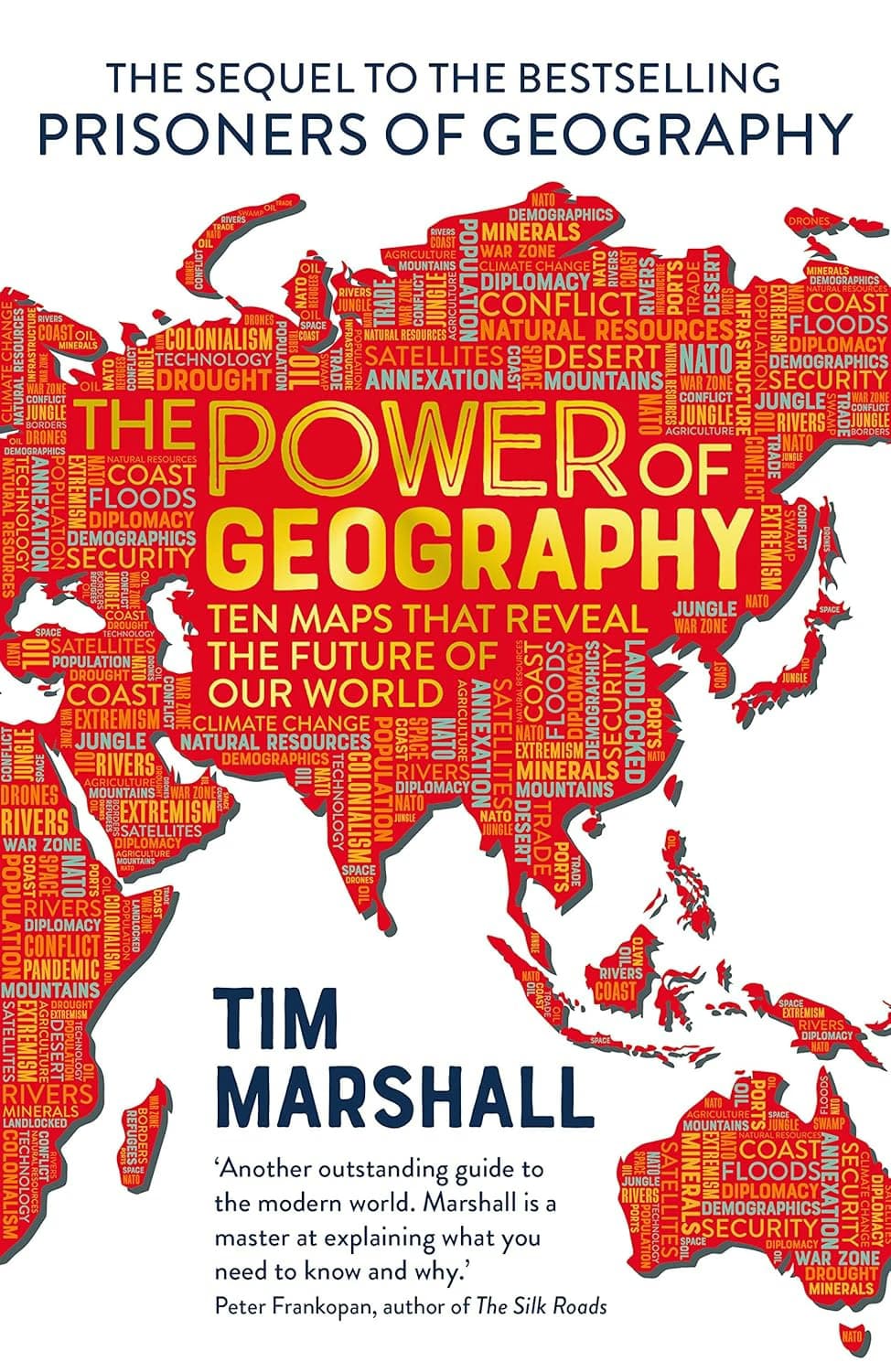
Tim Marshall's The Power of Geography: Ten Maps That Reveal the Future of Our World arrives with considerable expectations. As the sequel to his bestselling Prisoners of Geography, this 2021 non-fiction work promises to decode global politics through the lens of geography—exploring ten regions (Australia, Iran, Saudi Arabia, the UK, Greece, Turkey, the Sahel, Ethiopia, Spain, and space) that Marshall argues will shape humanity's future. The verdict is mixed: it's an intellectually stimulating read that succeeds as popular geopolitics, but it sacrifices depth for breadth and occasionally veers into speculation that outpaces evidence.
What This Book Actually Delivers
Marshall's core thesis remains compelling: geography isn't destiny, but it's a powerful constraint on political possibility. A country's rivers, mountains, climate, and borders don't determine its fate, yet they narrow the menu of realistic choices available to its leaders. This framework transforms abstract geopolitical news into comprehensible patterns.
The book examines why Australia's vast isolation and resource wealth position it as a Pacific power; why Iran's geography makes it a perpetual regional power despite sanctions; why Saudi Arabia must diversify beyond oil to survive; why the Mediterranean remains a flashpoint between NATO and Russian interests; and why the Sahel's climate collapse will trigger migration crises that reshape European politics.
What makes this Power of Geography review worth engaging with is Marshall's willingness to name power asymmetries directly. He doesn't sanitize Western interventions in smaller nations or pretend that geopolitical competition operates on a level playing field. The book acknowledges how larger powers—the US, China, Russia, France, Turkey—routinely manipulate weaker neighbors' internal affairs. This candor distinguishes it from more cautious geopolitical analysis.
The Writing: Accessible But Shallow
Marshall writes for a general audience, and it shows. His prose is clean, often witty, and rarely bogs down in academic jargon. You can read a chapter on Turkey or Ethiopia in one sitting without feeling intellectually exhausted. This accessibility is both strength and weakness.
The strength: complex geopolitical dynamics become genuinely graspable. Why does Greece fear Turkey? Because of maritime boundaries, competing historical claims, and NATO's contradictory commitments. Why is the Sahel destabilizing? Because desertification, population growth, and climate migration are colliding with weak state institutions and foreign military interventions. These aren't new insights, but Marshall presents them clearly.
The weakness: this clarity often comes at the cost of nuance. Each chapter feels like a sophisticated documentary segment—informative but designed for entertainment as much as education. Readers seeking rigorous political economy analysis or deep historical context will find themselves wanting more. Marshall gestures toward complexity but rarely sits with it.
Where the Book Excels
Marshall's chapter on space deserves particular mention. While most geopolitical analysis treats Earth-based competition, he correctly identifies that control of orbital infrastructure—satellites, communications, weapons systems—will define 21st-century power. This forward-thinking angle distinguishes The Power of Geography from more conventional regional analysis.
The interconnectedness argument also resonates. Marshall repeatedly shows how events in one region cascade globally: Sahel instability drives Mediterranean migration, which destabilizes European politics, which weakens NATO, which emboldens Russian and Chinese ambitions. This systems-level thinking is rare in popular geopolitics and genuinely valuable.
The historical grounding is solid. Rather than treating current crises as inevitable, Marshall traces how past decisions—imperial borders, resource extraction, military alliances—created present problems. Understanding why Greece and Turkey dispute maritime boundaries requires knowing Ottoman history, Cold War positioning, and EU expansion logic. He provides this context efficiently.
The Real Limitations
The predictive sections feel vague. Marshall argues that certain regions "will shape" the future, but his specific predictions are often hedged or obvious. Yes, climate migration will pressure Europe. Yes, the Middle East must diversify economically. Yes, great powers will compete for influence. These aren't wrong, but they're not particularly illuminating either.
The Western perspective is also limiting, though Marshall acknowledges it. The book treats non-Western nations primarily through the lens of how they affect Western interests or stability. Ethiopia's internal politics matter partly because of its Nile River significance; Iran's future matters because of oil and regional balance; Saudi Arabia's transformation matters because of energy security. This framing isn't dishonest, but it narrows the aperture considerably.
Some chapters feel rushed. The Spain chapter, for instance, reads like a condensed essay rather than a fully developed argument. Why does Spain matter geopolitically in ways that, say, Portugal doesn't? The book hints at answers but doesn't fully explore them. Similarly, the UK chapter focuses heavily on post-Brexit isolation without deeply examining how Britain might recalibrate its global role.
Who Should Actually Read This
Perfect for: Readers new to geopolitics seeking an accessible entry point; people who enjoyed Prisoners of Geography and want more; professionals in policy, business, or journalism needing quick primers on regional dynamics; anyone frustrated by news coverage that ignores geographic context.
Will disappoint: Academics or specialists seeking original research; readers wanting deep historical analysis; those expecting concrete predictions about specific events; people who prefer books that challenge Western assumptions rather than acknowledge them.
How It Compares
Unlike Prisoners of Geography (which examines broader continental and regional patterns), this sequel zooms into specific countries and their individual futures. Compared to Parag Khanna's Connectography, which emphasizes infrastructure and networks over traditional geography, Marshall's approach is more conservative—he trusts the explanatory power of maps and borders.
The book sits comfortably between popular journalism and academic analysis. It's more rigorous than typical airport-bookstore geopolitics but less demanding than scholarly works on international relations. This positioning is intentional and mostly successful.
Is The Power of Geography Worth Reading?
Yes, with caveats. If you want to understand why certain regions matter and how geography constrains political possibility, this book delivers. It won't make you an expert, but it will make you more informed than most people about global power dynamics. Marshall writes with genuine insight and occasional brilliance, particularly on emerging issues like space competition and climate-driven migration.
The real question is whether you want breadth or depth. The Power of Geography chooses breadth—ten regions in roughly 400 pages means each gets a sophisticated overview rather than exhaustive treatment. That's a legitimate editorial choice, and it works for the intended audience.
The book's greatest strength is showing how geography remains relevant in an age of digital connectivity and global supply chains. Physical location still matters enormously. Rivers still determine power. Borders still constrain choices. In a world obsessed with technology and ideology, this reminder is valuable.
Final Verdict
Marshall succeeds at his stated mission: making geography central to understanding global politics. The writing is engaging, the examples are illuminating, and the framework is useful. However, the book sacrifices depth for accessibility, and its predictive sections feel underdeveloped. It's an excellent primer but not a definitive work.
Read this book if you want to understand the geographic foundations of current geopolitical tensions. Don't read it expecting revolutionary insights or detailed predictions about the future. It's a sophisticated popularization, and that's exactly what it should be—and what it does reasonably well.