Category:
Book ReviewsThe Other Moctezuma Girls Review: A Stunning Historical Epic
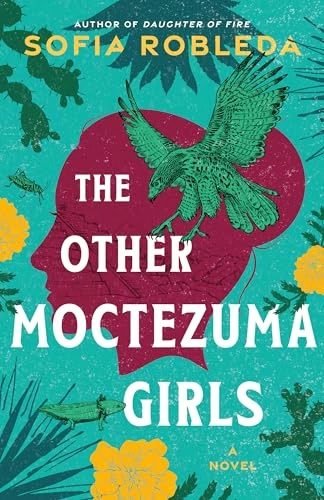
Prices can sometimes be lower on bigger marketplaces, but this link helps independent bookstores and local reading communities.
Sofia Robleda's The Other Moctezuma Girls is a sweeping historical fiction that dares to reclaim the narrative of women erased from history. This novel doesn't just tell a story—it resurrects one, giving voice to Tecuichpoch (the last Aztec empress) and her children in a way that feels both intimate and epic. If you're searching for a The Other Moctezuma Girls review that goes beyond surface-level praise, you'll find that this book succeeds brilliantly at something most historical fiction fails to do: make the personal stakes feel as monumental as the historical ones.
What This Book Actually Does
Set in 1551, thirty years after the Spanish Conquest devastated Tenochtitlan, The Other Moctezuma Girls follows Isabel as she embarks on a quest to uncover her mother's hidden legacy. The empress has left behind cryptic clues embedded in embroidered cushions, and Isabel—headstrong, determined, and caught between two worlds—is obsessed with discovering who her mother really was beneath the title, the trauma, and the forced survival.
The narrative structure is deliberately dual: we follow Isabel's present-day investigation while simultaneously reading her mother's journal entries from the past. This approach could have felt gimmicky in lesser hands, but Robleda uses it to devastating effect. We watch Isabel piece together a life of impossible choices—six marriages (most unconsensual), survival under colonial rule, and the weight of motherhood in a collapsing empire.
The Writing: Lyrical Without Being Precious
Robleda's prose is the backbone of this novel's success. She writes with a restraint that feels almost revolutionary in historical fiction, where flowery language often masquerades as depth. Instead, her descriptions are precise: the smell of cacao, the texture of ancient stone, the particular silence of a woman who has learned not to speak.
The cultural details aren't scattered carelessly—they're woven into the fabric of the narrative like threads in a weaving. You don't feel lectured about Aztec life; you experience it. This is crucial for historical fiction, where info-dumping can kill momentum faster than a conquistador's sword.
What's particularly striking is how Robleda handles emotional devastation. The grief in this novel doesn't announce itself. It accumulates. Characters don't have breakdowns; they have moments of quiet recognition. This restraint makes the emotional payoffs land harder.
Where This Novel Excels
Complex female characters with agency. Isabel, her younger sister Catina (who is deaf), and their mother aren't passive victims waiting to be rescued. They scheme, they resist, they make choices—sometimes terrible ones. Catina's deafness, in particular, is handled with refreshing nuance; she's not defined by her disability but shaped by it in realistic ways.
A love story that doesn't derail the plot. Isabel's romance with Juan, the young cook, could have been the trite subplot that undermines everything. Instead, it functions as another layer of her internal conflict: Can she trust her own desires when her entire world has been built on survival and suspicion?
Thematic depth about erasure. The novel's central question—"men would leave us nameless, if they could"—isn't just a pretty line. It's the engine driving the entire narrative. Robleda explores how women's stories get buried, rewritten, or claimed by others. In a post-conquest world, Isabel's quest to preserve her mother's account becomes an act of resistance.
Atmospheric worldbuilding. From the tunnels of ancient pyramids to the slopes of an active volcano, Robleda makes the landscape feel like a character itself. The journey isn't just a plot device; it's a physical manifestation of Isabel's internal journey.
What Doesn't Quite Land
For all its strengths, The Other Moctezuma Girls has moments where ambition outpaces execution. Some chapters run long, and while the pacing generally holds, there are stretches where the plot feels like it's treading water rather than propelling forward. The mystical elements—legends in the chinampas, supernatural encounters—feel slightly underdeveloped compared to the historical and emotional core. They're intriguing but not fully integrated.
The viceroyal court scenes, which promise intrigue and danger, sometimes feel rushed. Given that this is where Isabel confronts the Spanish power structure directly, these sequences could have carried more weight.
Additionally, some readers may find the dual timeline structure occasionally confusing, particularly when switching between Isabel's voice and her mother's. While this is intentional and thematically purposeful, it requires active engagement from the reader.
Who Should Read This Book
Perfect for: Readers who loved Circe or The Song of Achilles—novels that give voice to women written out of history. Anyone interested in Aztec history, Mexican colonial period, or indigenous perspectives on conquest. Readers seeking emotional depth alongside historical detail. Women, particularly, will find resonance in the exploration of maternal legacy and female resilience.
Might frustrate: Readers seeking fast-paced adventure will find the introspective moments slow. Those uncomfortable with ambiguity about consent and trauma in historical contexts. Readers who prefer straightforward narrative structures over dual timelines.
Historical Context Worth Knowing
Tecuichpoch (also known as Isabel Moctezuma in Spanish records) was a real historical figure, and Robleda's interpretation adds significant nuance to the sparse historical record. The real Tecuichpoch married multiple Spanish conquistadors, survived the conquest, and lived through the early colonial period—but her inner life remains largely mysterious. Robleda's fictional reconstruction feels respectful of this mystery while imagining the emotional and psychological toll such a life would exact.
The novel arrives at a moment when indigenous narratives are finally gaining visibility in mainstream publishing, and this book contributes meaningfully to that conversation.
The Verdict
The Other Moctezuma Girls is worth reading if you want historical fiction that respects your intelligence and emotional investment. Sofia Robleda's novel succeeds because it refuses to simplify its characters or its era. The Spanish Conquest isn't backdrop—it's trauma that reverberates through every page. The women aren't noble sufferers—they're complicated survivors making impossible choices.
This is a book that will stay with you long after you finish, particularly if you're attuned to questions of power, voice, and what gets remembered versus what gets erased.
Final Score: 8.5/10
A beautifully written historical epic that gives voice to the voiceless without sacrificing complexity or emotional authenticity.