Category:
Book ReviewsThe Most Dangerous Games Review: Bold but Uneven
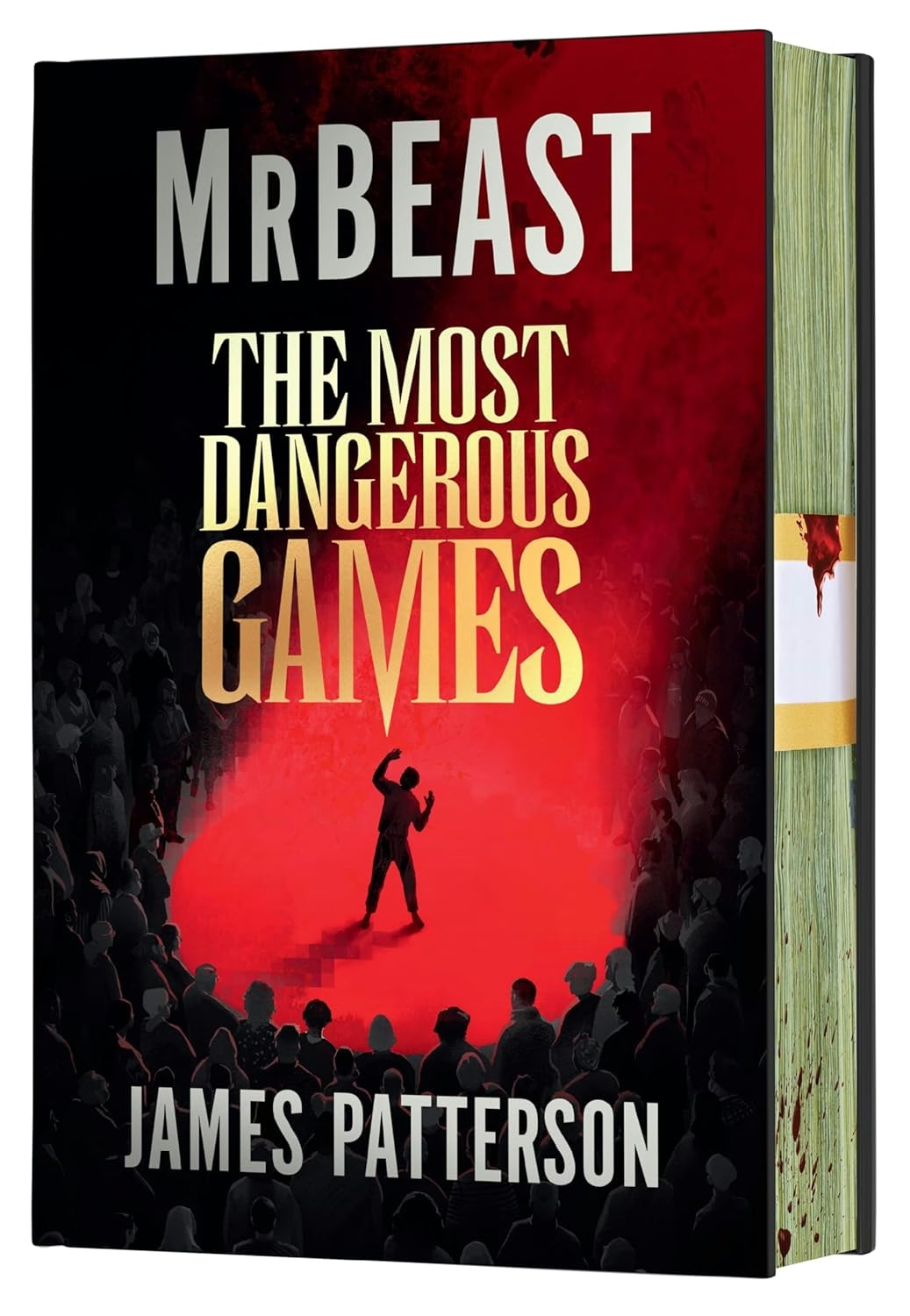
Prices can sometimes be lower on bigger marketplaces, but this link helps independent bookstores and local reading communities.
MrBeast and James Patterson's The Most Dangerous Games is a high-concept thriller that swings for the fences—and lands somewhere between exhilarating and exhausting. This collaboration between the world's biggest content creator and publishing's most prolific author promised something unprecedented: a billion-dollar survival competition filtered through the lens of literary fiction. What it delivers is a genuinely propulsive page-turner that also exposes the limits of spectacle-driven storytelling.
What This Book Actually Is
The Most Dangerous Games isn't a straightforward survival narrative. It's a competition thriller with psychological warfare at its core. One hundred contestants are selected from a thousand applicants to compete in a series of increasingly lethal challenges across the world's most hostile environments—Antarctica's frozen wastelands, shark-infested waters off Chile, scorching deserts, and lightless caves. The prize is a billion dollars. The catch: there's a hidden architect pulling strings, manipulating alliances, and deciding who deserves to survive.
The book positions itself as "Survivor on steroids," and that comparison is more accurate than marketing departments might admit. Like reality television compressed into narrative form, it prioritizes momentum over nuance, focusing reader attention on a handful of contestants while hundreds of others fade into background noise. This isn't a flaw so much as a deliberate structural choice.
The Genuine Strengths
This book is genuinely hard to put down. Once the competition begins—roughly one-third of the way in—the pacing becomes relentless. Patterson's fingerprints are all over the structure: short chapters, cliffhangers at strategic intervals, constant escalation. The environmental hazards are varied enough to maintain visual interest: the specific danger of each location feels distinct, from the disorienting darkness of caves to the psychological terror of open water.
The interpersonal dynamics prove more compelling than the survival elements. When contestants begin forming alliances, the book transforms from a physical challenge into a game of social manipulation. Betrayals land with genuine impact because the author takes time to establish relationships before dismantling them. Readers report becoming emotionally invested in specific characters—particularly a character named Wyatt, who experiences measurable growth across the narrative arc.
The hidden narrator concept, while not entirely original, functions effectively as a narrative engine. Having an unseen presence observing and judging the contestants creates a layer of paranoia that amplifies tension. Readers genuinely want to know who this figure is and what their endgame involves.
Where It Falls Apart
Here's where The Most Dangerous Games review needs to address the elephant in the room: this book reads like it was assembled rather than written. The conceptual ambition doesn't always translate into execution. Some survival scenarios veer into implausibility without earning it through character development or thematic weight. A shark encounter in Chilean waters or a desert sequence might make readers pause and think, "Would this actually happen this way?"
The writing itself is functional but rarely elegant. Sentences are constructed for speed, not beauty. Descriptions of environments tend toward the generic—we know it's cold in Antarctica and hot in the desert because we're told repeatedly, not because the prose makes us feel it. Dialogue occasionally sounds like exposition dressed up in quotation marks, with characters explaining situations to each other that they'd already know.
Most problematically, the book doesn't seem to know what it wants to be thematically. Is this a meditation on human nature under pressure? A commentary on celebrity and spectacle? A straightforward adventure? The narrative never commits to a perspective, which means the ending—when it arrives—feels more like a conclusion to a competition than a resolution to a story. Readers finish knowing who won but not necessarily understanding why that outcome matters beyond the literal billion dollars.
The character development, while stronger than typical thriller fare, remains surface-level. We learn functional details about contestants—their backgrounds, their motivations—but rarely achieve genuine psychological depth. This works fine for a page-turner but limits the book's staying power once you've finished it.
Who Should Actually Read This
This book is perfect for readers who loved The Hunger Games but want something faster-paced and less concerned with political subtext. If you enjoy reality television and want that experience in book form without the time commitment, The Most Dangerous Games delivers exactly that. Fans of James Patterson's existing work will find this familiar—the same structural DNA, the same emphasis on plot over prose.
Young adult readers and mainstream thriller enthusiasts will find this accessible and engaging. People who appreciate high-concept premises and don't mind suspending disbelief will have a good time. If you're reading on a beach or during a commute and want something that demands your attention without demanding intellectual effort, this works.
Do not pick this up if you value literary quality, thematic complexity, or character psychology. If you're tired of formulaic thrillers, this will feel like more of the same, just with bigger stakes. Readers who appreciate prose craftsmanship or nuanced worldbuilding will likely find this shallow. Anyone skeptical of MrBeast's involvement in publishing will have their skepticism confirmed—this reads like a content play first and a novel second.
The Polarization Question
Why does The Most Dangerous Games inspire such wildly different reactions? Because it's fundamentally a book about spectacle, and people have fundamentally different relationships with spectacle. Some readers find the relentless pacing and high stakes exhilarating. Others find it exhausting and hollow. Neither response is wrong—they're just different orientations toward what the book is attempting.
The critical divide isn't about quality in an absolute sense. It's about whether you value entertainment that asks nothing of you versus entertainment that engages your mind. Patterson and MrBeast have created a book that succeeds brilliantly at what it's designed to do: keep pages turning. It just doesn't try to do much beyond that.
Is The Most Dangerous Games Worth Reading?
Yes, with caveats. If you're asking whether this book is "good" in a literary sense, the answer is qualified. If you're asking whether it's worth your time as entertainment, that depends entirely on what you want from reading. The Most Dangerous Games review ultimately comes down to this: it's a competent, engaging thriller that knows exactly what it is and executes that vision effectively. It's not trying to be The Stand or Dune. It's trying to be a billion-dollar competition compressed into narrative form, and it succeeds.
The comparison that matters: think of this as closer to Dan Brown's The Da Vinci Code than to literary thrillers like The Woman in Cabin 10. If that reference point appeals to you, you'll likely enjoy this. If it doesn't, you'll probably feel like you're reading a screenplay that forgot to become a novel.
Final Verdict
7/10 — A slick, propulsive thriller that prioritizes entertainment over artistry and mostly delivers on its promise, though it lacks the depth to linger in your mind after the final page.