Category:
Book ReviewsThe Jackal Review: Myth-Busting Terrorism
Prices can sometimes be lower on bigger marketplaces, but this link helps independent bookstores and local reading communities.
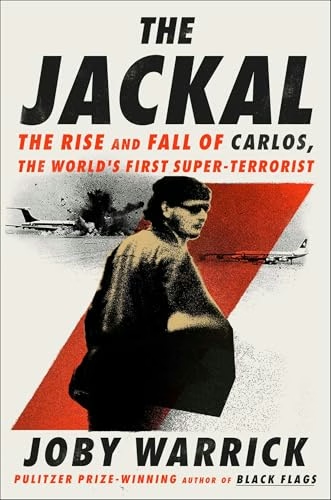
Joby Warrick's The Jackal: The Rise and Fall of Carlos, the World's First Super-Terrorist dismantles a carefully constructed legend with surgical precision. This is not the suave, James Bond-esque hitman you've seen in movies. Instead, Warrick—a Pulitzer Prize–winning journalist—reveals something far more compelling: a deeply flawed, often incompetent terrorist whose myth was infinitely more dangerous than his actual capabilities. The real story is messier, more human, and ultimately more illuminating about how terrorism actually works in the modern world.
Quick Verdict
The Jackal is a masterclass in investigative narrative nonfiction. Warrick separates fact from the carefully constructed fiction that Carlos himself spent decades promoting, delivering a page-turner that reads like a thriller while maintaining rigorous journalistic integrity. If you care about understanding how terrorism emerged as a global phenomenon in the Cold War era, this book is essential reading.
What This Book Actually Covers
The narrative follows Ilich Ramírez Sánchez—Carlos the Jackal—from his ideological awakening in the 1970s through his capture in 1994 and eventual imprisonment in France, where he remains today at 72 years old. Warrick traces his evolution from a committed (if erratic) operative for the Popular Front for the Liberation of Palestine to a gun-for-hire willing to work for anyone with sufficient funds, from Middle Eastern dictatorships to former Nazi networks.
The book's centerpiece is the 1975 Vienna OPEC ministers kidnapping—a operation so audacious it cemented Carlos's reputation as a master terrorist. Yet Warrick's investigation reveals the operation was far messier than legend suggests, with much of its success attributable to luck and the chaos of the moment rather than meticulous planning.
The Central Revelation: Incompetence Masquerading as Genius
Here's what makes this Jackal review so compelling: the book's most shocking argument is that Carlos was genuinely terrible at terrorism. He was impulsive, made catastrophic mistakes, trusted the wrong people, and often succeeded despite himself rather than because of superior intellect. This contradicts decades of mythology surrounding the man.
Yet this revelation paradoxically makes the book more terrifying, not less. It demonstrates that effective terrorism doesn't require genius—just brutality, access to networks, and willingness to act. The myth of the brilliant mastermind is comforting because it implies terrorism is rare and requires exceptional talent. The truth—that Carlos was a self-absorbed, hard-drinking womanizer who murdered associates on whims and still managed to evade capture for nearly two decades—is far more unsettling.
Writing Style: Narrative Nonfiction at Its Best
Warrick's prose never sacrifices clarity for drama. The book moves with genuine momentum despite being over 300 pages, because Warrick maintains relentless focus on Carlos and his immediate circle rather than sprawling into unnecessary geopolitical tangents. Multiple readers noted that the book reads like a 200-page narrative despite its substantial length—a testament to Warrick's editorial discipline.
The author masterfully weaves newly declassified archives, secret witness accounts, and a rare interview with Carlos himself into a coherent narrative. He doesn't shy away from contradictions. When Carlos conveniently "forgets" details of his most infamous killings, Warrick documents this deception rather than smoothing it over.
The geopolitical context—Cold War rivalries between East and West, the fracturing of Arab nationalism, France and Germany's complex relationships with terrorist networks—emerges naturally through character and incident rather than through expository lectures.
What Works: The Ideological Contradiction
The book's most fascinating element is its exploration of Carlos's fundamental hypocrisy. He claimed to be a committed Marxist revolutionary fighting for Palestinian liberation, yet he was a self-absorbed hedonist who used women as tools, murdered friends over personal slights, and ultimately worked for any government or organization willing to pay.
This contradiction reveals something crucial about terrorism in the 1970s and 80s: the gap between revolutionary rhetoric and personal motivation was often enormous. Carlos represents a particular type of terrorist—the ideological mercenary who uses political language to justify what is essentially criminal behavior driven by ego and bloodlust.
Warrick's examination of how Arab nations themselves targeted each other through terrorist proxies is particularly illuminating. The kidnapping of OPEC ministers wasn't primarily an anti-Western operation—it was a complex maneuver within intra-Arab politics, with some Arab states potentially benefiting from the disruption.
What Doesn't Quite Land: Limited Access to Carlos's Inner Life
While Warrick conducted a rare interview with Carlos in his French prison cell, the terrorist remains fundamentally opaque. This is partly intentional—Warrick acknowledges Carlos's compulsive lying—but it means readers never quite penetrate the psychological core of what drove this man beyond obvious narcissism and thrill-seeking.
The book would benefit from deeper psychological analysis. We understand what Carlos did and how he did it, but the why—beyond surface-level Marxist rhetoric and personal pathology—remains somewhat elusive. Warrick hints at Carlos's troubled childhood and his relationship with his father, but doesn't develop these threads into a coherent psychological portrait.
Additionally, some readers may find the book's focus on Carlos himself somewhat narrow. The supporting cast—his various wives, fellow operatives, intelligence officials pursuing him—occasionally fade into the background, which limits our understanding of how terrorist networks actually functioned.
Comparisons to Similar Works
If you've read Warrick's earlier Pulitzer Prize–winning book Black Flags (which examines the rise of ISIS), you'll recognize his approach: rigorous journalism combined with narrative momentum. The Jackal is more tightly focused than Black Flags, following a single protagonist rather than an organization across decades.
Compared to Bruce Hoffman's Inside Terrorism or Jessica Stern's Terror in the Mind of God, Warrick's book is far more narrative-driven and less academic. It's also more accessible than Walter Laqueur's historical surveys of terrorism. If you want biography-as-thriller that maintains journalistic integrity, The Jackal exceeds comparable works in the space.
Who Should Read This Book
Perfect for: Cold War history enthusiasts, terrorism studies students, readers interested in how revolutionary movements actually functioned in the 1970s-80s, anyone fascinated by the gap between myth and reality in historical narratives, and fans of rigorous investigative journalism.
Less ideal for: Readers seeking a sympathetic portrait of Palestinian resistance (this book is critical of Carlos but also documents genuine geopolitical complexities), those who prefer academic analysis over narrative, and anyone uncomfortable with graphic descriptions of violence and murder.
The Verdict: Essential Reading with Real Stakes
The Jackal review reveals a book that works on multiple levels. It's a gripping biography of a notorious figure. It's a rigorous investigation that separates myth from fact. It's a historical document illuminating how terrorism emerged as a global phenomenon. And it's a cautionary tale about how carefully constructed narratives can obscure uncomfortable truths.
Is The Jackal worth reading? Absolutely. Warrick has written a book that will likely become the definitive account of Carlos the Jackal for a generation. It challenges popular conceptions of terrorism and terrorists while remaining utterly readable. The book's greatest strength is demonstrating that the real story—messy, contradictory, driven by ego and circumstance as much as ideology—is far more interesting than any fiction.
Final Score: 9/10 — A masterfully researched and compulsively readable biography that redefines our understanding of modern terrorism's origins.