Category:
BiographyThe House of Hidden Meanings Review: Vulnerable but Paradoxically Guarded
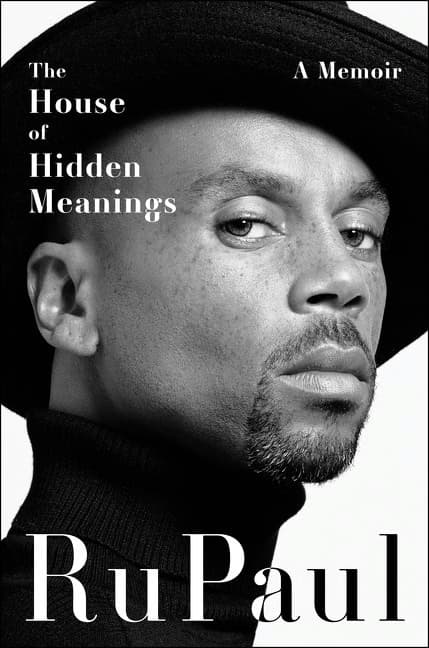
Prices can sometimes be lower on bigger marketplaces, but this link helps independent bookstores and local reading communities.
RuPaul's The House of Hidden Meanings is a memoir that promises to strip away artifice and reveal the man behind the icon. Instead, what emerges is something more complicated and conflicted—a book that oscillates between genuine vulnerability and carefully curated wisdom, leaving readers divided about whether they've truly gotten to know the drag superstar or simply encountered a more polished version of his public persona.
This isn't a typical celebrity tell-all. RuPaul eschews gossip and scandal in favor of excavating his own psychological landscape. The result is a meditation on survival, reinvention, and the price of ambition that feels genuinely important, even when it frustrates readers looking for something rawer.
What This Memoir Actually Delivers
RuPaul's story is undeniably compelling: a queer Black child navigating poverty, parental dysfunction, and the punk and drag scenes of 1980s Atlanta and New York. The memoir doesn't shy away from trauma. His absent father, his mother's volatility, and the economic precarity of his early years form the emotional bedrock of the narrative. These sections—particularly his reflections on his relationship with his now-husband Georges LeBar—contain genuine tenderness and clarity.
Where The House of Hidden Meanings truly excels is in its exploration of reinvention as a survival mechanism. RuPaul demonstrates how he repeatedly transformed himself to adapt to changing circumstances and opportunities. This wasn't frivolous shape-shifting; it was strategic evolution. He saw the potential in drag as a vehicle for fame when others saw only a subcultural dead-end. He recognized that polishing the "supermodel" version of himself would open doors that raw authenticity never could. These insights are valuable precisely because they're honest about ambition's role in his success.
The audiobook format amplifies this strength. RuPaul's distinctive cadence and vocal control bring an intimacy that the written word sometimes struggles to capture. Listening to him narrate his own story creates an immediacy that enhances the memoir's emotional resonance.
The Central Tension: Marketing vs. Memoir
Here's where The House of Hidden Meanings reveals its fundamental contradiction: RuPaul's commitment to being quotable often overwhelms his commitment to being honest. Almost every significant moment gets wrapped in philosophical language, aphorisms, and wordplay that distances the reader from the raw experience itself. It's as though he's constantly narrating his own life rather than simply living it on the page.
This isn't a minor stylistic choice—it's the book's central flaw. When a reader encounters yet another life lesson repackaged as a pithy observation about "hidden meanings" and personal philosophy, the cumulative effect is exhausting rather than enlightening. The memoir reads less like a man excavating his past and more like a man delivering a very long TED talk about his past. There's a difference, and it matters.
Critically, this approach creates distance at precisely the moments where vulnerability would be most powerful. RuPaul tells us about his struggles, but he tells us about them through the lens of what they taught him. We rarely get to sit with his pain unmediated by wisdom. Compare this to memoirs like Born to Run by Bruce Springsteen, which allows readers to inhabit the messiness of experience before extracting meaning, or Crying in H Mart by Michelle Zauner, where the author trusts readers to find their own significance in her story. RuPaul's approach feels safer, more controlled.
What the Memoir Reveals (Perhaps Unintentionally)
One of the most interesting—and potentially damaging—revelations in this memoir is RuPaul's admission that drag, for him, was never about art, community, or cultural defiance. It was a means to an end. Drag was the vehicle; fame was the destination. This honesty is refreshing, but it also complicates RuPaul's cultural position. He's built a global empire on the back of drag culture, yet the memoir suggests he was never truly invested in drag itself as an artistic or political project.
This creates a curious irony: the book inadvertently explains why RuPaul is so rarely in drag anymore. When your relationship to the art form was always transactional, moving beyond it feels natural. Yet this same revelation makes it harder to accept RuPaul's narrative as the "Queen of Drag" or the culture's ultimate authority. The memoir, in its honesty, undermines some of the mythology that surrounds him.
For readers invested in drag as a form of resistance and creative expression, this book may feel like a betrayal. It's less a celebration of drag culture and more a case study in how to weaponize marginality for mainstream success.
The Scope Problem
Multiple readers noted that The House of Hidden Meanings feels incomplete. The memoir covers his early years, his rise to fame, and his relationship with LeBar in detail, but his more recent decades—the Drag Race empire years, his evolution as a producer and cultural force—receive surprisingly little attention. Given that RuPaul has spent the last 15 years building one of the world's largest television franchises, the relative brevity of this section is notable.
It's unclear whether this reflects RuPaul's priorities or whether there are simply untold stories he prefers to keep private. Either way, readers finish this memoir feeling they've only scratched the surface of his full story. For a book that promises to reveal RuPaul "stripped bare," it maintains considerable mystery about his most productive and culturally significant years.
Writing Style: Flowery but Occasionally Authentic
RuPaul's prose tends toward the ornamental. Sentences often prioritize elegance over clarity, and metaphors accumulate in ways that sometimes obscure rather than illuminate. This isn't inherently problematic—many memoirs employ lyrical language—but it does create a barrier between reader and subject. You're constantly aware of the writing as a constructed thing rather than a transparent window into experience.
That said, the memoir isn't uniformly overwrought. In moments discussing his marriage, his recovery journey, and specific childhood memories, RuPaul's voice becomes more direct and less concerned with sounding profound. These passages remind us that a more stripped-down version of this memoir might have been more powerful.
Who Should Read This Book (And Who Shouldn't)
This book is perfect for:
- Readers interested in LGBTQ+ memoir and history, particularly Black queer narratives
- People fascinated by reinvention, ambition, and strategic self-creation
- Anyone seeking inspiration about turning perceived disadvantages into strengths
- Fans of Drag Race who want deeper context about RuPaul's worldview
- Listeners who prefer audiobook memoirs (RuPaul's narration is genuinely excellent)
This book will disappoint:
- Readers expecting celebrity gossip or behind-the-scenes Drag Race drama
- People seeking a raw, unfiltered exploration of trauma and recovery
- Those invested in drag as a political or artistic movement (the memoir's transactional view of drag may feel reductive)
- Readers wanting comprehensive coverage of RuPaul's recent decades
- Anyone allergic to aphoristic wisdom and philosophical reflection
The Verdict
The House of Hidden Meanings review reveals a book caught between competing impulses: the desire to be truly vulnerable and the compulsion to control the narrative through wisdom and wit. RuPaul's story is undeniably important, and moments of genuine connection do break through the carefully constructed prose. His journey from poverty and trauma to global influence is inspiring precisely because he doesn't pretend it was inevitable or easy.
But is The House of Hidden Meanings worth reading? Yes, with caveats. It's worth reading if you understand that you're not getting RuPaul "totally out of drag," as the book claims. You're getting RuPaul in a different kind of drag—the drag of the thoughtful, philosophical elder statesman. That performance is compelling, but it's still a performance.
The memoir succeeds as a meditation on survival and reinvention. It fails as a complete self-portrait. RuPaul remains, even in his most "revealing" work, enigmatic. Perhaps that's the real hidden meaning: some doors stay locked, even when someone claims to be opening them all.
Final Score: 7/10
A thoughtful, occasionally moving memoir that reveals important truths about ambition and survival while simultaneously demonstrating why RuPaul has remained so carefully constructed throughout his career.