Category:
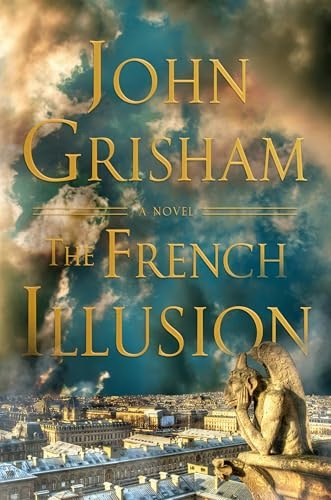
Book ReviewsThe French Illusion Review: Grisham's Espionage Gamble
Prices can sometimes be lower on bigger marketplaces, but this link helps independent bookstores and local reading communities.
John Grisham's The French Illusion represents a bold departure from the legal thriller formula that made him a household name. This kidnapping-turned-international-manhunt is Grisham's most ambitious foray into pure espionage fiction, and it's a book that will either grip you completely or leave you frustrated by its uneven execution. The verdict? It's a thrilling page-turner that stumbles in its final act—but for most readers, the ride is worth the destination.
What It's About
The premise hooks immediately: newlyweds Chelsea and Paul Tanner are kidnapped during their dream honeymoon in Paris. What starts as a straightforward ransom situation spirals into something far more sinister. Paul vanishes into a CIA operation designed to catch a serial kidnapper targeting wealthy families across continents. Chelsea's father, a wealthy orthopedic surgeon, finds himself entangled in a conspiracy that stretches from Paris to Washington, D.C., and beyond. The FBI, CIA, and French Intelligence scramble to coordinate while a young lawyer is recruited as bait in an elaborate trap.
The setup is Bourne Identity meets The Firm—globe-hopping intrigue with genuine emotional stakes tied to a family's desperation.
The Espionage Turn: Why This Matters
Grisham himself has acknowledged that The French Illusion draws inspiration from le Carré, Follett, and Ludlum—masters of international suspense. This isn't a legal thriller wearing espionage clothing; it's a genuine attempt to compete in the spy-fiction arena. That ambition alone is refreshing. For readers tired of courtroom procedurals, this pivot feels like watching a master craftsman try a new medium.
The first 75% of the book delivers exactly what spy-thriller readers crave: compartmentalized operations, false identities, international coordination, and the constant threat that something could go catastrophically wrong. Grisham understands how to build tension through procedural detail—the same skill that made his legal thrillers compelling translates surprisingly well to espionage.
What Works Brilliantly
The pacing is relentless. The French Illusion review sites consistently praise how quickly the story accelerates. Within pages, your comfort evaporates. Chelsea's social media silence becomes genuinely unsettling—a modern detail that grounds the horror in contemporary reality. The ransom negotiations create real moral complexity: Do you pay millions knowing it funds a criminal enterprise? Do you let your child die to stop the cycle?
The emotional core is genuine. The Clayburn and Tanner families aren't cardboard cutouts. Their willingness to sacrifice everything, their conflicting instincts about whether to trust authorities, their desperation—these feel earned. Grisham has always excelled at family dynamics, and this book leverages that strength.
The procedural details create authenticity. CIA operations, international law enforcement coordination, ransom payment logistics—Grisham researches thoroughly, and it shows. You believe the mechanisms of the hunt because the mechanics are credible.
The cat-and-mouse dynamic sustains tension. There's a why-dunnit quality that keeps you guessing about motivations and connections. Why these families? Why this pattern? The investigation unfolds methodically, and you're genuinely uncertain where it leads.
Where It Stumbles
Here's where The French Illusion by John Grisham reveals its limitations: the final quarter collapses under its own ambition.
Readers consistently report the same complaint—the ending feels rushed and anticlimactic. After 300+ pages of meticulous tension-building, the resolution arrives abruptly, as though Grisham lost interest in his own plot. The climax lacks the explosive catharsis you've been promised. Instead of a satisfying confrontation, you get exposition and explanation. It's the literary equivalent of a thriller that pumps the brakes hard at the finish line.
The writing itself is workmanlike. Grisham's prose isn't elegant or particularly stylish. It's functional—designed to move the plot forward without distraction. Some readers find this clarity appealing; others find it flat. Compared to le Carré's psychological depth or Follett's rich historical texture, Grisham's prose feels thin in places. He compensates with plot momentum, which works until the momentum stops.
The ending raises questions instead of answering them. A The French Illusion review that's honest must acknowledge that the resolution feels incomplete. Character arcs don't fully resolve. Emotional payoffs feel undercooked. You finish wondering if Grisham knew how to stick the landing or simply ran out of energy.
Who Should Read This
Perfect for: Readers who loved The Bourne Identity, The Firm, or le Carré's The Spy Who Came in from the Cold. If you want a thriller that moves fast and doesn't linger on introspection, this delivers. Fans of international crime procedurals and readers who enjoy globe-hopping plots will find plenty to enjoy. Audiobook listeners especially—the pacing works beautifully in audio format.
Skip it if: You need literary sophistication or complex characterization. If you demand satisfying endings that feel earned rather than rushed, you'll be frustrated. Readers who loved Grisham's legal thrillers specifically might find this a disappointing departure. If you want a complete, coherent spy novel rather than a thriller with espionage elements, le Carré or Deighton are better choices.
The Verdict on This Grisham Departure
The French Illusion is a fascinating experiment that mostly works. Grisham proves he can write effective espionage fiction—at least for 300 pages. The problem is that final 100 pages, which feel like they were written under deadline pressure. It's a book that gets you hooked completely, then lets you down gently rather than delivering the knockout you expected.
Is The French Illusion worth reading? Yes, if you enter with moderate expectations. It's a genuinely entertaining thriller that will keep you reading late into the night. But it's not a masterpiece, and it's not Grisham at his best. It's a talented author experimenting with new territory and succeeding about 80% of the way there.
The real question isn't whether this book is good—it's whether a thrilling but flawed ride justifies your time. For most readers seeking a fast-paced escape, the answer is yes. For critics demanding excellence, it falls short.
Final Score: 7/10
A compelling thriller that grips you completely before stumbling at the finish line—entertaining enough to finish in a day, but not quite excellent enough to stay with you afterward.