Category:
Book ReviewsThe French Illusion Review: Grisham's Espionage Gamble
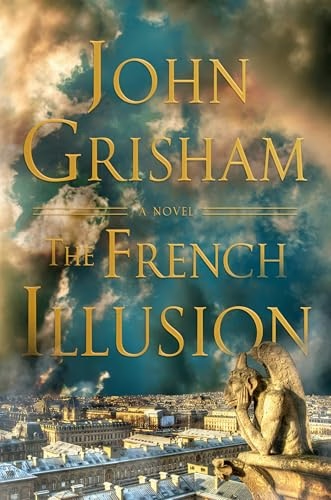
Prices can sometimes be lower on bigger marketplaces, but this link helps independent bookstores and local reading communities.
Quick Verdict
The French Illusion by John Grisham marks a deliberate departure from his courtroom comfort zone into international espionage territory—and it mostly works, though not without stumbling. This is Grisham attempting to channel le Carré and Ludlum, trading legal briefs for CIA operations and Parisian kidnappings. The result is a propulsive, anxiety-inducing thriller that grabs you by the throat for 75% of the journey, then inexplicably releases its grip just when you need it most.
What It's About
Chelsea and Paul Tanner's fairy-tale wedding and romantic Paris honeymoon transform into a parent's worst nightmare when they're abducted during a countryside excursion. What initially appears to be a straightforward international extortion scheme—pay millions, get your children back—rapidly spirals into something far more sinister. The FBI, CIA, and French Intelligence converge on the case, uncovering a pattern of kidnappings that suggests organized criminal networks operating across borders with unsettling precision.
The investigation fractures along familiar fault lines: the Clayburns possess substantial wealth and can mobilize resources quickly, while the Tanners face financial devastation to save their son. As negotiations deteriorate and the true scope of the conspiracy emerges, a young lawyer becomes unwitting bait in an elaborate CIA operation. The plot stretches across continents, weaving together political intrigue, clandestine activities, and the kind of shadowy operations that governments prefer to deny.
The Espionage Pivot
Grisham himself has acknowledged that The French Illusion represents his most deliberate foray into espionage fiction, drawing inspiration from masters like Ken Follett, John le Carré, Robert Ludlum, and Len Deighton. This isn't accidental genre-hopping—it's a calculated authorial choice to explore how the same narrative architecture that powers legal thrillers (high stakes, hidden motives, intricate conspiracies, morally compromised characters) can fuel international suspense fiction.
That ambition is evident throughout. The novel doesn't merely transplant courtroom tension to foreign intelligence agencies; it grapples with the friction between American and French authorities, the opacity of classified operations, and the way governments weaponize information. These are le Carré concerns, and Grisham pursues them with genuine interest.
What Works: The Relentless Opening
The first 75% of this novel operates like a precisely calibrated anxiety machine. Grisham launches the story at full throttle—the wedding celebration, the honeymoon documentation on social media, then the abrupt silence. That silence is devastating. The shift from romantic anticipation to parental terror happens with brutal efficiency, and the author refuses to let readers decompress.
The kidnapping itself is shockingly brutal rather than sensationalized. Grisham understands that the most effective thriller moments aren't the ones with the loudest explosions—they're the ones where normal life suddenly becomes nightmare. Chelsea's enthusiastic social media updates create an especially cruel irony: her digital footprint, meant to document joy, becomes evidence in an extortion case.
The dual-ransom structure adds genuine complexity. The Clayburns and Tanners receive separate demands for separate amounts, creating a scenario where the families' financial disparities become a source of tension rather than simple resolution. This is smart plotting that acknowledges how wealth doesn't guarantee security—it complicates it.
The investigation itself maintains momentum through bureaucratic collision. The FBI's domestic mandate clashes with the CIA's international operations, while French Intelligence pursues its own agenda. These institutional tensions feel authentic rather than contrived, and they prevent the narrative from settling into predictable patterns.
The Writing Question
Readers consistently note that Grisham's prose isn't great—and they're right. His sentences are functional rather than elegant, his descriptions efficient rather than evocative. But here's the crucial distinction: functional prose in a thriller is a feature, not a bug. Grisham's style creates propulsive momentum. Readers don't pause to admire his vocabulary; they turn pages compulsively.
Compare this approach to Stephen King's maximalist descriptiveness or le Carré's philosophical digressions. Grisham's minimalism serves his particular brand of suspense. The writing gets out of the way and lets plot momentum dominate. For readers seeking linguistic beauty, this will disappoint. For readers seeking narrative adrenaline, it's precisely calibrated.
Where It Stumbles: The Truncated Ending
Here's where The French Illusion review becomes complicated. Multiple readers identify the same problem: the final 25% loses narrative urgency. The ending doesn't crash spectacularly—it deflates. After building tension across continents and through multiple jurisdictional complications, the resolution arrives rushed, underdeveloped, and somehow anticlimactic.
This isn't a matter of differing taste. Readers who loved the opening 75% specifically cite disappointment with how the conclusion handles its accumulated plot threads. The ending feels less like a climax and more like an exit strategy—as though Grisham himself grew impatient with the material.
The unsurprising resolution particularly stings after the novel's earlier commitment to complexity. The conspiracy's true nature, once revealed, doesn't justify the elaborate setup. It's the literary equivalent of discovering that an intricate puzzle box contains something mundane.
Who Should Read This
Perfect for: Readers who devoured Ludlum's Bourne series, fans of international espionage fiction, Grisham loyalists willing to follow him into new territory, anyone seeking a one-day thriller that prioritizes plot momentum over literary ambition, readers who value pulse-racing narrative tension over character development.
Will Likely Disappoint: Literary fiction readers seeking sophisticated prose, le Carré devotees expecting philosophical depth, readers who demand satisfying resolutions to carefully constructed mysteries, anyone fatigued by high-concept thriller premises, readers who prioritize character interiority over plot mechanics.
The Verdict on Grisham's Genre Expansion
Is The French Illusion worth reading? Yes—with the caveat that you're purchasing a specific experience: breathless momentum and international intrigue, not literary innovation or surprising denouement. Grisham has written a competent espionage thriller that proves he understands the genre's mechanics, even if he doesn't quite master its depths.
The novel's 4.25/5 average rating reflects this divided response. Readers who surrender to the propulsive narrative give it five stars. Those who reach the ending expecting payoff proportional to the buildup drop to four stars or lower. This isn't a book that inspires ambivalent middle-ground reactions—it either delivers the specific thrills you're seeking or it doesn't.
Compared to Ludlum's The Bourne Identity, The French Illusion is less innovative but more grounded. Compared to le Carré's The Spy Who Came in from the Cold, it's more plot-driven but less philosophically ambitious. It occupies a middle space in the espionage thriller spectrum—accessible, engaging, but not pushing genre boundaries.
Final Verdict
7.5/10 — A propulsive thriller that maximizes tension through 75% of its length, then inexplicably abandons its own narrative promise in a rushed, underdeveloped conclusion that feels less like climax than escape route.
Grisham proves he can operate effectively outside the courtroom, but The French Illusion ultimately demonstrates why he built his empire there. His legal thrillers benefit from inherent procedural structure that espionage fiction requires him to construct from scratch. He gets most of the way there, then loses conviction precisely when readers need him most. It's a worthwhile read for genre enthusiasts, but not a landmark achievement in Grisham's catalog.