Category:
Book ReviewsThe Forgotten Midwife Review: Heartbreaking Historical Fiction
Prices can sometimes be lower on bigger marketplaces, but this link helps independent bookstores and local reading communities.
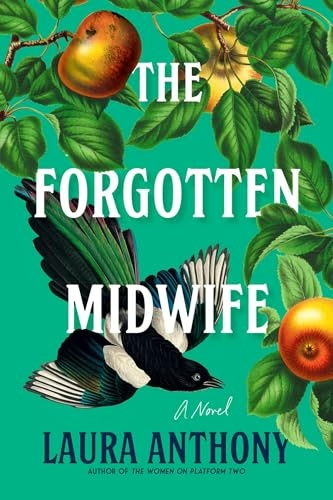
Laura Anthony's The Forgotten Midwife is a dual-timeline historical fiction novel that demands to be read, even though it will leave you emotionally devastated. This 2024 release tackles Ireland's dark history of "mother and baby homes" through two interconnected narratives: a modern-day woman uncovering her family's secrets and a 1950s nun-turned-midwife risking everything to protect vulnerable girls. The book has struck a chord with readers—averaging 4.44 out of 5 stars across over 10,000 ratings—but it's not without its complications.
The Core Story: Two Timelines, One Heartbreak
The narrative structure is elegant in its simplicity. In 2023, Riley Carmichael is preparing for her wedding when her grandmother Betty, slipping into dementia, presses a worn birth certificate into her hands—proof of a baby born in 1950s Ireland that Riley never knew existed. This mysterious document becomes Riley's obsession, propelling her to Ireland to uncover the truth.
The second timeline transports us to 1954 Tipperary, where Margaret Lannigan's life takes a devastating turn. When her older sister dies of diphtheria, Margaret is forced to honor a family obligation that has spanned generations: the eldest Lannigan daughter must become a nun. Stripped of her dreams of marrying Joseph, the man she loves, Margaret is sent to a Home for Fallen Girls—a Catholic institution designed to warehouse pregnant women deemed "disgraced" by society.
What unfolds is Margaret's quiet rebellion. Despite having no midwifery training, she becomes these women's fiercest advocate, protecting them from a cruel matron and complicit clergy while navigating a system designed to erase both the mothers and their babies.
What Makes This The Forgotten Midwife Review Worth Your Time
Anthony's decision to center the perspective of women within the system—rather than just the victims of it—is what separates this book from similar historical fiction exploring Ireland's institutional abuse. We've seen countless narratives about unwed mothers in these homes, but fewer that grapple with the complicated agency of the women forced to staff them.
Margaret is not a simple hero. She's trapped by the same rigid religious structures that oppress the girls she's trying to save. This moral ambiguity makes her arc infinitely more compelling than a straightforward savior narrative. She defies the system where she can, comforts where she's allowed, and carries the weight of her limitations throughout.
The research is meticulous. Anthony grounds her fiction in documented historical fact—these homes genuinely existed, the practices described genuinely occurred, and the systematic adoption schemes that separated mothers from babies were real government-sanctioned operations. The book never lets you forget that this isn't distant history; it's recent enough that survivors are still alive.
The Dual Timeline Device: Masterful or Manipulative?
The parallel narratives create a satisfying architecture where past and present gradually converge, but the pacing between timelines is uneven. The 1954 sections grip you immediately—the stakes are visceral, the injustice tangible. The 2023 timeline, by contrast, sometimes feels like a vehicle to deliver answers rather than a narrative with its own momentum.
Riley's emotional arc—grieving her grandmother while discovering her heritage—should carry equal weight, but it often plays second fiddle. Readers report feeling that the modern-day investigation becomes almost perfunctory once the historical mystery begins unraveling. The emotional payoff works, but it requires patience through some slower passages.
Writing Style: Personal and Propulsive
Anthony's prose is deliberately intimate, favoring emotional resonance over literary flourish. Sentences are direct and often short, creating a rhythm that mirrors the urgency of Margaret's situation and Riley's search. There's no purple prose here—the horror of the institutional setting doesn't need embellishment.
The dialogue feels authentic to both time periods, and Anthony resists the temptation to make her 1950s characters sound like museum pieces. Margaret speaks like a real person of her era, not a historical costume.
What Doesn't Quite Land
The book's greatest weakness is its treatment of male characters. Joseph, Margaret's lost love, exists primarily as absence and longing. The male authority figures—the priest, the matron's male counterparts—are deliberately one-dimensional, representing institutional power rather than complex individuals. This serves the thematic purpose, but it occasionally feels like a limitation rather than a choice.
Additionally, some readers will find the ending too neat. Without spoiling specifics, the resolution ties threads together in ways that feel satisfying emotionally but slightly convenient narratively. Historical fiction set in real trauma sometimes struggles with the tension between hope and accuracy—this book leans toward hope.
Who Should Read This (and Who Shouldn't)
Perfect for: Fans of historical fiction with feminist undertones (The Nightingale, The Book of Lost Names), readers interested in Irish history and Catholic institutional abuse, anyone drawn to stories about women finding agency within oppressive systems, book club readers who want something emotionally substantial to discuss.
Potentially frustrating for: Readers seeking complex male characters or balanced gender representation, those who prefer plot-driven narratives over character studies, anyone fatigued by the "institutional abuse" historical fiction subgenre (which has exploded in recent years), readers who dislike dual-timeline structures where one timeline feels secondary.
The Historical Context You Should Know
Ireland's "mother and baby homes," run primarily by the Catholic Church, operated from the 1920s through the 1990s. An estimated 9,000 babies died in these institutions due to neglect and poor conditions. Thousands more were illegally adopted, often to American families. A 2021 government commission confirmed systematic abuse and cover-up. This isn't distant history—it's a recent scandal that Ireland is still reckoning with. Anthony's novel contributes meaningfully to public memory of these institutions.
Is The Forgotten Midwife Worth Reading?
Yes, absolutely—with the caveat that you're signing up for an emotionally taxing experience. This isn't light reading. It's a book that will anger you, break your heart, and possibly make you reconsider what you thought you knew about institutional religion and women's history. The writing is assured, the research is solid, and the moral questions it raises linger long after the final page.
If you're comparing this to similar titles: it's less sweeping than The Nightingale but more intimate, less historically sprawling than The Book of Lost Names but more focused on institutional critique. It occupies its own space effectively.
Final Verdict
8/10 — A powerful, well-researched exploration of institutional cruelty and female resilience that occasionally prioritizes emotional catharsis over narrative complexity, but earns its emotional weight through authentic characters and meticulous historical grounding.