Category:
Book ReviewsThe Finest Hotel in Kabul Review: Intimate But Incomplete
Prices can sometimes be lower on bigger marketplaces, but this link helps independent bookstores and local reading communities.
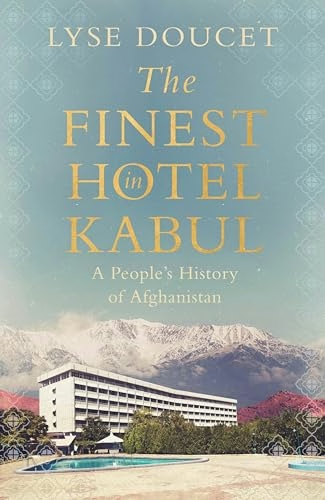
Lyse Doucet's The Finest Hotel in Kabul: A People's History of Afghanistan is a deceptively intimate book that trades sweeping historical narrative for personal testimony. The BBC's Chief International Correspondent uses the Inter-Continental Hotel as a narrative anchor to tell Afghanistan's story through the voices of hotel staff who've witnessed five decades of upheaval. It's a compelling premise executed with genuine compassion—but it's also a book that reveals the limitations of personal storytelling when confronting complex geopolitical history.
What This Book Actually Is
This isn't a conventional history. Doucet doesn't attempt to explain Afghanistan's tribal complexities, its succession of regimes, or the ideological forces that have shaped the nation. Instead, she offers something more modest: intimate portraits of individuals—Hazrat the aging housekeeper, Abida the pioneering female chef, Malalai and Sadeq, young professionals caught between hope and despair. Their stories are woven together through the hotel's physical transformation, from gleaming symbol of modernity in 1969 to battle-scarred survivor of the Taliban's return in 2021.
The Inter-Continental becomes a metaphor for Afghanistan itself—resilient, battered, perpetually caught between aspiration and collapse. This approach works beautifully in moments. When Doucet describes Hazrat's heartbreak at redundancy after fifty years of service, or Abida's quiet determination to maintain her culinary traditions through periods of enforced invisibility, the book achieves genuine emotional resonance.
Where the Writing Shines
Doucet's prose is accessible without being simplistic. She resists the urge to perform expertise, instead positioning herself as a witness alongside her readers. This humility is refreshing in a genre often dominated by Western journalists claiming to decode entire nations. Her interviews feel authentic, and she allows her subjects' voices to dominate rather than filtering everything through authorial interpretation.
The book's structure—moving chronologically through the hotel's decades—provides natural narrative momentum. You're propelled forward by curiosity about how each character navigates the next upheaval. The sensory details matter too: descriptions of the hotel's architecture, the food served in its restaurants, the changing fashions visible in its lobbies all ground abstract history in lived experience.
The Critical Problem: Nostalgia Without Context
Here's where The Finest Hotel in Kabul reveals its fundamental limitation. The book risks becoming a Western reader's nostalgic fantasy about pre-Taliban Afghanistan—a kind of literary equivalent of mourning the Winter Palace before the revolution. The subtitle promises "A People's History of Afghanistan," but whose people exactly? The book centers urban, hotel-adjacent Afghans, primarily from Kabul's educated middle class. It doesn't meaningfully engage with rural Afghanistan, tribal power structures, or the vast majority of Afghans who never set foot in the Inter-Continental.
More problematically, Doucet reports significant historical events without explaining their import. She mentions the Taliban's destruction of the Buddhas of Bamiyan almost in passing, as if readers will automatically understand the cultural and political significance. She documents King Zahir Shah's modernization attempts without exploring how they echoed earlier reforms by King Amanullah Khan—a crucial parallel that would illuminate why modernization has repeatedly triggered backlash in Afghanistan.
The book's treatment of Afghanistan's complexity feels surface-level. Why did the Soviet withdrawal lead to civil war? What were the competing interests among Afghan factions? How did Cold War proxy politics shape the country's trajectory? These questions remain largely unexamined. Readers seeking to understand Afghanistan's political economy or ethnic tensions will find themselves frustrated.
Comparison to Similar Works
To understand what The Finest Hotel in Kabul achieves and what it lacks, consider Wilfred Thesiger's The Marsh Arabs or Robert Byron's The Road to Oxiana. Both are travel narratives that have endured for decades because they combine personal observation with genuine attempt to understand local complexity. They don't pretend to comprehensiveness, but they dig deeper into cultural logic and historical causation than Doucet manages here.
Christina Lamb's Farewell Kabul offers a more instructive comparison—another journalist's account of Afghanistan, but one that weaves personal narrative with clearer political analysis. Lamb doesn't shy away from explaining the Taliban's ideology, the role of Pakistan's intelligence services, or the contradictions embedded in Western intervention. Doucet's book reads lighter and more human-scaled, but that lightness comes at the cost of understanding.
What Works Brilliantly
Despite these limitations, the book excels at what it actually attempts: making Afghanistan's recent history emotionally comprehensible through individual lives. Hazrat's story is genuinely moving—a man whose entire identity was built on Inter-Continental service, suddenly obsolete. Abida's quiet resistance to Taliban restrictions on women's work carries profound weight. Malalai and Sadeq's cautious optimism during the democratic interlude, followed by their devastation at the Taliban's return in 2021, captures something true about Afghanistan's recent tragedy.
Doucet's decision to decentre herself as narrator is admirable. She resists the Western journalist's typical pose of expert interpreter. Instead, she's present but secondary—a witness taking notes rather than someone claiming to explain Afghanistan to Western audiences. This restraint is rare and valuable.
The book also succeeds as a corrective to purely geopolitical accounts of Afghanistan. History isn't just about regimes and invasions; it's lived through by individuals trying to maintain dignity, pursue livelihoods, and preserve cultural traditions. Doucet captures that dimension effectively.
Who Should Read This (and Who Shouldn't)
Read this if: You want an emotionally accessible entry point to recent Afghan history. You're interested in how ordinary people navigate extraordinary circumstances. You appreciate literary nonfiction that prioritizes human connection over analytical comprehensiveness. You've followed Afghanistan reporting and want something that puts faces and voices to the headlines.
Skip this if: You're seeking serious historical analysis of Afghanistan's political economy, tribal structures, or geopolitical dimensions. You want to understand why Afghanistan has experienced repeated upheaval, not just how individuals experienced it. You find nostalgia for pre-Taliban Afghanistan politically problematic without deeper contextualization. You've already read more comprehensive histories and want something that builds on that foundation.
The Verdict
The Finest Hotel in Kabul review reveals a book caught between genres—neither fully a people's history nor a conventional travel narrative. It's genuinely moving and accessibly written, but it substitutes emotional resonance for political understanding. The personal stories matter and deserve to be told, but they're presented without sufficient context about the forces that shaped Afghanistan's trajectory.
Is The Finest Hotel in Kabul worth reading? Yes, if you approach it as intimate portraiture rather than comprehensive history. It's a book that makes you care about specific Afghans navigating impossible circumstances. That's valuable. But don't expect it to explain Afghanistan's complexity or provide the analytical depth that serious understanding requires. Think of it as a necessary complement to more rigorous histories, not a substitute for them.
The book's greatest strength—its focus on individual resilience and dignity—is also its limitation. Afghanistan's story is both deeply personal and structurally political. Doucet captures one dimension brilliantly while leaving the other largely unexplored.
Final Score
7/10 — Compassionate and moving personal narratives undermined by insufficient historical context and analytical depth.