Category:
Book ReviewsThe Dying Light Review: Cleeves Delivers Tense Mystery
Prices can sometimes be lower on bigger marketplaces, but this link helps independent bookstores and local reading communities.
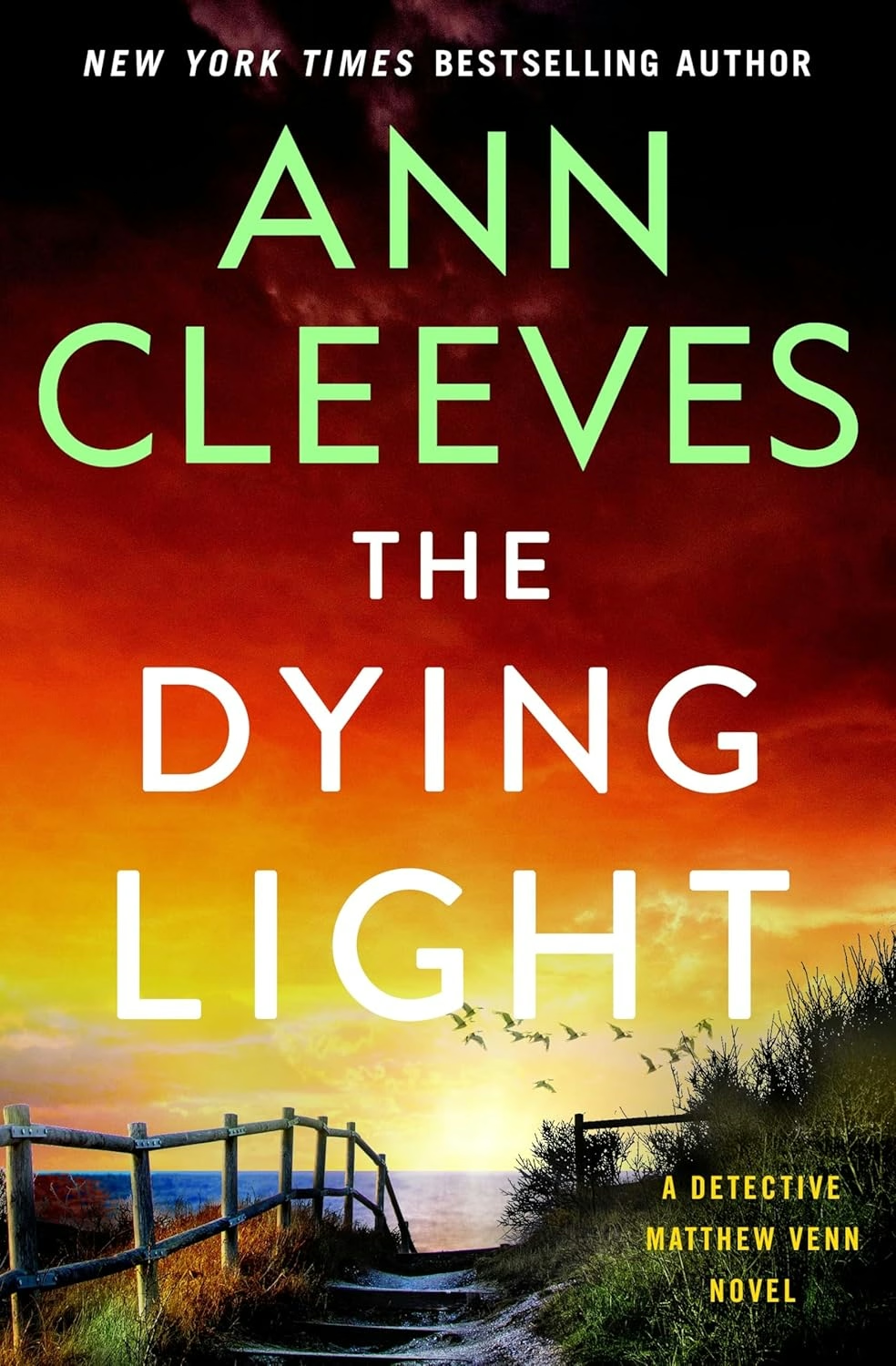
Ann Cleeves's The Dying Light is a masterclass in claustrophobic tension that proves the author has lost none of her investigative prowess. This fourth installment in the Two Rivers series featuring Detective Inspector Matthew Venn is a scorching summer mystery that peels back layers of secrets with surgical precision, though it occasionally stumbles under the weight of its own ambitions.
The setup is deceptively simple: a teenager named Lottie is found dead in a luxury holiday home's swimming pool, and her best friend Hannah vanishes without a trace. What unfolds is far more complex—a web of class tensions, political intrigue, and family secrets that transforms what could have been a straightforward whodunit into something far more unsettling.
What It's About
The Dying Light opens during a brutal Devon heatwave, immediately establishing an atmosphere of discomfort and unease. Lottie and Hannah had arrived at the Armstrong family's holiday home to celebrate the end of their school exams, but their stay becomes marked by social disruption. Lottie, brash and provocative, posts incendiary videos mocking the local folk music festival and the "parochial" community around them—a decision that proves catastrophic.
Hannah's father is Paul Armstrong, a rising political star whose prominence transforms the investigation into a media circus. Detective Venn must navigate not just the mystery of Lottie's death and Hannah's disappearance, but also the complex dynamics of a community fractured between old money locals and wealthy newcomers buying up properties as vacation homes. The tension isn't merely about solving a crime; it's about understanding the silent resentments that simmer beneath the surface of rural England.
Cleeves introduces a secondary plot involving Venn's husband Jonathan, who is searching for his birth mother while Venn struggles to balance his professional obligations with personal support. This subplot adds emotional texture to the procedural, grounding the investigation in Venn's own vulnerabilities.
Writing & Style: Atmospheric and Layered
Cleeves's prose in The Dying Light review reveals a writer who understands that mystery fiction thrives on atmosphere as much as plot mechanics. The Devon setting becomes almost a character itself—the oppressive heat, the clash between old and new money, the tight-knit community dynamics all contribute to a sense of impending doom.
The narrative structure mirrors Venn's investigative process, with information revealed gradually and strategically. Readers discover clues alongside the detective team, creating genuine investment in the outcome. The author's trademark technique of showing multiple perspectives—not just Venn's investigation but also the lives of his team members like DS Jen Rafferty and DC Ross May—provides breathing room in what could otherwise feel relentlessly intense.
One notable strength is how Cleeves handles British vernacular and cultural specificity. References to "toast soldiers," "hosepipes," and the Barum Brethren (the religious sect from Venn's past) feel organic rather than decorative, adding authenticity without alienating international readers.
What Works: Character Development and Procedural Excellence
The real triumph of The Dying Light lies in character progression. Readers returning to the Two Rivers series will notice subtle but significant evolution in Venn's team. DC Ross May has shed his earlier arrogance and developed into a genuinely likeable investigator. DS Rafferty juggles motherhood with professional demands in ways that feel lived-in rather than performative. These aren't just supporting players; they're fully realized individuals whose personal struggles intersect with the case in meaningful ways.
Venn himself remains the series' anchor—a character shaped by his traumatic expulsion from the Barum Brethren, whose strict morality still haunts him despite his rejection of faith. His queerness and marriage to Jonathan add emotional complexity often missing from procedural fiction. This isn't representation as checkbox; it's integral to understanding his character.
The mystery itself unfolds with genuine sophistication. The possibility that Lottie's death might be a case of mistaken identity—that someone intended to kill Hannah—creates real uncertainty about motive and culpability. The class tensions between wealthy newcomers and long-time rural residents provide plausible motivation for multiple suspects, and Cleeves doesn't resort to convenient red herrings.
What Doesn't Quite Land
For all its strengths, The Dying Light review must acknowledge some structural issues. The book attempts to balance too many plot threads—the main investigation, Jonathan's birth mother search, team members' personal crises, and political intrigue. While none of these elements are poorly executed, their coexistence occasionally dilutes focus.
The climax, while emotionally resonant, relies on information revelation rather than dramatic confrontation. Some readers may find the resolution feels slightly anticlimactic after the mounting tension. Additionally, the political subplot involving Paul Armstrong feels underdeveloped; his character could have been either more central or less prominent, but instead occupies an awkward middle ground.
The secondary mystery involving Jonathan's birth mother, though touching, competes for narrative attention with the primary case. Readers seeking a tightly plotted mystery might find themselves wishing for either deeper exploration of this thread or its removal entirely.
Who Should Read This
Perfect for: Fans of character-driven police procedurals who appreciate atmospheric British crime fiction. If you enjoyed Louise Penny's Inspector Gamache series or Tana French's Dublin Murder Squad novels, The Dying Light offers similar depth of character and sense of place. Readers invested in the Two Rivers series will find this entry rewarding, though the book functions adequately as a standalone.
Will likely disappoint: Those seeking fast-paced, plot-driven mysteries with minimal character development. Readers who prefer American procedurals with quicker resolutions may find Cleeves's deliberate pacing frustrating. If you're looking for high-stakes action sequences or shocking twists, this isn't your book.
Comparison to Similar Works
The Dying Light occupies interesting space compared to contemporary crime fiction. Unlike Tana French's more psychologically experimental approach, Cleeves maintains traditional detective methodology while infusing it with emotional complexity. Compared to Louise Penny's Gamache novels, Cleeves's work feels more specifically rooted in British class dynamics and regional identity—less universal perhaps, but more textured.
The Verdict: Is It Worth Reading?
Yes, The Dying Light is absolutely worth reading, particularly if you appreciate mystery fiction that treats character and atmosphere as seriously as plot. Ann Cleeves's fourth Two Rivers novel proves she remains a master of the procedural form, capable of creating genuine suspense while exploring deeper themes about community, class, and the secrets families keep.
The book's 4.38-star rating across over 1,200 ratings reflects its broad appeal, though that score slightly undersells its accomplishments. This isn't a perfect novel—its narrative ambitions occasionally exceed its execution—but it's a genuinely accomplished piece of crime fiction that rewards patient readers.
Is The Dying Light review consensus-building or divisive? It's remarkably consistent in positive reception, which speaks to Cleeves's skill at delivering exactly what her audience expects while occasionally surprising them. The summer setting, the class tensions, the personal stakes—all combine to create something that feels both familiar and fresh.
Final Score: 8/10
A sophisticated mystery elevated by exceptional character work and atmospheric prose, slightly diminished by narrative overreach, but ultimately a compelling addition to the Two Rivers canon that justifies Cleeves's reputation as one of contemporary crime fiction's finest practitioners.