Category:
Book ReviewsThe Dinner Party Review: A Gimmick That Overshadows Story
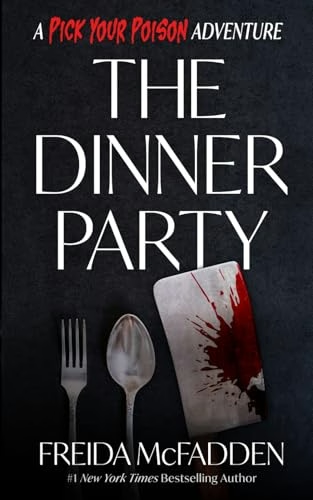
Freida McFadden's The Dinner Party: A Pick Your Poison Adventure is an ambitious experiment that asks readers to become active participants rather than passive observers. The concept is undeniably creative: over 20 branching narrative paths, interactive decision-making at chapter breaks, and the promise of meaningful player agency. Yet this Dinner Party review reveals a fundamental problem—the novelty of the format becomes so consuming that the actual story gets buried beneath the mechanics.
Let's be direct: this book divides readers like few others. Some consider it the most entertaining experience they've had all year. Others feel it's a well-intentioned disaster that mistakes gimmickry for substance. A 2.70/5 average rating on Goodreads tells you everything—this isn't a quiet miss. This is polarizing.
What You're Actually Getting
The Dinner Party drops you into financial desperation. You're broke, facing eviction, and your friend offers what sounds like easy money: waitressing at a dinner party in an isolated mansion on Peyton's Peak. The premise is deliberately sketchy, designed to make you question whether you should even go. That's where your power kicks in. You choose. Left or right. Go or stay. Pick up the hitchhiker or drive past.
McFadden's setup is genuinely clever. The story acknowledges its own artificiality—you're not just reading a book; you're selecting your adventure. Each choice branches into new scenarios, some darkly comic (feeding a cat kung pow chicken with zero consequences), others genuinely unsettling (encounters with cannibals, werewolves, and an abominable snowman). The promise of 20+ endings creates legitimate replay value.
But here's where The Dinner Party review gets complicated: the format's strength is also its fatal weakness.
The Format Problem
Interactive fiction requires a delicate balance. The reader needs to feel that their choices matter while the narrative maintains coherence and emotional weight. McFadden's approach splinters the story into so many fragments that neither condition is fully met.
Readers report that the narrative doesn't flow naturally when experienced linearly—which many found themselves doing after a few attempts. The branching paths feel disconnected, like separate short stories stitched together rather than a unified whole. When you're jumping between yeti encounters, werewolf marriages, and prison sentences, the tonal whiplash undermines any genuine tension.
The interactive element, while fun initially, becomes exhausting. Readers who tried to experience all paths reported decision fatigue. Those who read straight through felt they were missing the "intended" experience. It's a catch-22: engage with the gimmick and sacrifice narrative satisfaction, or ignore it and feel like you're reading the book wrong.
What Actually Works
To be fair, McFadden deserves credit for execution. The writing is snappy and self-aware. She leans into absurdity without pretending this is serious literary fiction. Some readers found exactly what they wanted: a personality test disguised as a thriller, unhinged and scientifically questionable, but entertaining.
The humor lands for some. The concept of "respawning" after character deaths removes stakes but adds a video-game sensibility that certain readers genuinely enjoyed. There's something liberating about a book that says, "If this ending bores you, start over." For readers exhausted by conventional thriller tropes, that permission slip matters.
The pure novelty factor shouldn't be dismissed either. In a market saturated with similar psychological thrillers, McFadden attempted something genuinely different. That ambition alone earns respect, even when execution falters.
Where It Stumbles
The core issue: story takes a backseat to mechanics. Readers expecting McFadden's signature thriller intensity—the psychological dread that defines her best work—find themselves reading something closer to a parody of thrillers instead. The tonal inconsistency between chapters makes it difficult to invest in character stakes.
The dialogue and character development suffer when narrative space is divided across dozens of paths. You don't get enough time in any single storyline to care deeply about outcomes. Compare this to traditional thrillers like Gone Girl or The Woman in Cabin 10, where sustained narrative tension builds through consistent character perspective and escalating stakes. The Dinner Party can't achieve that because it's fundamentally scattered.
There's also the practical reading experience. Clicking links, following paths, restarting chapters—it's interactive, yes, but it's not necessarily reading in the way readers traditionally experience novels. Some found this refreshing. Others felt it broke immersion and made the experience feel more like a choose-your-own-adventure book from the 1980s than a contemporary thriller.
Who Should Actually Read This
Perfect for: Readers who value experimentation over conventional storytelling. People who enjoy video games and interactive media. Those seeking something genuinely different from standard thriller fare. Anyone who finds humor in absurdist scenarios and doesn't need traditional narrative structure to enjoy themselves. Fans of McFadden's work who are curious about her range.
Avoid if: You want psychological depth and sustained tension. You prefer linear narratives with clear character arcs. You're looking for McFadden's signature thriller style. You get frustrated with gimmicky formatting that prioritizes novelty over substance. You expect emotional investment in character outcomes.
The Verdict
The Dinner Party: A Pick Your Poison Adventure by Freida McFadden is worth reading if you approach it as experimental entertainment rather than thriller fiction. Is The Dinner Party review worth your time? That depends entirely on what you want from a book.
If you're seeking a traditional narrative experience with psychological tension, this isn't it. If you want to participate in a chaotic, absurdist experiment that occasionally entertains but rarely grips, you'll find value here. McFadden took a genuine creative risk, and while the execution doesn't fully justify the concept, the attempt itself has merit.
The real question isn't whether The Dinner Party is good—it's whether you're the type of reader who values novelty and participation over narrative satisfaction. For roughly half the people who've read it, the answer is yes. For the other half, it's a well-intentioned misfire.
Final Verdict: 5/10 — Creative concept undermined by format that prioritizes gimmickry over genuine storytelling depth.