Category:
Book ReviewsThe Detective's Wife Review: Gripping But Uneven
Prices can sometimes be lower on bigger marketplaces, but this link helps independent bookstores and local reading communities.
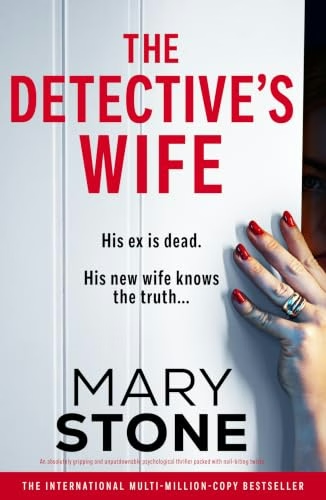
Mary Stone's The Detective's Wife is a psychological thriller that asks an unsettling question: would you marry a man you suspect of murder? The answer Jo Adair gives—yes—forms the backbone of this 2026 release, creating a premise that's genuinely intriguing even when the execution falters.
This is a book that divides readers sharply. Some find it absolutely unputdownable; others feel betrayed by an ending that prioritizes shock value over coherence. Understanding which camp you'll fall into requires knowing exactly what The Detective's Wife promises and what it actually delivers.
The Setup: A Question That Hooks You
Jo is a forensic psychologist who meets Detective Conor Slater under professional circumstances. His first wife, Hannah, vanished years ago under murky circumstances, and suspicion has never fully lifted from Conor's shoulders. Despite this shadow, Jo falls for him—hard enough to marry him, move into his house, and take on his two children.
The brilliance of Mary Stone's premise lies in its simplicity: the mystery isn't whether Conor killed Hannah. The mystery is why Jo married him knowing he might have. That's a psychological puzzle worth solving, and it's what makes this thriller stand out from the typical "detective's wife" domestic suspense fare.
The opening chapters deliver genuine tension. Jo notices the shrine-like quality of Conor's home, still dominated by Hannah's presence. The charming man who courted her vanishes once she moves in. Small moments—a forgotten name, a lingering glance at Hannah's photograph, Conor's selective memory about key details—accumulate into something genuinely unsettling.
What Works: Character Complexity and Psychological Depth
Jo herself is the book's strongest asset. She's not a passive victim or a naive woman blinded by love. She's a trained psychologist who actively investigates her husband, snoop and stalker impulses included. This makes her agency complicated in ways that feel authentic rather than contrived.
The dual narration—one narrator for Jo's perspective, another for secondary characters—works effectively in the audiobook format. The two narrators provide distinct vocal signatures that help readers track perspective shifts without confusion. Stephanie Cannon and Lisa Rost-Welling bring warmth and nuance to their performances, particularly in capturing the emotional weight of family dynamics.
Stone also deserves credit for the workplace scenes involving Jo's clients at a psychiatric facility. These chapters initially feel like digressions, but they serve a purpose: they establish Jo's professional expertise while introducing themes of unreliable perception and hidden identities. The parallel between her clients' delusions and her own potential self-deception becomes thematically resonant.
The stepmother-stepdaughter dynamic between Jo and Conor's teenage daughter Blake provides genuine emotional stakes. Jo hasn't won Blake over, and the tension never fully resolves—which feels more realistic than a heartwarming reconciliation would.
Where It Stumbles: The Ending Problem
Here's where The Detective's Wife review scores become polarized. The ending pivots dramatically, introducing a secondary mystery that many readers found convoluted rather than clever. Without spoiling specifics, the resolution feels like it belongs to a different book—one with higher stakes but lower internal logic.
Readers who loved the intimate psychological cat-and-mouse game between Jo and Conor report feeling cheated when the narrative suddenly expands into territory that feels both implausible and tonally inconsistent. The ending doesn't ruin the book, but it does undermine the careful tension Stone built across the preceding chapters.
The narration also creates occasional problems. One narrator makes Conor and Blake sound significantly older than their actual ages, which creates a subtle but distracting disconnect between voice and character.
Comparison to Similar Thrillers
If you've read Gone Girl by Gillian Flynn or The Housemaid by Nita Prose, you know the appeal of unreliable narrators and domestic deception. The Detective's Wife operates in that same territory but takes a different angle: instead of asking whether a spouse is guilty, it asks why someone would marry them knowing they might be.
Unlike Gone Girl, which thrives on its protagonist's calculated manipulation, The Detective's Wife is more introspective and psychological. Unlike The Housemaid, which relies on gothic atmosphere, Stone's thriller grounds itself in procedural realism and forensic psychology. The comparison points matter because they set expectations—and The Detective's Wife doesn't quite reach the narrative sophistication of its closest competitors.
Who Should Read This (And Who Shouldn't)
Perfect for: Fans of psychological thrillers who value character study over plot mechanics. If you loved the domestic tension in The Girl on the Train or the unreliable-narrator games in Rebecca, this book will keep you engaged. Audiobook listeners will particularly appreciate the dual narration. You should read The Detective's Wife if you're willing to accept an imperfect ending in exchange for a genuinely original premise.
Skip it if: You need tight, logical plotting that doesn't sacrifice coherence for surprise. If the ending of a thriller matters more to you than the journey, Mary Stone's The Detective's Wife will frustrate you. Readers who demand that every plot thread resolve satisfyingly should look elsewhere.
Writing and Style
Stone's prose is clean and efficient—she doesn't waste words on purple description. The dialogue feels natural, and the pacing rarely drags. She's particularly skilled at building dread through small, accumulating details rather than dramatic confrontations.
The narrative structure works well for most of the book. Alternating perspectives between Jo and others creates mystery without feeling manipulative. Stone trusts readers to piece together implications without spelling everything out, which is refreshing in a genre often guilty of over-explanation.
The Verdict
Is The Detective's Wife worth reading? Yes, but with caveats. The premise is genuinely original, the character work is solid, and the psychological tension carries you through most of the book. The audiobook narration is excellent. However, the ending prioritizes shock over sense, and that's a significant flaw that prevents this from being an unqualified recommendation.
This is a book that works as an entertaining thriller and a character study, but not quite as the airtight psychological puzzle it aspires to be. Mary Stone has written something compulsively readable that doesn't quite stick the landing—which is frustrating precisely because the setup suggested she might.
If you're in the mood for a page-turner that asks interesting questions about trust, psychology, and why we choose the people we marry, The Detective's Wife delivers. Just don't expect the ending to be as clever as the premise promises.
Final Score: 7/10
Justification: A compelling psychological thriller with an original premise and strong character work that's undermined by an ending that prioritizes shock value over narrative coherence.