Category:
Book ReviewsThe Daily Laws Review: Greene's Masterclass or Manipulative Manual?
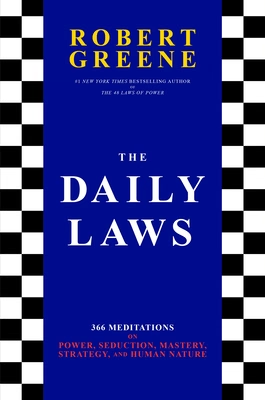
Prices can sometimes be lower on bigger marketplaces, but this link helps independent bookstores and local reading communities.
Robert Greene's The Daily Laws: 366 Meditations arrives with a provocative premise: distill 22 years of bestselling wisdom into bite-sized daily lessons that take five minutes to absorb. The result is simultaneously one of Greene's most accessible works and his most controversial—a book that readers either embrace as transformative or reject as a cynical playbook for power-hungry manipulation.
Let's be direct: this book will polarize you. Some readers call it the perfect entry point to Greene's penetrating insights on human nature. Others abandon it within weeks, finding the constant focus on strategy, persuasion, and power uncomfortable or morally questionable. Before deciding if The Daily Laws deserves a place on your nightstand, you need to understand exactly what you're getting.
What This Book Actually Is
The Daily Laws curates Greene's most distilled wisdom from his previous works—The 48 Laws of Power, The Laws of Human Nature, Mastery, and The Art of Seduction—plus material from an unreleased manuscript. Each of the 366 entries (accounting for leap years) contains a refined lesson followed by a "Commandment," which is essentially a daily prompt or action to practice.
The structure is deliberately cyclical. Greene organizes the year into 12 thematic months: laying groundwork for mastery, self-transformation, skill application, entering the game of power, identifying deceivers, mastering tactics, influencing others, persuasion, crisis management, embracing your shadow self, achieving self-control, and confronting mortality. This architecture means you could theoretically read the book in order or pick it up at any point in the year.
Compare this to The Daily Stoic by Ryan Holiday, which offers philosophical reflection for modern living. Greene's approach is fundamentally different—less about finding peace and more about understanding the mechanics of human behavior and social dynamics.
The Writing & Delivery: Accessible Without Dumbing Down
Greene's trademark style translates remarkably well to the daily format. His prose remains sharp and uncompromising, but the brevity forces genuine refinement. There's no room for tangential storytelling here—each lesson gets to the point with historical examples and psychological insight compressed into 300-400 words.
The Commandments vary in quality and practicality. Some are genuinely actionable ("Identify one person in your position who has failed. Study their mistakes closely"). Others feel more abstract ("Observe how people react when they feel their status is threatened"). This inconsistency isn't necessarily a flaw—it mirrors real life, where some days offer clearer lessons than others.
The book's physical design supports the daily reading habit. It's substantial enough to feel weighty but not so dense that you'll feel obligated to read multiple entries. The typography is clean, making it genuinely pleasant to read for five minutes over coffee.
What Works Brilliantly
The Daily Laws review process reveals several genuine strengths. First, the book successfully democratizes Greene's ideas. His earlier works require significant time investment—Mastery alone demands 400+ pages of dense narrative. For readers intimidated by that commitment, this daily format removes barriers.
Second, the thematic organization is psychologically intelligent. By grouping related lessons into months, Greene creates natural narrative arcs within the year. Month three (skill mastery) builds logically on month two (self-transformation). Month ten (embracing shadow aspects) arrives after you've spent nine months learning external strategies, creating a natural pivot toward internal work.
Third, the historical examples are consistently fascinating. Greene draws from figures like Cleopatra, Napoleon, Rockefeller, Coco Chanel, and Chekhov—not as hagiography but as case studies in human psychology. These aren't celebrity gossip; they're genuine historical analysis that deepens the lessons.
Fourth, for existing Greene fans, this book functions as an excellent refresher and synthesis tool. If you've read his previous works but struggled to retain the core principles, The Daily Laws distills those insights into their purest form.
Where It Falls Short
The Daily Laws review must address legitimate criticisms. The most serious is tonal: this book consistently frames human interaction through a lens of strategy, power, and advantage. The underlying philosophy assumes that understanding others' motivations primarily serves self-interest. Some readers find this refreshingly honest; others find it deeply uncomfortable.
Readers have noted that the constant focus on identifying manipulation, mastering tactics, and influencing others can feel relentlessly cynical. If you're seeking spiritual growth or philosophical comfort, this isn't it. Greene doesn't offer solace; he offers clarity about how power actually operates—which many find unsettling.
The daily format, while convenient, creates a structural problem: there's no narrative momentum. You can't build tension or complexity across entries. Each lesson stands alone, which means profound ideas sometimes feel reductive when compressed into a single page. Greene's fuller books allow him to develop arguments; here, he can only assert them.
Additionally, some entries feel less relevant than others. A lesson about navigating court politics in 16th-century Florence may not resonate if your challenges are contemporary. The book tries to bridge this gap with modern examples, but the historical focus occasionally creates distance rather than connection.
Who Should Actually Read This
This book is genuinely excellent for:
- New Greene readers seeking an introduction without committing to 400-page doorstoppers
- Business professionals navigating organizational politics and leadership challenges
- Anyone interested in psychology and human behavior from a strategic perspective
- People who appreciate historical case studies and biographical analysis
- Readers seeking daily intellectual stimulation that doesn't require deep concentration
This book is probably wrong for:
- Readers seeking spiritual or emotional comfort—Greene offers neither
- Those uncomfortable with strategic thinking about human relationships
- People who find cynicism about human nature alienating rather than enlightening
- Readers who prefer narrative-driven learning over aphoristic wisdom
- Anyone who has already read all of Greene's previous books and seeks genuinely new material (you'll recognize most content)
The Comparison That Matters
If you're deciding between The Daily Laws and The Daily Stoic, understand the fundamental difference. Holiday's book teaches you how to find peace and virtue within circumstances you cannot control. Greene's book teaches you how to understand and navigate power dynamics in circumstances you can influence. They're not competing books; they're addressing different human needs.
The Daily Laws is more practical for workplace dynamics, social strategy, and understanding manipulation. The Daily Stoic is more useful for emotional resilience and philosophical grounding. Many readers benefit from reading both simultaneously, as one reader noted—alternating entries provides balance.
The Divisive Truth About This Book
The polarized reader responses aren't accidental. This book's core premise—that understanding human nature primarily serves strategic advantage—genuinely offends some people's values. Others find that same premise liberating. There's no middle ground here. You'll either appreciate Greene's unflinching perspective on power and persuasion, or you'll find it manipulative and hollow.
The book doesn't pretend otherwise. Greene isn't selling you self-help positivity or spiritual awakening. He's offering a masterclass in recognizing patterns in human behavior. Whether that's valuable depends entirely on what you want from reading.
Final Verdict
The Daily Laws: 366 Meditations is a remarkably well-executed distillation of Robert Greene's 22-year body of work. The daily format genuinely works, the writing remains sharp, and the historical examples are consistently illuminating. For readers new to Greene or seeking daily intellectual stimulation, it's an excellent investment.
However, this is not a book for everyone. Its relentless focus on strategy, power, and advantage will alienate readers seeking philosophical comfort or spiritual growth. The cynical lens through which Greene views human motivation is his greatest strength and most significant limitation.
Is The Daily Laws worth reading? Absolutely—if you're interested in understanding how power actually works and how people genuinely behave beneath social conventions. If you're seeking inspiration or comfort, look elsewhere.