Category:
Book ReviewsThe Coworker Review: Ambitious But Uneven
Prices can sometimes be lower on bigger marketplaces, but this link helps independent bookstores and local reading communities.
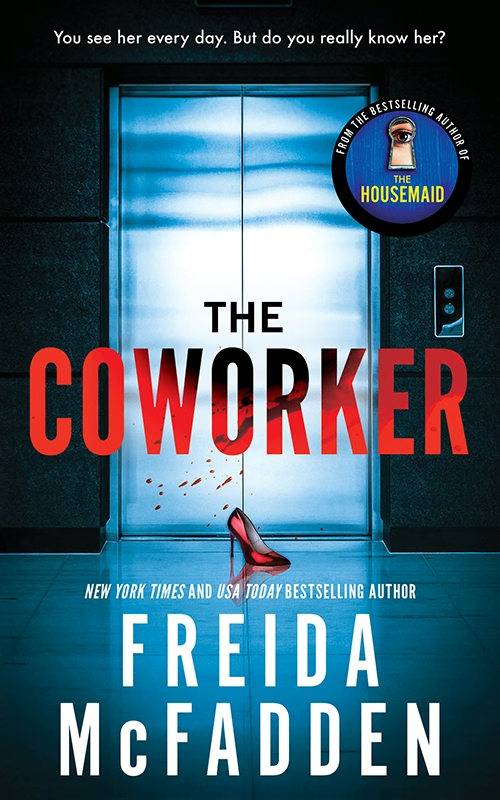
Freida McFadden's The Coworker is a psychological thriller that swings wildly between genuinely gripping suspense and frustratingly contrived plotting. After spending over two decades developing this manuscript, McFadden delivers a premise with real potential—two drastically different coworkers, mounting mystery, and multiple unreliable narrators—but the execution stumbles under the weight of its own ambition. This is a book that will captivate some readers completely while leaving others feeling manipulated by its twists.
What It's About
The setup is deceptively simple: Natalie Farrell, a conventionally successful sales rep, notices her strange coworker Dawn Schiff hasn't shown up to the office at her usual 8:45 a.m. arrival. When Natalie receives a distressed phone call from Dawn, followed by an unsettling silence, she investigates—only to discover something horrifying at Dawn's home. From there, The Coworker unfolds across multiple timelines and perspectives, gradually revealing that this isn't a straightforward case of victimhood.
McFadden constructs her narrative around two polar opposite protagonists: Natalie, the conventionally attractive, socially adept golden girl of the office, and Dawn, a neurodivergent accountant obsessed with turtles, color-coded schedules, and rigid routines. The contrast is intentional and sometimes heavy-handed, but it serves the story's central question: who is really the victim here?
The Unreliable Narrator Problem
The concept of dual unreliable narrators is The Coworker's greatest strength and its most significant vulnerability. McFadden forces readers into a constant state of questioning—which woman is lying? Is one of them a villain? Are both innocent? This uncertainty drives the page-turning momentum that makes the book genuinely difficult to put down.
However, this technique only works if the narrators sound distinctly different. Several readers have noted that McFadden's characterization of Natalie and Dawn becomes muddled, with their narrative voices blurring together in ways that confuse rather than intrigue. When you can't immediately identify whose perspective you're reading from, the unreliability becomes frustrating rather than clever. This is a critical flaw in a book where narrative perspective is everything.
Writing Style and Pacing
The Coworker is undeniably fast-paced. The book practically begs to be consumed in one sitting—chapters are short, cliffhangers are frequent, and the momentum rarely stalls. This is McFadden at her most commercially savvy, understanding exactly how to keep readers turning pages late into the night.
The audiobook experience, however, presents its own challenges. Narrator performance becomes crucial when two characters sound similar on the page, and some listeners have reported that the audio narration fails to adequately distinguish between the protagonists. This is a production issue that undermines McFadden's narrative strategy.
The pacing, while relentless, sometimes veers into territory that feels more soap opera than thriller. Certain plot developments strain credibility, and the book doesn't always know when to exercise restraint. McFadden spoon-feeds character details—particularly regarding Dawn's neurodivergence—that might have been more effective if allowed to emerge naturally.
The Twist Problem
McFadden reveals her first major twist relatively early, and most attentive readers will see it coming. This isn't necessarily damning; many successful thrillers telegraph their first reveal. What matters is whether the subsequent twists justify the setup, and here The Coworker is genuinely divided in reader opinion.
The second and third twists, which arrive in the final sections and epilogue, demonstrate more sophisticated plotting. They recontextualize earlier scenes and force readers to reconsider their assumptions about both characters. Yet some readers find these later revelations absurd—contrivances that require too much coincidence and too much suspension of disbelief even for fiction.
This is where the "20 years in development" claim becomes relevant. McFadden has clearly worked to eliminate plot holes, and the bones of the story are structurally sound. But sound structure doesn't guarantee emotional resonance or logical believability.
Character Development and Neurodivergent Representation
One of The Coworker's more interesting elements is its portrayal of Dawn, a character coded as autistic or on the autism spectrum. The representation is neither stereotypical nor entirely convincing. McFadden attempts to show depth beyond the "quirky genius" trope—there's genuine vulnerability in how she depicts Dawn's social struggles and internal world.
That said, the portrayal occasionally feels like it's checking boxes: the rigid schedules, the special interest (turtles), the literal thinking. It's not offensive, but it's not particularly nuanced either. The book works better when it treats Dawn as a fully realized person rather than a collection of neurodivergent traits.
Natalie, by contrast, receives less complexity. She's positioned as the "normal" one, the beautiful sales rep who seems to have it all. Her character development is minimal, which makes her narrative voice feel thinner than it should.
What Works
When The Coworker clicks, it really clicks. The central mystery is genuinely compelling, and the question of who deserves sympathy is legitimately ambiguous for much of the book. The ending contains an emotional beat that genuinely lands—a moment of vulnerability that feels earned and human in a way that standard psychological thrillers often miss.
McFadden's understanding of office dynamics is sharp. The way she captures the mundane cruelty of workplace hierarchies—how Natalie's popularity makes her inherently credible while Dawn's strangeness makes her inherently suspect—adds thematic weight to the plot.
The pacing is relentless in the best way. This is a book designed to be read in one or two sittings, and it delivers on that promise.
What Doesn't Work
The primary issue is believability. Several plot developments require readers to accept increasingly unlikely scenarios, and the book doesn't always earn that suspension of disbelief through character development or emotional investment. By the end, some readers will feel they've been led on a wild goose chase rather than taken on a carefully constructed mystery.
The audiobook narration problem is real and significant. In a book this dependent on narrative voice, production quality matters enormously.
There's also a sense that McFadden is trying to do too much. The book wants to be a mystery, a character study, a commentary on workplace dynamics, and a meditation on victimhood. Occasionally, these elements work in concert; often, they work against each other.
Compared to Similar Thrillers
If you've read Gone Girl by Gillian Flynn, The Coworker operates in similar territory—unreliable narrators, shocking twists, a central mystery that's as much about deception as about crime. But Flynn's novel has a structural elegance and character complexity that The Coworker doesn't quite achieve. McFadden's book is more straightforward, more plot-driven, less interested in psychological depth.
Compared to McFadden's own The Housemaid, The Coworker is more conventional. The Housemaid has a gothic atmosphere and creeping dread that this book lacks. The Coworker is faster, punchier, more immediately gripping—but also less lingering.
Who Should Read This
Perfect for: Readers who prioritize plot momentum over character depth. Fans of McFadden's previous work who appreciate her commercial sensibility. Anyone who loves workplace thrillers and doesn't mind implausible twists. Audiobook listeners who can tolerate narration that blurs character distinctions. People who want to finish a book in one sitting.
Skip if: You value believable plotting over narrative momentum. You're fatigued by the "unreliable narrator" trend in psychological thrillers. You dislike books that feel manipulative with their reveals. You prefer character-driven narratives. You're looking for McFadden's best work—her Housemaid series is stronger.
Is The Coworker Worth Reading?
Yes, but with caveats. This Coworker review ultimately comes down to what you want from a thriller. If you're seeking an intelligent, carefully constructed mystery that respects your intelligence, you'll likely find this disappointing. If you want a compulsively readable book that grabs you and doesn't let go for 300+ pages, you'll probably enjoy it.
McFadden's 20-year investment in this manuscript shows in the structural integrity and the absence of obvious plot holes. But it's also a book that occasionally feels like it's straining under the weight of its own ambition, trying to justify that lengthy development period with increasingly baroque plot complications.
The emotional core—that final moment of vulnerability—suggests McFadden is capable of writing something truly resonant. The Coworker doesn't quite get there, but it gets close enough that fans of the genre will find plenty to appreciate.
Final Verdict
7/10 — A compulsively readable thriller that prioritizes momentum over believability, with genuine emotional moments undermined by contrived plotting and narrative voice confusion.