Category:
Book ReviewsThe Coming Wave Review: Visionary Warning or Tech Hype?
Prices can sometimes be lower on bigger marketplaces, but this link helps independent bookstores and local reading communities.
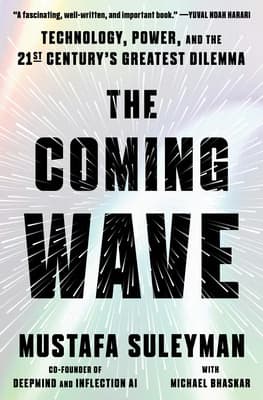
Mustafa Suleyman's The Coming Wave: Technology, Power, and the Twenty-first Century's Greatest Dilemma arrives as perhaps the most anticipated tech manifesto since Yuval Noah Harari's Sapiens—yet it's also one of the most polarizing. The book presents itself as an insider's urgent warning about AI and synthetic biology reshaping civilization, but beneath its ambitious scope lies a frustratingly uneven work that swings wildly between genuine insight and unsupported speculation.
Quick Verdict
Suleyman's core argument is compelling: we face a "containment problem" as powerful technologies proliferate beyond our control. But the execution is bloated, repetitive, and often lacks the rigor needed to back extraordinary claims. This is a book with a vital message trapped inside a rambling manifesto.
What This Book Actually Argues
The premise is straightforward enough. Suleyman, co-founder of DeepMind and now CEO of Inflection AI, contends that we're entering an era where AI and biotech will advance so rapidly that traditional governance structures can't keep pace. He envisions a near-future where DNA printers, quantum computers, and autonomous weapons become as accessible as smartphones are today.
The "coming wave" itself isn't new technology—it's the convergence of AI and biology, where machine learning accelerates genetic engineering, which in turn feeds data back into AI systems. This feedback loop, Suleyman argues, could either liberate humanity from disease and scarcity or enable small groups to engineer pathogens that could devastate populations.
His proposed solution? Containment through institutional control, international cooperation, and ensuring "the right people" maintain oversight. This is where the book reveals its most troubling assumption: that technocratic governance can solve problems created by democratized technology.
The Strengths: Real Concerns Worth Your Time
Suleyman deserves credit for naming a genuine problem that most tech discourse ignores. The "containment problem" is real. As synthetic biology tools become cheaper and more user-friendly, the barriers to creating dangerous pathogens genuinely do lower. This isn't science fiction—it's a documented concern among biosecurity experts.
The book's warning about dual-use technologies has merit. A tool that enables personalized medicine can also enable targeted bioweapons. AI that optimizes drug discovery can also optimize toxin creation. These aren't hypotheticals; they're inherent features of powerful technologies.
Suleyman also correctly identifies that nation-states remain fragile institutions poorly equipped to regulate global technological change. When a teenager in Estonia can access the same AI models as a Fortune 500 company, traditional regulatory frameworks collapse. This observation alone makes The Coming Wave worth reading for anyone interested in technology policy.
Where It Falls Apart: The Credibility Problem
Here's where this Coming Wave review gets critical: the book makes sweeping claims with minimal evidence. Suleyman asserts that 3D printing will revolutionize construction, that AI will solve drug discovery bottlenecks, that quantum computers will crack encryption—then moves on without addressing counterarguments or limitations.
Take 3D printing. Suleyman presents it as a transformative technology that will slash housing costs. In reality, 3D printing remains a niche construction tool useful for specific applications (curved walls, rapid prototyping) but hasn't fundamentally altered building timelines or affordability. The real constraints in housing—land costs, labor, permitting—aren't solved by printing technology.
Or drug discovery. Suleyman suggests AI will revolutionize pharmaceutical development. Yet anyone familiar with the field knows the computational bottleneck isn't target identification or molecular modeling—it's target validation and toxicology testing, which require years of empirical work. No amount of AI acceleration changes that timeline.
This pattern repeats throughout the book. Suleyman makes technology do rhetorical work it hasn't earned. He's not alone in this; it's endemic to tech discourse. But for a book claiming insider expertise, it's disappointing.
The Structural Problem: Rambling When It Should Be Razor-Sharp
The book suffers from severe editorial neglect. It's repetitive—the core argument appears in nearly identical form multiple times. It's padded with endless historical comparisons that don't advance the thesis. And critically, it's almost entirely unreferenced, making it impossible to distinguish between documented fact and speculation without prior knowledge.
This matters because Suleyman is asking readers to trust his judgment on matters of existential importance. But trust requires transparency. When he makes a claim about AI capabilities or biotech timelines, readers need to know: is this based on published research, industry experience, or educated guessing?
Compare this to The Alignment Problem by Brian Christian or Superintelligence by Nick Bostrom, which grapple with similar themes but ground arguments in research and rigorous reasoning. Those books trust readers' intelligence. The Coming Wave doesn't—it compensates for weak argumentation with volume and urgency.
The Ideological Assumption: Who Gets to Decide?
The most revealing weakness in Suleyman's Coming Wave review emerges in his solution: containment through institutional control. He argues that the right people—presumably experts like himself—should maintain oversight of powerful technologies. This is presented as obvious wisdom, but it's actually a profound political claim.
Who are "the right people"? How do we ensure they remain accountable? What happens when institutions fail? Suleyman doesn't adequately address these questions. He essentially advocates for technocratic governance without acknowledging its vulnerabilities or the legitimate concerns about concentrated power.
Historically, technologies have been controlled not by enlightened experts but through messy combinations of regulation, market forces, user behavior, and accident. The printing press wasn't contained by authorities—it escaped their control and reshaped civilization. The internet wasn't governed by a wise council—it developed through distributed innovation and subsequent regulatory capture. Suleyman's faith in containment through elite consensus seems naive given this history.
Who Should Read This Book
Read it if: You work in technology policy, AI, or biosecurity. You want to understand how Silicon Valley's leadership thinks about existential risk. You're interested in technology governance debates. You can tolerate repetition and rambling for occasional genuine insight.
Skip it if: You want rigorous argumentation backed by evidence. You're looking for concrete policy solutions rather than warnings. You've already read Superintelligence or The Alignment Problem—you'll find this less intellectually satisfying. You're allergic to tech hype and unsupported speculation.
The Verdict: Important Warnings, Frustrating Execution
The Coming Wave by Mustafa Suleyman addresses urgent questions that deserve serious attention. The containment problem is real. The convergence of AI and biology does present novel risks. These insights alone justify reading the book.
But the book undermines its own message through poor execution. The rambling structure, unsupported claims, and ideological assumptions about technocratic governance weaken arguments that could be devastating if properly developed. This is a book that needed a stronger editor and more rigorous thinking.
Is The Coming Wave worth reading? Yes—but with skepticism. Treat it as a conversation starter rather than a definitive analysis. Use it to identify important questions, then seek out more rigorous sources for answers. Suleyman has identified real problems; he just hasn't solved them.
Final Score: 6/10
Vital warnings undermined by sloppy argumentation and unsupported speculation—a book that matters despite itself.