Category:
Book ReviewsThe Castle Review: Ronson's Darkest Investigation Yet
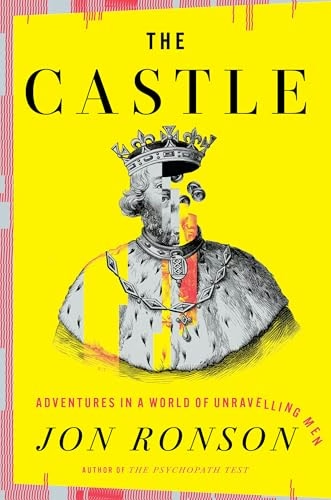
Prices can sometimes be lower on bigger marketplaces, but this link helps independent bookstores and local reading communities.
Jon Ronson's The Castle: Adventures in a World of Unraveling Men is a disturbing, darkly hilarious descent into the modern masculinity crisis—and it's his most unsettling work since So You've Been Publicly Shamed. After an 11-year publishing hiatus, Ronson returns not with a comfortable comeback, but with a true crime narrative that begins when his own son is lured to a mysterious castle in Connecticut under false pretences. What unfolds is a labyrinthine investigation into the lives of disconnected men searching desperately for purpose, often with catastrophic consequences.
This The Castle review cuts through the noise: the book is genuinely worth reading if you're interested in how online culture has fractured male identity, but it's structurally messier and less propulsive than Ronson's earlier work. The question isn't whether Ronson can still deliver compelling narrative nonfiction—he can—but whether his sprawling, tangent-laden approach serves the story or undermines it.
What's Actually Happening Here?
The central mystery involves Chris Marks, a wealthy Connecticut heir who has converted his estate into what amounts to a recruitment ground for vulnerable young women he calls "princesses." When Ronson's son Joel receives cryptic texts luring him to this castle under false pretences, it triggers the author's investigative instincts. But this isn't a straightforward true crime thriller about one man's delusions.
Instead, Ronson uses the castle incident as a portal into a much larger phenomenon: the millions of men disconnected from traditional markers of identity—employment, education, social status. The narrative spirals outward to include a culture-war YouTuber, a town historian, a lawncare influencer wrongly implicated in a bizarre online conspiracy, and even two recently paroled murderers who become part of Ronson's investigation. Each thread illuminates a different facet of male disenfranchisement in the 21st century.
The book's central thesis is unsettling: What happens when men lose the institutional anchors that once defined their worth? When money, innovation, authority, and expertise no longer guarantee social standing but instead become liabilities? Ronson argues that this identity vacuum has created a dangerous pipeline—from loneliness to radicalization to disinhibition to potential violence.
The Writing: Sprawling, Deliberate, Occasionally Frustrating
Ronson's trademark style is fully present here: he inserts himself relentlessly into the narrative, questioning his own motivations, acknowledging his compulsive need to work, and confronting uncomfortable truths about his own proximity to the subjects he investigates. In one particularly raw moment, he admits that his son's danger "had, after all, given me something to do"—a confession that reveals how Ronson's obsessive need for purpose mirrors the pathology he's documenting.
But the structural approach is deliberately non-linear. Unlike The Psychopath Test, which moves with surgical precision through a single investigation, The Castle doubles back, follows tangents, and circles around its core themes. Some readers will find this meandering quality frustrating—the data sometimes gets lost in the musings, and the multiple narrative threads require patience to untangle.
Others will recognize this approach as intentional. The book's fragmented structure mirrors the fragmentation of male identity it's exploring. There's no clean resolution because there isn't one. The investigation doesn't neatly solve the mystery of the castle; instead, it expands into a portrait of systemic cultural failure.
What Works Brilliantly
Ronson's greatest strength has always been his ability to render subjects with genuine empathy while simultaneously exposing their pathology. He doesn't cartoonize Chris Marks or the other men in this book—he humanizes them in ways that make them simultaneously sympathetic and deeply unsettling. This is the opposite of sensationalism.
The psychological insight is razor-sharp. Ronson traces how social media algorithms, online echo chambers, and the collapse of traditional male authority structures have created a generation of men unmoored from society. He examines how once-tolerated behavior becomes intolerable, and how that social rejection can accelerate the very radicalization it's meant to prevent.
The humor remains Ronson's secret weapon. Even when documenting genuinely disturbing behavior, he finds moments of absurdist comedy that prevent the book from becoming a grim slog. This tonal balance—moving fluidly between horror, humor, and genuine insight—is what separates Ronson's work from standard true crime or cultural criticism.
The book also raises urgent questions about masculinity that mainstream discourse often avoids: What does male identity look like when traditional sources of value have been stripped away? How do we distinguish between men who are struggling and men who are dangerous? Is there a redemptive path for the disconnected, or are we simply managing the fallout?
Where It Stumbles
The primary weakness is pacing. At times, the investigation feels like it's circling without forward momentum. Readers accustomed to the tight narrative architecture of So You've Been Publicly Shamed may find themselves frustrated by the book's willingness to meander. Some threads feel underdeveloped—the lawncare influencer subplot, for instance, is fascinating but feels tangential to the central investigation.
There's also a tension between the personal stakes (Ronson's son's safety) and the broader cultural investigation. The book sometimes struggles to reconcile these two narratives, and the personal element occasionally feels exploited for narrative momentum rather than genuinely integrated into the larger argument.
Finally, while Ronson excels at asking questions, the book occasionally feels light on concrete answers or actionable insights. It's a diagnosis of the problem rather than an exploration of solutions—which may be intentional, but leaves some readers wanting more prescriptive analysis.
Who Should Read This
This book is essential for anyone genuinely interested in understanding the modern masculinity crisis beyond surface-level takes. If you've read Men Who Hate Women by Laura Bates or The Right to Sex by Amia Srinivasan, The Castle offers a complementary perspective from someone embedded in the male-centered spaces where these crises originate.
It's perfect for readers who appreciate narrative nonfiction that refuses easy answers, who value psychological nuance over moral judgment, and who understand that understanding dangerous people doesn't require excusing them.
Skip this if you want a lean, propulsive thriller. Skip it if you need clear resolutions and tidy narrative arcs. Skip it if you're looking for a book that confirms your existing beliefs rather than complicates them.
The Real Test: Is The Castle Worth Reading?
Yes, but with caveats. Jon Ronson's The Castle is his darkest and most intellectually ambitious work—a book that grapples with genuinely disturbing cultural phenomena without flinching or simplifying. It's not as immediately gripping as his earlier investigations, and its structure demands more from readers than his previous bestsellers.
But it's also a necessary book. At a moment when we're struggling to understand radicalization, male alienation, and the pathologies emerging from online culture, Ronson provides something rare: empathetic investigation that doesn't require moral compromise. He walks into the darkest corners of contemporary masculinity and returns with something that makes you simultaneously laugh, wince, and think.
The 11-year wait was worth it. Not because The Castle is Ronson's most polished work, but because it's his most urgent one.
Final Verdict
8.5/10 — A sprawling, unsettling investigation that proves Ronson's ability to find profound cultural meaning in the margins, even if the journey is messier than expected.