Category:
Book ReviewsThe Castle in the Glen Review: Scottish Mystery Masterclass
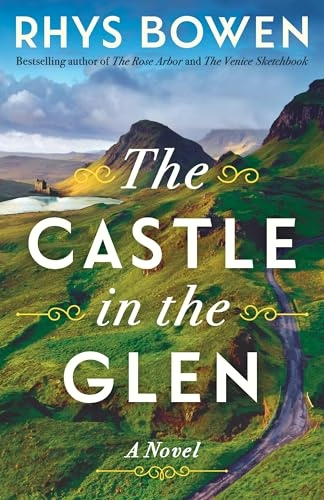
Prices can sometimes be lower on bigger marketplaces, but this link helps independent bookstores and local reading communities.
Rhys Bowen's The Castle in the Glen is a masterfully constructed historical mystery that does something increasingly rare in contemporary fiction: it trusts readers enough to layer multiple timelines, unreliable narrators, and genuinely shocking revelations without ever feeling manipulative. This is a book that works on at least three levels simultaneously—as a gothic romance, as a literary thriller about the nature of storytelling itself, and as a meditation on how secrets embed themselves in families across generations. The verdict is straightforward: if you enjoy mysteries with substance, atmospheric Scottish settings, and plots that genuinely surprise without feeling contrived, this novel absolutely deserves your time.
What It's About
The premise is deceptively simple. Emma Callander, a struggling Australian writer living in London during 1964, is offered a lucrative opportunity to ghostwrite the final novel in a celebrated mystery series by the aging and increasingly forgetful Iris Blackburn. The manuscript Iris wants completed is set on the Isle of Skye and centers on a 1904 drowning that claimed a couple and led to the disappearance of a mysterious young woman locals called "the Wild Girl."
What begins as a straightforward ghostwriting assignment transforms into something far more dangerous when Emma travels to Scotland for research and discovers that Iris's novel isn't fiction at all—it's a barely fictionalized account of a real, unsolved crime. As Emma digs deeper, she uncovers secrets that powerful descendants of the aristocratic family involved would prefer remained buried. The mystery spirals outward, connecting 1904 to 1964, and raising the central question that drives the entire narrative: what really happened that night on the Isle of Skye sixty years ago?
The Narrative Architecture Works
What distinguishes The Castle in the Glen review conversations from typical mystery discussions is how readers consistently praise Bowen's structural choices. The novel operates as a genuine mystery-within-a-mystery, with Emma's 1960s investigation running parallel to the historical events she's researching. This dual-timeline approach could easily become confusing—and Bowen acknowledges this by including character introductions at the beginning that readers genuinely need—but the execution is elegant.
The pacing never drags. Each section reveals enough to compel you forward while withholding crucial information that recontextualizes everything you thought you understood. This is mystery writing that respects intelligence. Bowen doesn't rely on cheap plot twists or manufactured cliffhangers; instead, she uses the fundamental unreliability of memory and the deliberate concealment of truth as her primary tools. The famous "twist not even Emma could have seen coming" that the synopsis hints at actually lands because Bowen has earned it through careful, methodical setup rather than narrative sleight of hand.
Setting as Character
The Scottish Highlands and Isle of Skye function as more than mere backdrop here. Readers consistently report that after finishing this book, they feel as though they've actually visited these locations. The windswept, rugged landscape becomes almost a character itself—beautiful but forbidding, romantic but isolating, the kind of place where secrets naturally take root and flourish.
Bowen's prose captures the atmospheric quality of these settings without ever becoming purple or overwrought. The mist, the castles, the isolated communities—all of this accumulates into a genuine sense of place that enhances rather than distracts from the mystery. This is particularly impressive given that significant portions of the novel are set in London, where Bowen must establish an equally compelling but entirely different atmosphere.
Emma Callander: A Protagonist Who Earns Agency
Emma stands out as a notably intelligent and resourceful protagonist. She's not a detective or investigator by training; she's a writer trying to establish her career, and that distinction matters. Her investigation of the mystery unfolds naturally from her work as a ghostwriter rather than from some convenient plot device that forces her into danger.
Her relationship with Tony Gordon, Iris's lawyer, develops organically and never overwhelms the central mystery. The romance element works because it emerges from shared danger and mutual respect rather than being imposed on the narrative as an obligation. This is one area where The Castle in the Glen notably differs from many contemporary historical mysteries that treat romance as a mandatory box to check.
Where the Complexity Becomes Demanding
Here's where honest criticism matters: this novel is not a casual beach read, despite being genuinely entertaining. The multiple timelines, the large cast of characters spanning two centuries, and the deliberate withholding of crucial information mean readers need to stay engaged and attentive. Those character introductions at the beginning aren't optional—they're essential. Skip them at your peril.
Some readers will find this demanding nature refreshing; others will experience it as friction. If you prefer mysteries that clearly signal all their pieces upfront and move in straightforward chronological fashion, The Castle in the Glen will feel deliberately obfuscated. The novel trusts readers to track complexity without constant reminders, which is admirable but not universally appreciated.
Additionally, the 1960s setting, while beautifully rendered, requires some historical awareness to fully appreciate certain cultural and social elements. This isn't a flaw—it's simply what the book is—but it's worth noting for readers who prefer contemporary settings or who find historical context necessary rather than enriching.
Comparison to Similar Works
If you've enjoyed Tana French's Dublin Murder Squad series or Kate Morton's The Distant Hours, The Castle in the Glen operates in similar territory: contemporary investigations that unravel historical mysteries, atmospheric settings that function as integral to plot, and protagonists who become personally invested in uncovering truth. However, Bowen's approach differs meaningfully. Where French emphasizes psychological complexity and Morton leans toward gothic romance, Bowen achieves a balance that feels distinctly her own—more grounded, perhaps, and less reliant on the supernatural or the psychologically extreme.
Compared to traditional cozy mysteries or straightforward detective procedurals, The Castle in the Glen is considerably more literary and demanding. The mystery isn't primarily about "whodunit" but rather about understanding the complex web of motives, secrets, and circumstances that led to the crime. This is mystery fiction that asks readers to think about narrative, memory, and truth itself.
Who Should Read This
Perfect for: Readers who loved The Distant Hours or The Thursday Murder Club; anyone who appreciates Scottish settings and atmospheric fiction; mystery enthusiasts who value character development and thematic depth over pure plot mechanics; readers who enjoy stories about storytelling itself; anyone interested in how secrets embed themselves across generations; fans of Rhys Bowen's previous work.
Proceed with caution if: You prefer straightforward, linear narratives without timeline jumps; you want a cozy mystery with minimal stakes or danger; you're looking for a quick, breezy read rather than something requiring active engagement; you dislike multiple perspectives or need clear protagonist designation; you prefer contemporary settings exclusively.
The Verdict
The Castle in the Glen is a sophisticated, genuinely engaging mystery that rewards attentive reading. Rhys Bowen's The Castle in the Glen demonstrates why she's earned a devoted readership—this is mystery writing that respects intelligence, builds atmosphere with precision, and delivers revelations that feel earned rather than imposed. The novel balances multiple narrative threads without losing focus, creates characters readers genuinely care about, and maintains genuine suspense across its runtime.
The 4.55/5 rating from over 1,200 readers reflects genuine quality. The few four-star reviews rather than five typically cite the demanding nature of the narrative structure rather than actual flaws in execution. This is a book that knows what it is and commits fully to that vision.
Final Score: 9/10 — A masterfully constructed mystery that elevates the genre through intelligent plotting, atmospheric setting, and characters who feel genuinely human rather than serving plot mechanics.