Category:
Book ReviewsThe Back Bedroom Review: Unflinching But Frustratingly Incomplete
Quick Verdict
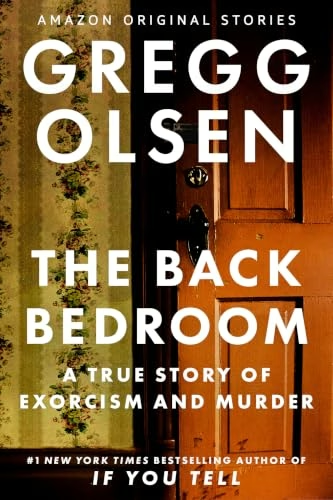
The Back Bedroom: A True Story of Exorcism and Murder by Gregg Olsen is a brutally honest account of religious manipulation and child abuse that demands to be read—but not necessarily enjoyed. This short-form true crime narrative exposes one of Washington state's most horrifying crimes with procedural precision, though Olsen's journalistic restraint leaves crucial questions unanswered and readers emotionally unsatisfied.
What You're Actually Getting Into
Gregg Olsen's The Back Bedroom documents the 1976 death of three-year-old Davey Weilbacher, whose decomposing body was discovered in a sealed bedroom of a modest yellow house in Yakima, Washington. The child had been beaten to death nearly two months before authorities found him—a prolonged campaign of ritualistic abuse orchestrated by self-proclaimed prophet Leon Cunningham and enabled by a network of family members, including Davey's vulnerable young mother, Debra.
The story operates as a case study in how charismatic manipulation, religious extremism, and domestic isolation create the perfect conditions for unthinkable violence. Cunningham convinced his followers that Davey was demon-possessed, and that exorcism through beating was the only path to salvation. What unfolds is a meticulously documented descent into cult-like abuse that raises uncomfortable questions about complicity, family loyalty, and how communities fail their most vulnerable members.
The Writing: Procedural Precision Over Emotional Resonance
Olsen approaches this material like a true crime podcast transcript—straightforward, fact-heavy, punctuated with interview quotes. There's no flowery prose here, no literary embellishment. The narrative moves chronologically through the investigation, the discovery, and the eventual convictions with the efficiency of a police report.
This stylistic choice creates a peculiar tension. On one hand, the unflinching directness prevents the story from becoming exploitative. Olsen doesn't sensationalize; he documents. On the other hand, readers expecting narrative depth or psychological insight will find themselves reading what amounts to an extended article rather than a fully realized book. The short-form length compounds this problem—there's simply not enough space to develop the psychological complexity of how ordinary people become capable of extraordinary cruelty.
What Works: The Uncomfortable Truth About Cult Dynamics
Olsen excels at exposing the machinery of manipulation. He traces how Cunningham, despite appearing unremarkable by conventional standards, managed to exert absolute control over his household and extended social circle. The documentation of his methods—the prayer sessions, the scriptural justifications, the escalating violence framed as spiritual necessity—reveals patterns that resonate beyond this single case.
The book's greatest strength is its refusal to let readers off the hook. Davey's father, his grandparents, his aunts, and neighbors all encountered evidence of abuse—bruises, behavioral changes, disturbing statements—yet remained silent or complicit. Olsen forces us to confront an uncomfortable reality: this tragedy wasn't the work of one madman but a system of enablers. That systemic failure is more haunting than any individual villain could be.
The fifty-year journey to finally tell this story, anchored by one woman's delayed testimony, adds a layer of contemporary relevance. In an era of recovered memories and delayed justice, Olsen's account raises questions about trauma, silence, and the long arc of accountability.
What Falls Short: Incompleteness as a Fatal Flaw
The most consistent criticism across reader responses centers on what's missing. Olsen provides ample detail on Leon Cunningham's control methods but offers frustratingly little psychological analysis of how an apparently unremarkable man achieved such dominance. Readers are left asking: what made him different? What made people susceptible?
More problematically, the book retreats from several key figures at crucial moments. Davey's father essentially disappears from the narrative after the early sections. The motivations and thoughts of Debra—Davey's mother and a central figure in the tragedy—remain largely opaque. Did she genuinely believe her son was possessed, or was she so broken by divorce and isolation that she sought belonging at any cost? Olsen hints at answers but rarely commits to them.
The ending compounds this frustration. Readers learn that all perpetrators were convicted, but the sentences feel glossed over. There's no exploration of how the justice system handled the case, whether sentences were adequate, or how survivors and family members have processed decades of aftermath. For a book centered on a fifty-year journey to justice, the resolution feels rushed and incomplete.
The repetitive structure—pray, obey Leon, beat Davey, pray again—that some readers noted isn't a flaw in Olsen's writing but rather an accurate reflection of the abuse's cyclical nature. However, this accuracy doesn't necessarily make for compelling reading, particularly in a short-form format where space could have been devoted to deeper character work.
The Emotional Weight: Why Some Readers Will Struggle
This is not a book to read casually. The subject matter—sustained abuse of a toddler by multiple adults—is genuinely disturbing. Parents of young children report particular difficulty with the material, and that's not hyperbole. Olsen doesn't shy away from describing the violence, and the cumulative effect is devastating.
That said, the emotional devastation isn't always productive. Some readers finish feeling sick and hollow, which is understandable. Others finish frustrated that the emotional weight wasn't matched by narrative depth or resolution. The book occupies an uncomfortable middle ground: too disturbing to be a casual true crime read, but too procedural to achieve the cathartic power of truly great crime narrative.
Who Should Read This (And Who Absolutely Shouldn't)
Read this if: You're interested in cult psychology and religious manipulation. You appreciate true crime that prioritizes accuracy over sensationalism. You want to understand how communities enable abuse through silence. You're researching 1970s Washington state crimes or cult dynamics.
Skip this if: You're sensitive to child abuse content. You prefer narrative-driven storytelling over procedural documentation. You expect comprehensive psychological analysis. You want satisfying resolution and closure. You're looking for a page-turner rather than a serious true crime study.
Proceed with caution if: You're a parent. You expect Olsen's other works (like If You Tell, which explores similar themes with greater narrative depth) to set the tone here. You want multiple perspectives from all involved parties.
Comparison to Similar Works
If you've read Michelle McNamara's I'll Be Gone in the Dark, expect something fundamentally different. McNamara's obsessive, first-person investigation creates narrative tension and emotional investment. Olsen's approach is more journalistic and distant. If you've encountered The Killer Across the Table or similar FBI profiler memoirs, The Back Bedroom is less about psychological profiling and more about documented facts.
For cult-focused true crime, this sits somewhere between the analytical rigor of The Wager and the narrative accessibility of mainstream true crime podcasts—but it commits fully to neither approach.
The Verdict: Important But Imperfect
The Back Bedroom is a necessary book that tells an important story that deserves to be told. Gregg Olsen's The Back Bedroom review of the facts is meticulous and respectful to Davey's memory. The documentation of how religious manipulation enables abuse is genuinely valuable.
But the short-form format and procedural style create distance at precisely the moments where readers crave connection and understanding. You'll finish this book disturbed and informed, but potentially frustrated by what remains unexplored. It's the kind of book that sparks conversations rather than provides answers—which may be exactly the point.
Is The Back Bedroom worth reading? Yes, if you approach it as a documented case study rather than a narrative thriller. No, if you expect emotional resolution or comprehensive psychological insight. The book's power lies not in how it makes you feel but in what it makes you think about—how ordinary people become complicit in extraordinary evil, and how long it takes for truth to finally emerge.
Final Score: 6.5/10
Justification: Meticulously researched and morally important, but limited by format and incomplete character exploration that leaves readers more frustrated than satisfied.