Category:
Book ReviewsThe American School of Spies Review: Fascinating But Uneven
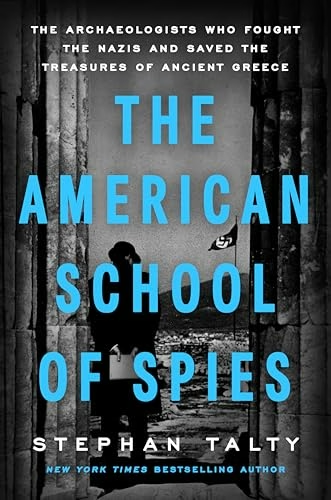
Prices can sometimes be lower on bigger marketplaces, but this link helps independent bookstores and local reading communities.
Quick Verdict
Stephan Talty's The American School of Spies delivers an undeniably compelling premise—archaeologists turned OSS spies protecting Greek treasures from Nazi plunder—but the execution is frustratingly inconsistent. The book alternates between gripping espionage narrative and academic history lesson, leaving readers with an engaging but occasionally scattered account that doesn't quite live up to its tantalizing concept.
What This Book Is Really About
Talty's narrative follows Rodney Young, a Princeton-trained archaeologist recruited by Wild Bill Donovan's newly formed Office of Strategic Services in 1942. Young assembles an unlikely team of classicists, epigraphers, and scholars—the "Greek Desk"—tasked with an extraordinary dual mission: gather intelligence on Nazi movements while secretly protecting Greece's irreplaceable cultural artifacts.
The stakes were genuine and staggering. As Nazi forces occupied Greece, they systematically looted archaeological treasures and ancient monuments. Talty's book chronicles how these academics became resistance fighters, hiding priceless artifacts in caves, ancient tombs, and beneath the streets of Athens. They forged fakes to deceive Nazi collectors, orchestrated daring rescues, and ultimately coordinated with Greek American soldiers to defend their homeland's cultural legacy.
It's a story that genuinely sounds too wild to be true—yet it happened.
The Narrative Strengths: Where Talty Excels
The book's greatest asset is its central premise, which Talty leverages effectively in the opening chapters. The image of academics trading lecture halls for spy craft creates immediate narrative tension. When the story focuses tightly on specific operations—artifact concealment, intelligence gathering, narrow escapes—the pacing becomes genuinely thrilling.
Talty excels at humanizing his subjects. Rodney Young emerges as a complex protagonist: brilliant but occasionally reckless, driven by genuine patriotism yet navigating the moral ambiguities of wartime espionage. The supporting cast of classicists and scholars feels authentic, their academic backgrounds providing both comic relief and credible expertise.
The cultural preservation angle distinguishes this from standard WWII spy narratives. Most readers won't have encountered detailed accounts of how Greek treasures survived Nazi occupation, making this material inherently fresh. Talty effectively conveys why these artifacts mattered—not just as historical objects, but as symbols of Greek identity and Western civilization itself.
Where the Book Stumbles: Structural Issues
Here's where The American School of Spies review must acknowledge its significant limitations: the book's focus fractures roughly halfway through. Talty's title promises archaeology and archaeologists, yet substantial portions shift toward Greek American military operatives with minimal archaeological background. This isn't inherently problematic—the military history is interesting—but it creates a bait-and-switch dynamic that frustrates readers expecting a cohesive narrative about scholars protecting cultural heritage.
The research depth is uneven. Talty occasionally relies too heavily on single sources for entire chapters, and references remain thin—often just five or six per chapter. Compare this to Susan Heuck Allen's Classical Spies, a superior exploration of the same subject matter that offers substantially more rigorous documentation and nuanced analysis. Talty's approach feels more journalistic than scholarly, which works for accessibility but undermines authority when discussing complex historical details.
Character development is inconsistent. While Young receives extensive attention, other key figures—Jack Caskey, Jerome Sperling, Dorothy Cox—appear episodically with minimal context. Some individuals are introduced without proper identification; a British soldier defending Crete is mentioned without naming him (J.D.S. Pendlebury), leaving readers confused about significance.
Factual errors occasionally surface. Talty claims Jason's Argo was named for Argos in the Peloponnese, when classical sources clearly indicate it was named for the shipbuilder Argos. These mistakes, while not pervasive, damage credibility when discussing specialized historical material.
Writing Style and Pacing
Talty's prose is accessible and often engaging, prioritizing momentum over scholarly precision. The narrative flows quickly, rarely bogging down in technical detail. This makes the book highly readable for general audiences unfamiliar with classical archaeology or WWII espionage.
However, this accessibility comes at a cost. The writing sometimes oversimplifies complex historical situations, and the structure—jumping between different operatives, locations, and timelines—can feel disjointed. Readers seeking deeper analysis of the cultural significance of preserved artifacts or the intelligence operations' strategic impact may find themselves wanting.
Who Should Read This Book
Perfect for: WWII history enthusiasts seeking fresh angles beyond traditional military narratives. Readers fascinated by cultural preservation, archaeology, or espionage will find genuine value here. Anyone intrigued by the intersection of academia and wartime service should absolutely pick this up. The book's accessibility makes it ideal for readers new to WWII history who want engaging storytelling over academic rigor.
Will disappoint: Scholars and serious historians seeking rigorous documentation and analysis. Readers expecting a focused narrative centered on archaeological preservation may feel misled by the military history tangents. Those familiar with more detailed accounts like Allen's Classical Spies will notice the comparative shallowness of Talty's research.
The Verdict: Is It Worth Reading?
Yes, The American School of Spies is worth reading—with the caveat that expectations matter significantly. This is an entertaining popular history that successfully brings an obscure but fascinating story to mainstream attention. Talty deserves credit for excavating this narrative and recognizing its inherent drama.
But it's not a definitive account. It's a gateway book—one that introduces readers to this remarkable chapter of history and hopefully inspires them to seek more detailed explorations. The book works best as a narrative adventure rather than authoritative history, and judged on those terms, it succeeds more often than it fails.
The central premise alone—archaeologists becoming spies to save treasures from Nazi destruction—justifies the read. Talty captures the genuine ingenuity and courage of these academics-turned-operatives. The problem isn't the story; it's the telling, which sometimes sacrifices depth for momentum.
Final Score: 7/10
An engaging popular history that succeeds as entertainment but falls short of the rigorous scholarship its subject deserves.