Category:
Book ReviewsTalking Classics Review: Provocative, Not Reassuring
Prices can sometimes be lower on bigger marketplaces, but this link helps independent bookstores and local reading communities.
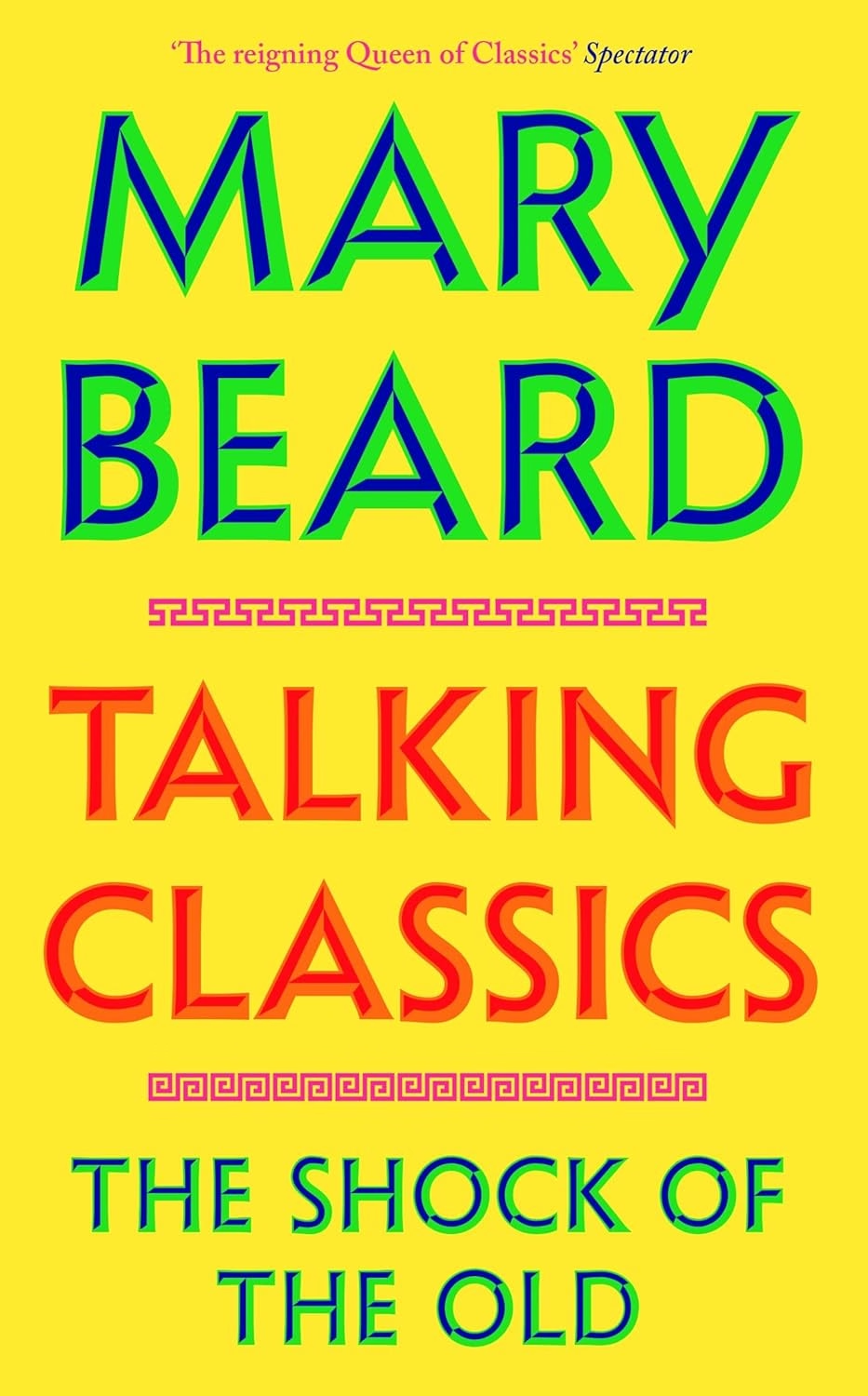
Mary Beard's Talking Classics: The Shock of the Old is a deceptively casual book that refuses to let the ancient world stay safely in the past. This isn't SPQR 2.0—it's something more deliberately unsettling: a collection of interconnected essays, lectures, and reflections that argue the classics remain radically relevant precisely because they're strange and often uncomfortable.
The book's central thesis is provocative: the ancient world isn't a museum piece to admire from a distance, but a living, contested space where meaning keeps getting reinvented. Beard examines not just what ancient Greece and Rome actually were, but how subsequent generations—artists, dictators, revolutionaries, and cultural figures—have weaponized, romanticized, and politicized antiquity for their own purposes.
What This Book Actually Is
This Talking Classics review must address a fundamental question: what are you actually buying? The answer matters because it determines whether you'll love or resent this book.
It's not a traditional history narrative. There's no chronological sweep, no thesis methodically proven through evidence. Instead, Beard structures the book like a series of conversations with a brilliant, opinionated scholar who keeps circling back to one central idea: why should we care about the distant past?
The format mirrors how Beard actually works—as a teacher, public intellectual, and cultural commentator. Readers consistently report that Talking Classics reads like sitting in a lecture hall or coffee shop listening to her think aloud. This is intentional. The book invites interrupted, non-linear reading. Pick it up, read a section, put it down, return to it weeks later. It doesn't punish that approach; it almost demands it.
The Shock of the Old: Beard's Real Argument
The title carries weight that becomes clearer as you progress. Beard isn't trying to make the classics comfortable or confirm they're timeless. She wants antiquity to remain strange—occasionally unsettling, often provocative, always alive.
One standout section examines Jean-Baptiste Wicar's painting of Virgil reading the Aeneid to Augustus's family, with Octavia overwhelmed at the mention of her dead son Marcellus. This isn't about Virgil or Augustus. It's about how a later artist emotionally reimagined Rome, projected his own meaning onto ancient texts, transformed them into something new. Beard uses this pattern repeatedly: showing how we don't access ancient Rome directly, but always through layers of interpretation, reinterpretation, and reinvention.
Another haunting thread involves archaeologist Ranuccio Bianchi Bandinelli, who guided Hitler and Mussolini through Rome in 1938. Beard explores this uncomfortable historical moment—how fascist leaders appropriated classical symbolism, how the ancient world became a weapon. This isn't academic hand-wringing. It's a concrete demonstration that how we talk about the classics has real political consequences.
Writing & Style: Conversational Authority
Beard writes with the confidence of someone who's spent half a century teaching and studying the ancient world. But she doesn't deploy that authority to intimidate. Instead, she uses it to ask better questions, to challenge assumptions, to admit uncertainty where it exists.
The prose is deliberately accessible without being dumbed down. She'll reference Bob Dylan and Beyoncé alongside Augustus and Aeneas. She includes "lively stories, curious facts and some good gossip," as the book's description promises. This isn't scholarly distance masquerading as objectivity; it's a scholar actively thinking, reconsidering, sometimes changing her mind mid-argument.
The book's structure—loosely connected essays rather than tight argumentation—initially feels scattered. But that's the point. Beard is modeling a particular way of engaging with ideas: playful, exploratory, willing to follow tangents because tangents sometimes reveal truth.
What Works Brilliantly
The book's greatest strength is its honesty about the classics' complicated legacy. Beard doesn't pretend ancient Greece and Rome were egalitarian or enlightened. She directly confronts how wealthy white men have monopolized classical education, how racist movements have cherry-picked ancient texts to justify their agendas, how elitism has clung to classical studies like ivy on a column.
But—and this is crucial—she argues this shouldn't make us dismiss the classics. Instead, it should make us reclaim them. The ancient world belongs to everyone, not to the gatekeepers who've claimed ownership.
Another genuine insight: discussing the ancient world creates unusual intellectual freedom. In contemporary discourse, people self-censor, regurgitate slogans, avoid saying what they actually think. But debate a figure from ancient Rome? Suddenly people feel permission to reason through complex moral questions, to argue about what constitutes "goodness," to think rather than perform.
Beard's personal stories ground abstract arguments in lived experience. She's not theorizing from a distance; she's reflecting on what she's witnessed, taught, learned.
What Doesn't Quite Land
The book's conversational, essayistic structure—its greatest strength—is also its limitation. Some readers will find it too loose, too willing to meander. If you want rigorous argumentation building toward a definitive conclusion, Talking Classics will frustrate you. The book deliberately resists that kind of closure.
The focus on how the classics have been used by later generations sometimes overshadows discussion of ancient texts themselves. Readers wanting deep literary analysis of specific works may feel shortchanged. Beard is more interested in the cultural work the classics perform than in close reading.
Length is also a consideration. The book is relatively brief—easily read in a sitting or two. Some readers will feel they've barely scratched the surface of Beard's thinking. Others will appreciate the restraint.
Who Should Read This
Perfect for: Anyone interested in why the ancient world still matters. Teachers looking to inspire students about classical literature. Cultural critics examining how history gets weaponized. People who loved Beard's previous books or TV series and want her distinctive voice in essay form. Readers who appreciate intellectual conversations more than traditional history narratives.
Will likely disappoint: Those seeking comprehensive classical history or deep textual analysis. Readers wanting a tightly argued thesis rather than interconnected reflections. Anyone who views the classics as comfortably familiar rather than productively strange.
The Verdict
Talking Classics: The Shock of the Old is absolutely worth reading—not because it's perfectly executed, but because it asks the right questions at exactly the right moment. Is Mary Beard's Talking Classics good? Yes, though not in the way traditional book reviews typically measure goodness.
It's good because it trusts readers to follow her thinking rather than spoon-feeding conclusions. It's good because it refuses to let the ancient world become safe or settled. It's good because it models intellectual engagement: curious, honest, willing to admit complexity.
The book won't satisfy everyone. Some readers will wish for more structure, more depth on specific texts, fewer tangents. But those "flaws" are actually features—they're Beard deliberately choosing conversation over lecture, exploration over pronouncement.
After half a century engaging with antiquity, Beard has earned the right to write exactly the book she wanted. Talking Classics is that book: personal without being solipsistic, accessible without being shallow, conversational without being casual about ideas that genuinely matter.
The ancient world isn't going anywhere. But how we talk about it, who gets to claim it, what we do with it—those questions are urgent and alive. This book makes that case compellingly.
Final Score: 8/10
A genuinely thought-provoking essay collection that prioritizes intellectual engagement over comprehensive coverage, making it essential for anyone questioning why the classics still matter in the 21st century.