Category:
Book ReviewsSunlight Finds You Review: Heartbreaking Love Story
Prices can sometimes be lower on bigger marketplaces, but this link helps independent bookstores and local reading communities.
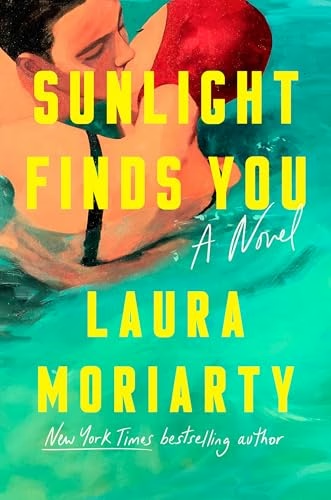
Laura Moriarty's Sunlight Finds You is not the summery beach read its sun-soaked cover promises. This is a deceptively complex historical fiction novel that masquerades as a romance before revealing itself as something far more ambitious—a multigenerational exploration of how teenage choices reverberate through an entire lifetime. If you're expecting a light, feel-good love story set in 1949 Florida, prepare to be emotionally ambushed.
The novel follows seventeen-year-old Nora as she meets Leonard, the brilliant, introverted son of New York transplants, in sun-drenched St. Petersburg. Their connection is immediate and tender, but when Leonard's father's suspicions force them apart, Nora makes a desperate choice that sets off a chain reaction of secrets, betrayals, and self-exile. Told from the perspective of an older, wiser Nora looking back across decades, the narrative spans roughly fifteen years and explores the permanent scars that first love can leave—not through nostalgia, but through unflinching honesty.
What This Book Actually Is
Sunlight Finds You refuses easy categorization, and that's precisely what makes it compelling. Yes, it's a love story, but it's equally a coming-of-age narrative, a historical drama about women's constrained choices in the 1950s, and a meditation on forgiveness and self-determination. Moriarty weaves these elements so seamlessly that readers often finish the book surprised by how much emotional weight it carried.
The historical setting isn't window dressing. Post-war St. Petersburg functions as more than backdrop—it's a character itself. The boom-town energy, the influx of newcomers seeking fresh starts, the rigid social hierarchies of the era, and the particular shame women faced when they made unconventional choices all shape Nora's trajectory. This attention to historical specificity gives the novel authenticity that elevates it beyond generic romance territory.
The Writing and Narrative Voice
Moriarty's prose is deceptively accessible. The sentences flow with such ease that readers report finishing the book in single sittings, unable to put it down despite its emotional heaviness. This readability is a gift, not a limitation—it allows the story's thematic complexity to work on you without feeling labored or overwrought.
The narrative structure, told through older Nora's retrospective lens, is crucial to the novel's success. She's not a passive narrator; she's actively wrestling with her past, offering "an honest but compassionate account" of her choices. This creates an intimate, confessional tone that makes readers feel like confidants rather than observers. We're not just watching Nora's story unfold; we're being trusted with it.
Where It Excels
The characterization is exceptional. Leonard isn't a cardboard love interest—he's a fully realized person with his own vulnerabilities, growth, and eventual disillusionment. His mother's complex relationship with Nora feels genuine, and his father's distrust, while antagonistic, carries understandable weight. The supporting cast never feels like mere plot devices.
The novel's exploration of maternal sacrifice and self-determination resonates with contemporary concerns despite its 1950s setting. Moriarty examines how women of that era faced impossible choices: stay silent and complicit, or speak up and face exile. This thematic relevance explains why readers consistently note the book feels urgent and present despite its historical distance.
The emotional arc is masterfully controlled. Rather than climaxing at the lovers' separation, Moriarty extends the narrative, showing how Nora builds a life beyond Leonard, only to have their paths intersect again. This structure allows for genuine complexity—love doesn't resolve neatly, and neither does this novel.
What Doesn't Quite Land
The primary tension in reader response reveals itself here: some readers wanted more romance, more resolution, more "sunlight" in the literal sense. The novel's emotional intensity, while its greatest strength, can feel relentless for readers seeking escapism. If you're looking for a book that ultimately celebrates love's triumph, you'll find this more ambiguous than satisfying.
The pacing occasionally drags in the middle sections as Nora navigates adulthood. Some readers felt these chapters, while thematically necessary, could have been tightened without losing their impact. The novel's refusal to provide neat answers about whether Nora made the "right" choices might frustrate readers who prefer clearer moral guidance.
The Real Verdict: Is Sunlight Finds You Worth Reading?
Absolutely, but with caveats. This Sunlight Finds You review must acknowledge that the novel's greatest strength—its emotional complexity and refusal to sentimentalize—is also what prevents it from being a universally beloved page-turner. It's a book for readers who value character depth and thematic richness over plot momentum, who can sit with ambiguity, and who appreciate historical fiction that uses the past to illuminate contemporary dilemmas.
Compare it to The Nightingale by Kristin Hannah or All the Light We Cannot See by Anthony Doerr if you want historical fiction with romantic elements, but understand that Sunlight Finds You is more introspective and less plot-driven than either. It's closer in spirit to literary fiction that happens to be set in the past rather than historical fiction that prioritizes sweeping narrative.
Laura Moriarty's Sunlight Finds You earned its 4.34/5 average rating (across 1,240 ratings) because it delivers on multiple levels—as a love story, as social commentary, and as a character study. It was selected as a Read With Jenna pick, recognition that speaks to its literary merit and accessibility.
Who Should Read This
Perfect for: Readers who loved The Chaperone (Moriarty's previous New York Times bestseller), literary fiction enthusiasts, anyone interested in women's history and the constraints of 1950s society, readers seeking emotionally intelligent explorations of first love, and those who appreciate unreliable or retrospective narrators.
Skip it if: You want light, escapist romance; you prefer plot-driven narratives over character studies; you need clear resolutions and moral certainty; you're looking for a feel-good beach read; or you find retrospective narration frustrating rather than intimate.
Final Score: 8.5/10
Sunlight Finds You is a beautifully crafted novel that uses a love story as the vehicle for exploring forgiveness, self-determination, and the long shadow our choices cast. It's not flawless—the pacing occasionally falters, and its emotional intensity isn't for everyone—but it's undeniably special. This is the kind of book that lingers, that makes you reconsider your own choices, and that rewards a second read. Moriarty proves herself a master of character and emotional nuance, crafting a narrative that feels both deeply personal and universally resonant. Whether you're a devoted historical fiction reader or someone seeking literary depth in unexpected places, Sunlight Finds You deserves a spot on your reading list.