Category:
Book ReviewsStrangers to Ourselves Review: Nuanced, Uneven, Essential
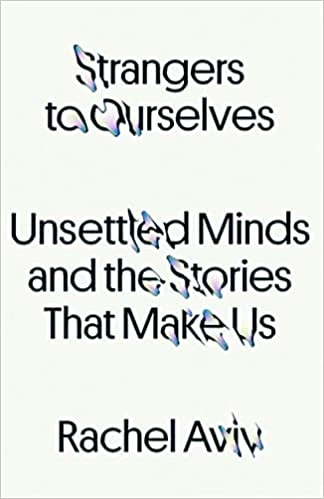
Prices can sometimes be lower on bigger marketplaces, but this link helps independent bookstores and local reading communities.
Rachel Aviv's Strangers to Ourselves: Unsettled Minds and the Stories That Make Us is a provocative non-fiction exploration that challenges how we narrate mental illness. This is not a self-help book masquerading as memoir, nor is it a clinical textbook dressed up in literary clothing. Aviv's debut sits in uncomfortable territory—part investigative journalism, part personal testimony, part philosophical inquiry—and that tension is precisely what makes it worth your time, even when it stumbles.
Let's be direct: this book asks a question that most mental health literature avoids. What if the stories we tell about our diagnoses actually shape how our illnesses unfold? Aviv doesn't dismiss psychiatric medicine or psychology wholesale. Instead, she interrogates whether our cultural obsession with naming, labeling, and medicalizing every fluctuation of the mind might be obscuring something crucial about human resilience and the messy, non-linear nature of recovery.
What This Book Actually Does
Aviv follows four individuals whose lives collide with psychiatric diagnosis in radically different ways. There's Naomi, a Black woman from Chicago's Robert Taylor Homes who cycles through psychosis, incarceration, and the brutal intersection of racism and schizophrenia. Laura, an affluent young woman who spent a decade defining herself through her diagnosis before deciding to abandon medication and rediscover who she might be without it. Bapu, an Indian woman celebrated as a saint in Kerala's healing temples, whose spiritual calling was reframed as mental illness by Western psychiatric frameworks. And Ray, a man whose entire adult life becomes consumed by seeking revenge against the psychoanalysts he blames for his suffering.
Interleaving these narratives is Aviv's own account of being hospitalized at age six with anorexia—making her one of the youngest patients ever diagnosed with the condition—and her parallel trajectory with a fellow patient whose life diverged from hers in ways that still haunt her decades later.
This structure could have felt gimmicky. Instead, Aviv uses her own vulnerability as a throughline that legitimizes her interrogation of others' stories. She's not observing from the outside; she's writing from within the system she's critiquing.
Where Aviv's Writing Soars
The Naomi section is where Strangers to Ourselves becomes genuinely indispensable. Aviv doesn't separate Naomi's mental health symptoms from the systemic racism, poverty, and incarceration that frame her life. She shows how psychiatric diagnosis becomes another tool of control, how medication compliance is demanded within a carceral system, and how the question "Are you sick or are you responding rationally to an irrational world?" becomes impossible to answer. This is social psychiatry at its finest—rigorous, empathetic, and politically unflinching.
The section on Laura's relationship with psychotropic medication is similarly nuanced. Aviv explores the genuine relief medication can provide while also examining the existential vertigo of discovering you don't know who you are without it. She resists easy conclusions. Laura's decision to go off her meds isn't framed as heroic or reckless—it's presented as a legitimate, complicated choice made by someone trying to reclaim agency over her own narrative.
The epilogue about Hava, Aviv's fellow patient from childhood, lands with emotional weight precisely because Aviv has earned it through 300 pages of careful, unsentimental observation.
The Uneven Patches
Not every section maintains this intensity. The Ray narrative, while conceptually interesting, drags in places. Aviv documents his decades-long campaign against his former analysts with thoroughness that sometimes reads more like reportage than storytelling. The writing doesn't have the same stylistic vitality here—it feels more like a series of documented facts than a compelling narrative arc.
The Bapu section, though it makes important points about how Western psychiatry has colonized non-Western spiritual traditions, occasionally sacrifices narrative momentum for thematic complexity. Readers expecting a tightly woven story might find themselves skimming.
There's also a question of whether the book's unifying thesis is explicit enough. Aviv circles around her central argument—that the stories we tell about mental illness become self-fulfilling prophecies—but never quite states it with crystalline clarity. This ambiguity is sometimes a strength (it keeps the book from becoming preachy), but it occasionally leaves readers grasping for the connective tissue.
The Larger Conversation Aviv Enters
This book arrives at a cultural moment when mental health awareness has become mainstream but also increasingly commodified. We're obsessed with diagnoses, with naming our conditions, with finding the right medication or the right therapist. Aviv's intervention is to suggest that this naming impulse, while sometimes liberating, can also become a cage.
Compare this to Claudia Rankine's Citizen, which similarly interrogates how narratives of identity and trauma shape lived experience, or Andrew Solomon's The Noonday Demon, which approaches depression with both scientific rigor and personal testimony. Aviv's book sits alongside these as essential reading for anyone thinking seriously about mental health, but it's more skeptical than Solomon and more grounded in individual psychology than Rankine.
Who Should Read This—And Who Won't
This book is essential for therapists, psychiatrists, social workers, and anyone in mental health professions who has started to wonder whether our diagnostic frameworks are serving patients or constraining them. It's vital for people who've felt flattened by a diagnosis, who've questioned whether their medication is helping or hindering, who've sensed that something gets lost in translation when lived experience becomes clinical language.
It's also genuinely moving for anyone interested in how narrative shapes identity—writers, philosophers, people interested in memoir and the construction of self.
However: if you're seeking a practical guide to managing mental illness, this isn't it. If you want a straightforward narrative with clear heroes and villains, Aviv won't provide that. If you're deeply invested in psychiatric medicine as unambiguous progress, you'll find parts of this book frustrating. Some readers will find the unevenness of quality across sections—the way some chapters sparkle while others plod—reason enough to put it down.
The Verdict
Strangers to Ourselves is worth reading because it asks questions that matter. Aviv doesn't answer them neatly, and that's precisely the point. Mental illness isn't a puzzle with a solution; it's a human experience that resists easy categorization. This book refuses the false comfort of simple answers.
Is this book perfect? No. The writing wavers, the structure could be tighter, and the central thesis could be more forcefully articulated. But Aviv has written something rarer than perfection—she's written something true, in the way that matters. She's documented how people actually live with and through mental illness, in all its contradictory, stubborn, resilient complexity.
The question isn't whether Strangers to Ourselves is a flawless book. The question is whether you're ready to have your assumptions about mental health, diagnosis, and recovery genuinely unsettled. Aviv's book does that work.