Category:
Book ReviewsStolen Focus Review: Hari's Radical Reckoning
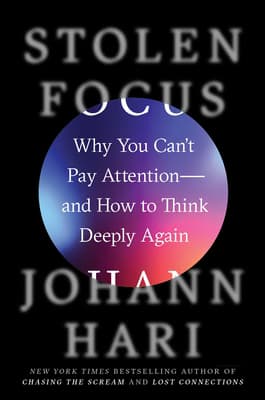
Prices can sometimes be lower on bigger marketplaces, but this link helps independent bookstores and local reading communities.
Johann Hari's Stolen Focus: Why You Can't Pay Attention— and How to Think Deeply Again arrives as a provocative diagnosis of modern life's most pressing ailment: our collapsing capacity for sustained attention. This is not another self-help book blaming you for doom-scrolling. Instead, Hari presents a meticulously researched indictment of the systems deliberately designed to fragment our focus—and crucially, he offers a roadmap for reclaiming it.
What This Book Actually Argues
Hari's central thesis challenges the dominant narrative about attention collapse. We've been told our inability to focus is a personal failure—a lack of willpower in the face of tempting technology. Stolen Focus demolishes this myth entirely. The real culprit isn't your weak character; it's a sophisticated ecosystem of corporate interests, algorithmic manipulation, and environmental factors that have systematically eroded our cognitive capacity.
The book identifies twelve deep causes of attention loss, from the deliberate engineering of social media platforms to rising air pollution and the decline of mind-wandering. This breadth is both the book's greatest strength and its most contentious feature. Unlike shallow productivity guides, Hari refuses to pretend there's a simple solution—because there isn't one.
The Research That Hits Different
What distinguishes this Stolen Focus review from others is the book's forensic approach to evidence. Hari doesn't traffic in anecdotes; he presents concrete data that's genuinely alarming. He cites research showing that the average attention span for a trending topic on social media has plummeted from 17.5 hours in 2013 to just 11.9 hours by 2016. Scientists analyzing text from the 1800s to the present discovered a sharp, measurable decline in humanity's ability to sustain focus—a trend the internet accelerated but didn't create.
Perhaps most damning is the "switch cost effect" Hari explores: when you multitask, your brain must reconfigure between tasks, causing a cognitive penalty equivalent to a 10-point IQ drop. That's twice the impact of smoking cannabis. The implication is staggering—we're voluntarily handicapping ourselves every time we check our phones during focused work.
Where Hari Excels
The strongest sections expose how Silicon Valley deliberately weaponizes attention. Hari interviews tech dissidents who reveal the psychological tricks embedded into apps and platforms. He describes a chilling metaphor: a room of people in virtual reality headsets, with Mark Zuckerberg alone at the front, fully present. This image captures the dystopian future Hari fears—a hypnotized majority and an aware elite who understand attention's true value.
His exploration of flow states and mind-wandering is particularly valuable. Hari argues that creativity requires uninterrupted time for your brain to synthesize information and draw novel connections. This isn't poetic speculation; it's grounded in neuroscience. The brain, like a muscle, strengthens with practice at monotasking. In an age obsessed with productivity hacks, this simple truth feels revolutionary.
The practical solutions Hari offers—from his visit to an office in New Zealand that implemented remarkable productivity techniques to concrete individual strategies—provide actionable paths forward. This isn't mere diagnosis; it's treatment.
The Controversial Chapter That Divides Readers
Here's where this Stolen Focus review must address the elephant in the room: Hari's treatment of ADHD has generated legitimate criticism. By his own admission, Hari isn't neurodivergent, and his research on ADHD leans heavily on scientists rather than psychologists or people with lived ADHD experience. The chapter risks reducing ADHD to merely an attention problem exacerbated by environmental factors, which oversimplifies a complex neurological condition.
Critics rightly point out that while environmental degradation certainly doesn't help anyone concentrate, suggesting that modern life causes ADHD misses the neurobiological reality. Some of Hari's examples—children misdiagnosed with ADHD who were actually experiencing trauma—are compelling but feel cherry-picked. This section weakens an otherwise rigorous book and may frustrate readers with ADHD or neurodivergent expertise.
Writing Style and Accessibility
Hari's prose remains conversational without sacrificing depth. He writes like someone genuinely troubled by what he's discovered, not a detached academic. The book is eminently readable—this isn't a dense tome requiring a neuroscience degree. That accessibility is intentional and important; if attention collapse is a societal crisis, the solution must reach beyond specialists.
However, some readers may find the breadth overwhelming. Hari touches twelve different causes of attention loss, which means each receives limited space. The book occasionally feels like a collection of fascinating essays rather than a unified argument, though this structure also allows readers to dive deeper into specific chapters that resonate most.
Who Should Read This Book
Perfect for: Anyone struggling with focus in the modern world, particularly knowledge workers and parents concerned about their children's screen time. Readers interested in technology criticism, psychology, and systems-level thinking will find genuine intellectual nourishment. If you've read similar books like Deep Work by Cal Newport or The Attention Merchants by Tim Wu, Stolen Focus offers complementary insights with a more personal narrative voice.
Problematic for: Those seeking quick productivity hacks will be disappointed—this book deliberately rejects band-aid solutions. Readers with ADHD or neurodivergence may find the ADHD chapter reductive or frustrating. Anyone deeply invested in tech industry narratives might bristle at Hari's unsparing critique of platform design.
The Verdict: Is Stolen Focus Worth Reading?
Absolutely. Despite its imperfections, Stolen Focus by Johann Hari makes an essential argument at precisely the right moment. The book combines rigorous research, compelling storytelling, and genuine solutions into something rare: a non-fiction work that's both intellectually serious and genuinely useful. The ADHD chapter stumbles, but it's a flaw in an otherwise formidable achievement.
This book won't fix your attention problems overnight. But it will fundamentally change how you understand them—and that shift in perspective is the first step toward reclaiming your focus. In a world designed to fragment your attention, that's revolutionary.
Final Score: 8.5/10
A vital, well-researched examination of attention collapse that occasionally overreaches but ultimately delivers both diagnosis and hope.