Category:
Book ReviewsSea of Tranquility Review: Mandel's Ambitious Leap
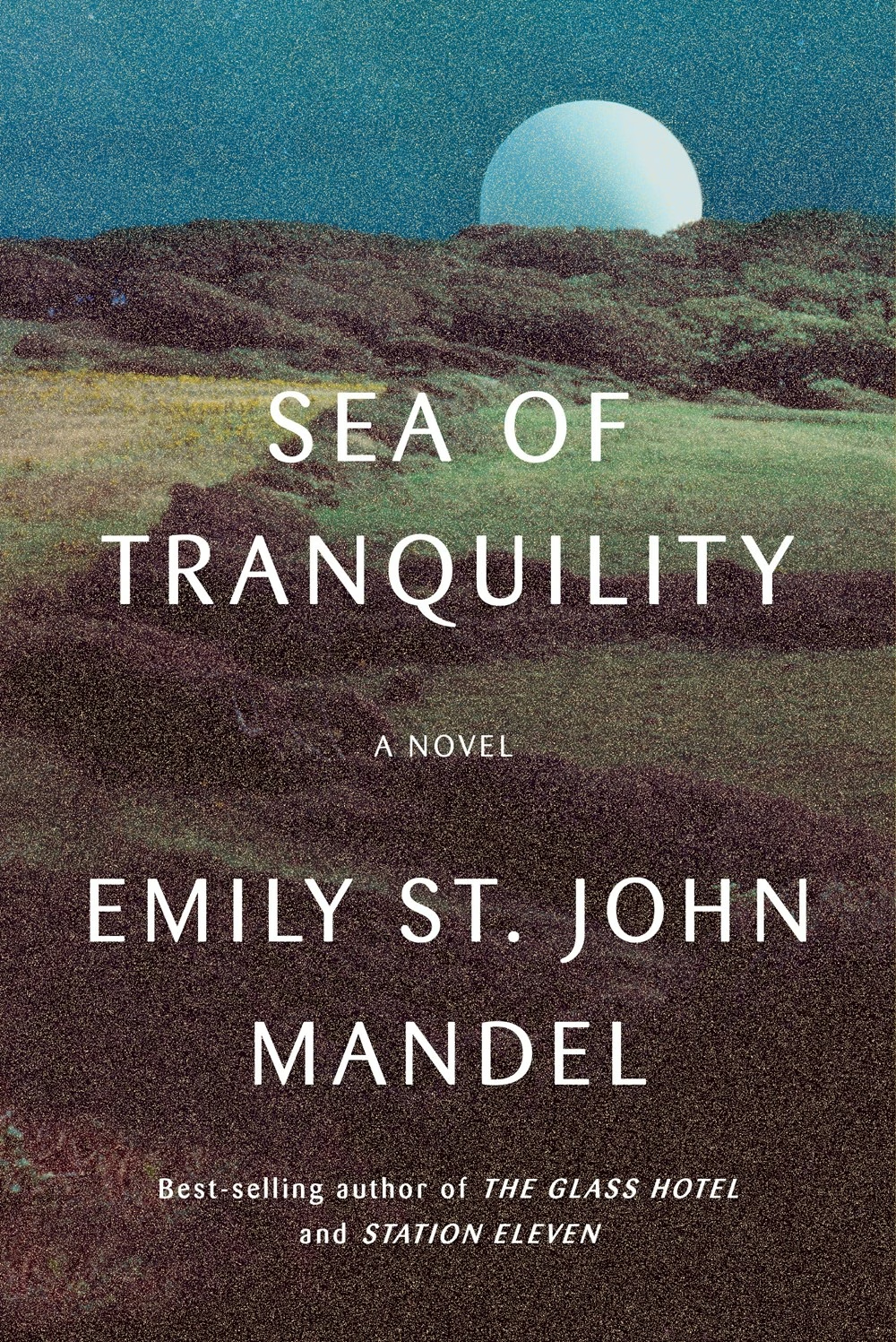
Prices can sometimes be lower on bigger marketplaces, but this link helps independent bookstores and local reading communities.
Quick Verdict
Sea of Tranquility by Emily St. John Mandel is a stunning, intellectually ambitious novel that demands patience before delivering profound rewards. This isn't a conventional time travel story—it's a meditation on identity, reality, and what it means to exist across centuries. If you loved Station Eleven, you'll find this even more rewarding. If you bounced off Mandel's earlier work, this might be the novel that changes your mind.
What This Book Actually Is
The marketing calls this a time travel novel, and while technically accurate, that description misses what makes Sea of Tranquility genuinely special. Yes, the narrative spans from 1912 Vancouver Island to a moon colony in 2203 to a dark Night City in 2401. But Mandel isn't interested in temporal paradoxes or bootstrap loops. Instead, she uses time travel as a philosophical framework to explore something far more intimate: the dissolution of self that happens when you're consumed by performance, by expectation, by the machinery of existence.
The story weaves together four seemingly disconnected narratives. Edwin St. Andrew, an exiled aristocrat, arrives in the Canadian wilderness in 1912 and experiences a moment of inexplicable beauty—a violin's notes echoing through an airship terminal. Two centuries later, Mirella navigates the fractured landscape of 2020 New York during a pandemic. Olive Llewellyn, a famous novelist, tours Earth in 2203 from her home in a moon colony, carrying a strange passage in her bestselling pandemic novel. And Gaspery-Jacques Roberts, a detective in a future Night City, investigates an anomaly that connects all their stories.
The Writing and Structure
Mandel's prose maintains the quiet, contemplative quality that defined Station Eleven, but here it feels more purposeful. The slow-build narrative structure—what might frustrate readers expecting plot velocity—actually serves the novel's thematic core. You're meant to feel untethered, to experience the same temporal disorientation as the characters.
The first 40% moves deliberately, introducing disparate characters and timelines without immediately revealing their connections. This pacing demands trust from the reader. Some will abandon ship here; others will find themselves unable to stop reading by the 60% mark. The turning point arrives when the narrative architecture becomes visible, and suddenly every quiet moment from earlier scenes resonates with new meaning.
Mandel's dialogue feels natural and unforced, particularly in the sections featuring Olive's book tour. The pandemic subplot threads through multiple timelines, creating echoes and variations on themes of isolation, mortality, and what we leave behind. While some readers question whether this recurring motif was necessary, it actually functions as the novel's heartbeat—a reminder that catastrophe is cyclical, that humans are trapped in patterns of crisis and recovery.
What Works Brilliantly
The thematic coherence is extraordinary. Mandel takes seemingly unrelated moments—a violin in a terminal, a writer forgetting her hotel room number, a detective's glimpse of temporal anomaly—and gradually reveals how they're all expressions of the same existential crisis. The novel's central insight, that all times might be one, that identity might be illusory, lands with real emotional weight rather than abstract intellectualism.
Olive Llewellyn's character arc is particularly masterful. Her gradual fragmentation as she moves through time zones and book tour cities, her inability to distinguish between performances and authentic moments, her crisis of meaning—this is where Sea of Tranquility achieves genuine profundity. The scene where she can't remember her hotel room number, where all times collapse into one disorienting present, captures something essential about contemporary existence that feels urgent and true.
The novel also succeeds in making simulation theory feel emotionally resonant rather than philosophically sterile. By the final sections, when the question of whether reality itself might be constructed becomes explicit, you're not reading abstract speculation. You're reading about characters you've come to care about grappling with the terror and potential liberation of that possibility.
Where It Stumbles
The pacing challenge is real. The first third requires significant investment before the payoff becomes apparent. A reader picking this up expecting propulsive narrative will feel frustrated. The structure, while ultimately justified, demands an unusual kind of patience that not every reader will grant.
The pandemic subplots, while thematically coherent, occasionally feel tacked on rather than essential. The Mirella sections in 2020 New York, though beautifully written, don't integrate as seamlessly as the other timelines. Some readers will find this narrative strand adds necessary texture; others will view it as unnecessary digression.
Minor technical issue: character names can create confusion. Vincent, a female character, appears in a section where pronouns might momentarily disorient readers scanning quickly. This is a small stumble in an otherwise meticulously constructed novel.
Who Should Read This
Perfect for: Readers who loved Station Eleven but wanted something even more philosophically ambitious. People interested in time travel as metaphor rather than mechanics. Anyone fascinated by questions of identity, reality, and what it means to perform selfhood in late capitalism. Book club participants seeking rich thematic material for discussion. Fans of literary science fiction who prioritize ideas and emotion over plot velocity.
Probably won't click for: Readers who want fast-paced, plot-driven narratives. People who bounced off Mandel's earlier work and haven't reconsidered. Anyone seeking traditional time travel adventure. Those impatient with slow-burn storytelling. Readers who find pandemic fiction exhausting (fair warning: it's present throughout).
The Verdict on Whether It's Worth Reading
Yes. Sea of Tranquility is absolutely worth reading, though with caveats about pacing and structure. This is Mandel operating at peak ambition, attempting something genuinely difficult: a novel that functions simultaneously as intimate character study, time travel narrative, and philosophical meditation on the nature of reality.
The book's core insight—that maybe there is no meaning, maybe none of it's real, maybe the world is always ending, and maybe that doesn't matter—lands not as nihilistic despair but as strange comfort. In a moment of collective anxiety about pandemic, climate, and societal fracture, Mandel offers something paradoxically hopeful: the possibility that our need to find meaning transcends whether meaning actually exists.
Final Score
8.5/10 — A beautifully constructed, thematically rich novel that rewards patient readers with genuine profundity, though its deliberate pacing and structural complexity won't satisfy everyone seeking entertainment.