Category:
Book ReviewsSea of Charms Review: A Cozy Fantasy That Actually Delivers
Prices can sometimes be lower on bigger marketplaces, but this link helps independent bookstores and local reading communities.
Sarah Beth Durst's Sea of Charms is a rare breed of contemporary fantasy: it's genuinely cozy without feeling boring, romantic without being saccharine, and adventurous without losing its intimate character focus. This is a book that understands what readers actually want from cozy fantasy in 2024—emotional depth wrapped in whimsy, with stakes that matter even when the tone stays warm.
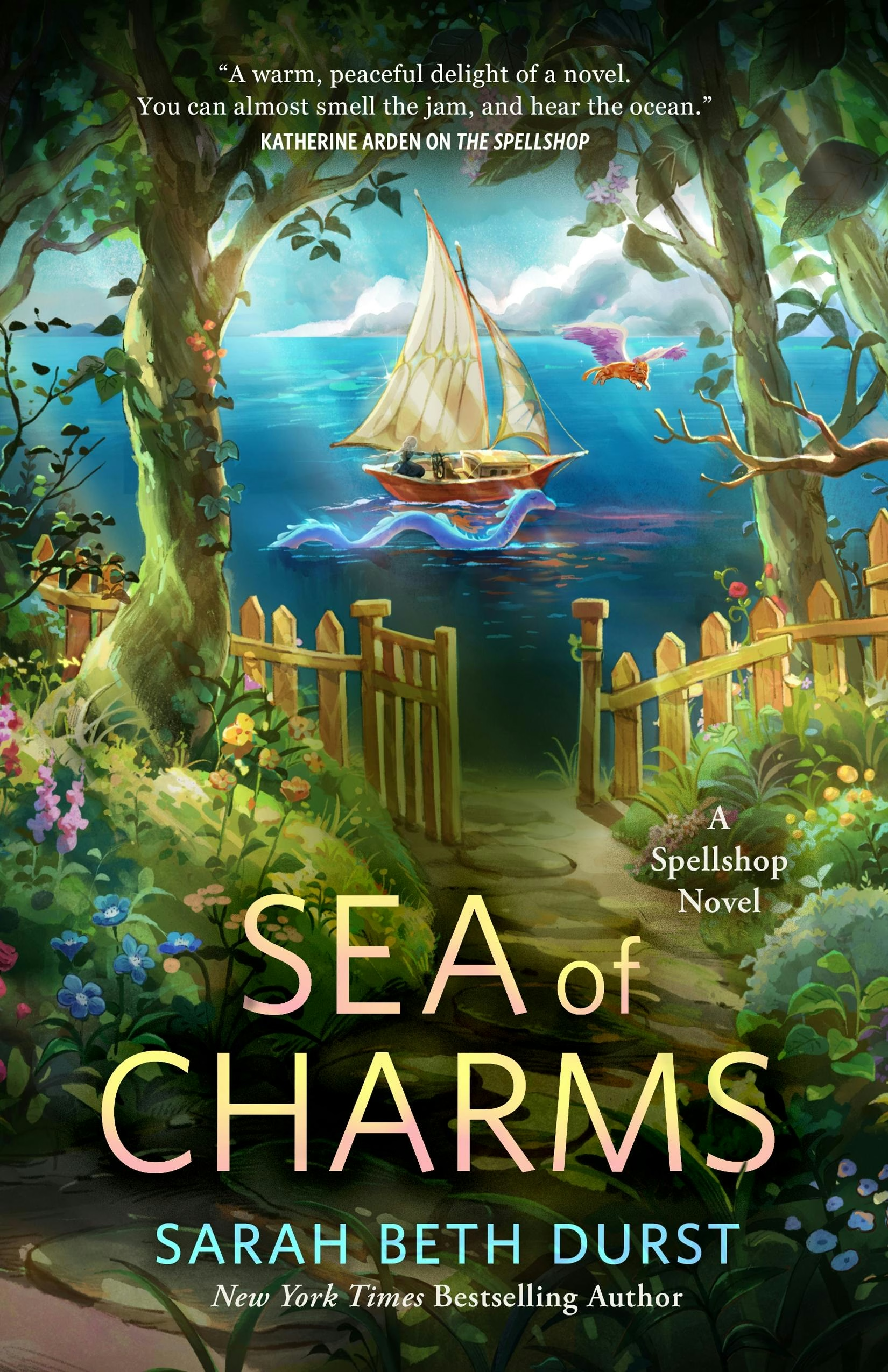
The premise alone is deceptively simple. Marin, a supply runner with her own enchanted boat and a sea serpent companion named Perri, finds herself caught in a revolution when the capital city of Alyssium goes up in flames. What begins as a desperate rescue mission transforms into something unexpected: a chosen family, a love story, and a meditation on healing from emotional manipulation. The genius of this setup is that it doesn't feel contrived. Durst doesn't force Marin into heroism—she stumbles into it, reluctantly, because turning away contradicts who she fundamentally is.
What This Book Actually Is
Sea of Charms exists in an interesting middle ground. It's the third book in Durst's interconnected Crescent Islands world (following The Spellshop and The Enchanted Greenhouse), but it functions as a complete standalone. You won't feel lost diving in here, though readers familiar with the previous books will catch satisfying worldbuilding callbacks. The earlier novels kept their protagonists isolated on islands, shrouding the larger political landscape in mystery. Marin's story reveals what was actually happening in the capital during those events, filling in crucial gaps while telling its own compelling narrative.
The romance angle deserves special attention because it's handled with unusual maturity. Marin's ex-fiancé didn't just break her heart—he manipulated her, embezzled from her family, and left her working grueling supply runs to pay off her parents' debts. When Dax appears, charming and passionate about his music, Marin's resistance isn't melodramatic hesitation. It's trauma. She's genuinely unsure whether opening her heart is worth the risk, whether vulnerability is a luxury someone in her position can afford. The book doesn't dismiss this as something a kiss will fix.
The Ensemble Cast That Actually Works
Most cozy fantasies live or die by their side characters, and Sea of Charms assembles a genuinely delightful crew. Beyond Marin and Dax, there's Perri the sea serpent (who functions as both companion and moral compass), Ree (a sentient sailor plant who steals nearly every scene), and Stowie (a flying cat with personality to spare). What's remarkable is how naturally these characters balance each other. They're not interchangeable quirks—they have distinct voices, conflicting priorities, and actual relationships with one another that develop across the narrative.
Ree especially deserves praise. A talking plant could easily become annoying, but Durst writes this character with genuine warmth and unexpected emotional intelligence. The dynamic between Ree and Marin, between Ree and Dax, between Ree and everyone, reveals something true about found family—that it's not always obvious who belongs in your life until they're already there.
Where the Writing Shines
Durst's prose in this book is genuinely elegant without being overwrought. The sea itself becomes a character—beautiful, dangerous, and indifferent to human drama. There's a sequence early on where Marin navigates through wreckage and chaos that conveys both urgency and the weird, surreal quality of witnessing civilization collapse. The author doesn't linger in misery; she finds the human moments within catastrophe.
The dialogue crackles. Early in the book, Marin tells Dax that books aren't worth more than his life, and he responds: "We will agree to disagree on that." That exchange tells you everything about who these people are. Dax's stubbornness about his instruments, his refusal to abandon art even when facing death, isn't presented as foolish romanticism. It's treated as a legitimate value system—one that ultimately saves him and everyone around him.
The pacing deserves mention too. Sea of Charms is a book that moves. There are genuine high-stakes moments—the sea is deadly, revolution is chaotic, and escape isn't guaranteed. For something marketed as cozy fantasy, it doesn't shy away from real tension.
What Doesn't Quite Land
If there's a weakness here, it's that some readers might find the emotional stakes feel slightly muted compared to the physical adventure. The revolution and the refugee crisis create urgency, but the book never quite interrogates the political dimensions of what's happening. We understand that change is coming to the empire, but we don't deeply engage with whether that change is just, who's being left behind, or what the long-term consequences might be. It's a choice that keeps the focus intimate rather than epic—which works for the book's identity, but might frustrate readers wanting more thematic complexity.
Additionally, the romance arc, while genuinely touching, follows a fairly predictable trajectory once you understand Marin's emotional baggage. The resolution feels earned rather than surprising, which is satisfying but not shocking.
Who Should Read This
Perfect for: Fans of TJ Klune or Travis Baldree who want their fantasy warm but not weightless. Readers who loved The Spellshop series and wanted more of Marin's story. Anyone craving adventure that doesn't require emotional devastation. People who appreciate found family narratives where the family members actually have distinct personalities.
Might disappoint: Readers wanting high-stakes political intrigue or moral ambiguity. Those who need romance to be the absolute center of the narrative rather than one important thread. Fantasy readers who prefer darker tones or grimdark worldbuilding.
How This Compares
If you've read Klune's The House in the Cerulean Sea, you'll recognize that same blend of whimsy and genuine emotion. Both books understand that cozy fantasy isn't about the absence of stakes—it's about the presence of warmth. Sea of Charms is slightly more adventure-focused than Klune's work, with more physical action and travel. Compared to Baldree's He Who Fights with Monsters, Durst's book is far more character-intimate and considerably less focused on system mechanics, though both share that sense of found family as central to the narrative.
The Verdict
Sea of Charms review: This is exactly the book it claims to be, executed with genuine skill. Sarah Beth Durst has written a cozy fantasy that respects its readers' intelligence while delivering exactly what the genre promises—warmth, charm, adventure, and the comfort of belonging. The ensemble cast feels real, the romance earns its emotional weight, and the prose carries you across the sea with genuine pleasure.
Is Sea of Charms worth reading? Yes, absolutely—especially if you've been burned by cozy fantasy that mistakes blandness for coziness. This book proves the subgenre can contain real stakes, real character development, and real magic without sacrificing its fundamental warmth.
Final Score: 8.5/10 — A thoroughly charming adventure that executes its vision flawlessly, with only minor limitations in thematic depth preventing it from reaching the very top tier.