Category:
Book ReviewsScion Review: Stylish Thriller That Sacrifices Depth
Prices can sometimes be lower on bigger marketplaces, but this link helps independent bookstores and local reading communities.
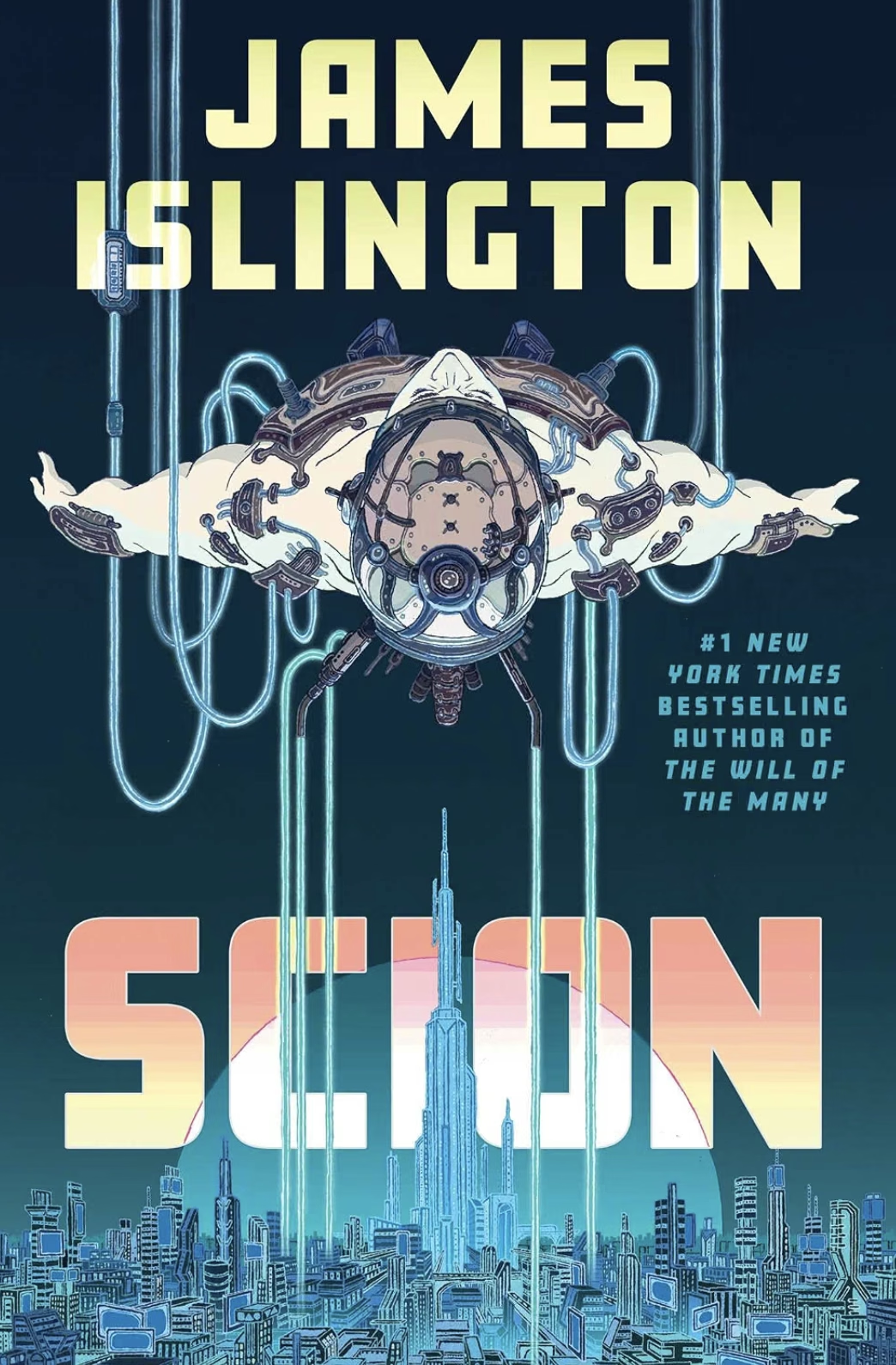
James Islington's Scion is a cyberpunk thriller that arrives with considerable momentum—a New York Times bestselling author pivoting from epic fantasy into fast-paced sci-fi. The premise alone is magnetic: a genetically enhanced assassin tasked with eliminating immortal billionaires in a dystopian future. Yet this Scion review reveals a book that prioritizes velocity over substance, delivering a sleek, entertaining read that ultimately feels hollow beneath its polished surface.
The core tension emerges immediately: Scion is a 240-page sprint that reads like it wants to be a sprawling cyberpunk epic but settles for being a contained thriller. It's exhilarating while you're reading it, then oddly forgettable once you've finished. For readers expecting the philosophical depth and intricate worldbuilding of Islington's The Will of the Many, this book will feel like a step backward dressed up as a genre experiment.
What Scion Is Really About
The marketing suggests one thing: a roving assassin systematically hunting down wealthy immortals. The reality is different. Azure, our protagonist, spends most of Scion not assassinating but protecting—functioning as a bodyguard to a mysterious, aging woman named Jasa who commands vast resources and harbors dangerous secrets.
This bait-and-switch isn't inherently problematic. Protection narratives can be just as compelling as assassination plots. But Islington never commits to exploring either premise with real rigor. The book treats its central conflict as a series of plot beats rather than an opportunity to examine what it means to be a genetically modified killer in a world where death itself has become optional for the wealthy.
The world contains genuinely unsettling details—air can be turned off for those who don't comply with government mandates; human enhancement has blurred the line between person and machine; immortality has created a permanent underclass. These elements should form the backbone of a Blade Runner-style meditation on identity and mortality. Instead, they're window dressing.
The Writing and Style: Snappy But Shallow
Islington's prose in Scion is undeniably readable. Azure's first-person narration crackles with sarcasm and wry humor. The pacing is relentless—there are genuinely no dead chapters, which is rarer than it should be. The banter between Azure and other characters, particularly the hyperintelligent AI assistant Atti, carries real charm and personality.
But readability isn't the same as depth. Azure remains fundamentally flat despite the first-person perspective. We learn what he does, not who he is. His genetic modifications are described in functional terms rather than existential ones. His relationship to his own humanity—a question that should be central to any cyberpunk assassin narrative—never gets serious examination.
The dialogue sparkles, but the worldbuilding whispers. Islington drops provocative details (the air-control system, the legal status of "lifer" assassination, the nature of genetic enhancement) without ever explaining their origins or implications. It's the literary equivalent of a character dropping a cryptic line and walking away before you can ask follow-up questions.
What Actually Works
Despite its limitations, Scion succeeds as a pure thriller. The plot moves with genuine momentum. You want to know what happens next, and the book delivers that satisfaction consistently. The unlikely friendship between Azure and Jasa—the aging woman he's hired to protect—carries unexpected emotional weight. There's a real dynamic there, built on mutual respect and hidden vulnerability.
The action sequences are crisp and kinetic. Islington clearly understands how to choreograph violence on the page. When Scion leans into its thriller DNA, it works. If you're looking for a 4-5 hour read that keeps you turning pages without demanding much intellectual engagement, this book delivers.
The premise itself is clever. The idea of "lifers"—ultra-wealthy individuals who've achieved practical immortality—creating demand for a specific class of assassin-for-hire is a solid sci-fi concept. It's just never interrogated beyond the surface level.
The Real Problem: Questions Without Answers
The fundamental issue with Scion is its refusal to engage with its own ideas. A cyberpunk dystopia works when it explores why the world is broken. What political choices led to this system? What are the actual motives driving the government, the corporations, and the individuals pulling strings? How did enhancement technology reshape society?
Scion asks all these questions implicitly through its worldbuilding but never attempts to answer them. The book feels like the first act of a larger story, which would be fine if it concluded with genuine revelation. Instead, it ends with the same mysteries it began with, leaving readers wondering what the point was.
The 240-page length compounds this problem. There's simply not enough space to establish a complex world and develop meaningful character depth and execute a satisfying plot. Islington chose to prioritize plot, which is a legitimate choice, but it means Scion never becomes the book its premise suggests it could be.
Compare this to Neuromancer by William Gibson, which established cyberpunk conventions in roughly the same page count but created a world that felt lived-in and dangerous. Or Altered Carbon by Richard K. Morgan, which used a similar premise (consciousness transfer, enhanced bodies, immortality for the wealthy) to explore genuine philosophical questions about identity and humanity. Scion sits in their shadow without achieving their ambition.
Who Should Read Scion
Perfect for: Readers who want a fast, entertaining sci-fi thriller without heavy philosophical baggage. Fans of Islington's work who are curious about his genre range. People who value snappy dialogue and breakneck pacing over elaborate worldbuilding. Anyone looking for a quick read that won't demand significant time investment.
Will likely disappoint: Readers expecting the substance and complexity of The Will of the Many. Cyberpunk purists who want genuine exploration of transhumanism, identity, and social collapse. People who need their dystopian fiction to grapple seriously with its own premises. Readers who prefer character-driven narratives over plot-driven ones.
The Misleading Marketing Problem
One legitimate complaint: the book's marketing positions Scion as a story about an assassin hunting immortals. This is technically accurate for perhaps the first 30 pages. The rest of the narrative is something different—a protection thriller with mystery elements. That's not necessarily bad, but it's a misdirection that affects how readers experience the book. If you go in expecting one thing and get another, disappointment follows naturally.
Is Scion Worth Reading?
Yes, if your expectations are calibrated correctly. Scion is worth reading as a stylish, entertaining thriller that happens to be set in a cyberpunk world. It's not worth reading if you expect it to be a thoughtful exploration of transhumanism, immortality, or the nature of consciousness in an age of radical enhancement.
James Islington's Scion is the literary equivalent of a well-crafted action film—engaging in the moment, quickly forgotten afterward. There's nothing wrong with that, but it's important to know what you're getting. The book is perfectly competent at being a thriller. It's just not interested in being anything more.
Final Verdict
Scion is a smooth, readable cyberpunk thriller that prioritizes entertainment over substance. The pacing is excellent, the humor lands, and the plot moves with genuine momentum. But the worldbuilding lacks depth, the main character remains frustratingly opaque despite first-person narration, and the book never grapples seriously with its own fascinating premises. It's a fun weekend read that dissolves from memory by Monday.
The gap between what Scion could have been and what it actually is remains its most interesting quality—which is a shame, because exploring that gap might have made for a better book.