Category:
Book ReviewsRun for Your Life Review: Thrilling But Divisive
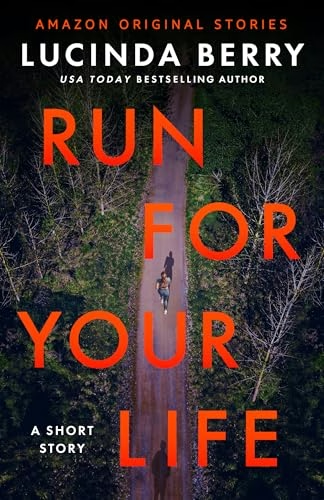
Lucinda Berry's Run for Your Life is a 72-page psychological thriller that promises to be a gripping survival story—and it partially delivers. The novella follows Riley Fletcher, a woman whose ordinary morning run becomes a nightmare when she wakes bound and bleeding in a lakeside cabin, held captive by Dawson Miller, a former coworker with a carefully constructed plan. What makes this Run for Your Life review worth your time isn't just whether the book succeeds, but understanding why it sparks such wildly different reactions from readers.
Berry is a USA Today bestselling author known for crafting intense, character-driven narratives. This novella proves she can generate genuine tension in minimal pages—but it also reveals the limitations of her approach when tackling sensitive subject matter.
What It's About
The premise is straightforward: Riley's routine becomes her prison. After being abducted during a morning jog, she finds herself dependent on her captor for survival. As Dawson tends to her injuries with unsettling care, Riley realizes this abduction isn't random violence—it's methodical, purposeful, and deeply personal. She must decode his motivations while finding a way to escape before his scheme unfolds completely.
The novella also weaves in commentary on America's healthcare system, positioning Dawson's actions as a response to systemic failure. This thematic layer elevates the story beyond a simple kidnapping narrative, though not everyone agrees it works.
The Pacing Problem (and Its Strengths)
At just 72 pages, Run for Your Life doesn't waste time. The action begins immediately and maintains relentless momentum throughout. Readers consistently praise the tight pacing—many report finishing the entire novella in a single sitting, some in as little as an hour and a half. For commuters, those with limited reading time, or anyone craving a quick adrenaline hit, this compressed format is genuinely effective.
The audiobook narration by Elena Rey deserves particular credit here. Reviewers note that her performance transforms the claustrophobic atmosphere into something genuinely unsettling, making the listening experience feel more immersive than the page experience likely is. If you're considering this book, the audio version appears to be the superior format.
Where It Succeeds
Berry demonstrates real skill in creating moral complexity. By the final pages, readers understand multiple perspectives—Dawson's desperation, Riley's terror, and the systemic pressures that led to this collision. This isn't an excuse for anyone's choices, but it adds psychological depth that elevates the story beyond typical thriller fare.
The survival elements feel authentic. Riley's physical limitations after her injuries create genuine stakes; she can't simply overpower her captor or flee into the forest. Her dependence on Dawson for basic care creates an unsettling dynamic that Berry exploits effectively. This psychological tension—the disorientation of being cared for by your abuser—is where the novella finds its strongest footing.
The healthcare commentary also lands with impact. Rather than feeling preachy, it emerges organically from Dawson's backstory and motivations, giving the narrative weight beyond entertainment.
The Controversial Ending
Here's where Run for Your Life becomes genuinely divisive. Some readers find the conclusion emotionally devastating and thematically satisfying. Others feel it's abrupt, unsatisfying, or even ethically problematic.
One significant criticism concerns Riley's agency in a crucial moment. With access to a weapon and an opportunity to protect herself, Riley hesitates—troubled by the fact that Dawson has been "nice to me." For some readers, this felt like a betrayal of the character's survival instinct. The question "Could I really shoot him after he's been nice to me?" prompted one reviewer to respond bluntly: yes, you absolutely could and should.
There's also tension around the book's dedication. Berry wrote this novella in memory of two women who were abducted and killed on runs. Some readers questioned whether depicting an abductor with sympathetic motivations honors that dedication or undermines it. This isn't a flaw in the writing itself, but it's a legitimate ethical concern worth acknowledging.
What Doesn't Work
The novella's brevity is both its greatest strength and its most significant limitation. While the tight pacing keeps readers engaged, many feel the story needed more room to breathe. Numerous readers expressed frustration that such a compelling premise didn't expand into a full novel. The ending, while impactful for some, feels rushed to others—a consequence of trying to resolve complex character arcs and thematic questions in 72 pages.
For readers expecting a traditional thriller with clear resolution and protagonist triumph, Run for Your Life disappoints. This isn't a story where the hero escapes and returns to normalcy. The psychological and physical toll lingers, and the resolution raises as many questions as it answers. If you're seeking cathartic escapism, look elsewhere.
Who Should Read It
Perfect for: Fans of psychological thrillers who appreciate moral ambiguity (think Gone Girl or We Need to Talk About Kevin), audiobook listeners seeking a high-impact short listen, readers interested in healthcare system critique woven into fiction, and anyone who enjoys survival stories with emotional depth.
Skip if: You prefer straightforward plots with clear good-versus-evil dynamics, you want traditional "hero escapes" resolution, you're uncomfortable with stories that humanize perpetrators, or you dislike abrupt endings that leave loose threads.
The Audiobook Advantage
This is worth emphasizing: if you're considering Run for Your Life, the audiobook is demonstrably superior. Elena Rey's narration adds layers of emotion and tension that elevate the experience. The compressed runtime (roughly 90 minutes) also feels more natural in audio format than it might on the page.
Comparing to Similar Works
If you've read The Woman in Cabin 10 by Ruth Ware or Sharp Objects by Gillian Flynn, you know the psychological thriller landscape. Run for Your Life sits somewhere between those works—shorter and less complex than either, but more willing to humanize its antagonist than Ware typically is. It's closer in spirit to a dark short story collection than a traditional novel, which explains why some readers felt satisfied while others craved more.
Final Verdict
7/10 — A punchy, emotionally resonant novella that succeeds as a short thriller but leaves you wanting more.
Lucinda Berry's Run for Your Life is absolutely worth reading if you approach it with realistic expectations. It's not a full novel, and it's not a traditional thriller with a triumphant escape. What it is: a tightly constructed psychological study of desperation, trauma, and the systems that break people. The pacing is relentless, the moral questions are genuinely unsettling, and the audiobook performance is exceptional.
The real question isn't whether this book is "good"—that depends entirely on what you want from it. Is it worth your hour and a half? If you appreciate character-driven narratives, psychological complexity, and aren't seeking traditional resolution, absolutely. If you want a longer, more traditionally structured thriller with clear stakes and closure, you'll likely feel frustrated by its brevity.
Berry has created something that lingers precisely because it refuses easy answers. That's either the book's greatest strength or its most significant flaw, depending on your tolerance for ambiguity. Either way, it's worth experiencing for yourself.