Category:
Book ReviewsRevenge of the Tipping Point Review: Darker, Messier, More Real
Prices can sometimes be lower on bigger marketplaces, but this link helps independent bookstores and local reading communities.
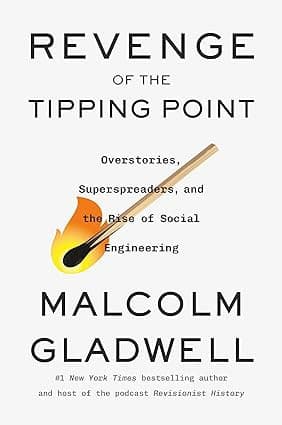
Malcolm Gladwell's Revenge of the Tipping Point arrives twenty-five years after his groundbreaking bestseller with a fundamentally different mission: to show us what happens when social epidemics go wrong. This is not a victory lap. It's a reckoning.
Where The Tipping Point offered an optimistic framework for understanding how ideas spread and change takes hold, Gladwell's new work flips the script entirely. He's no longer asking "How do good ideas go viral?" Instead, he's wrestling with a far more troubling question: "What happens when we weaponize the very mechanisms of social contagion?" The answer, as it turns out, is that we get the opioid crisis, bank robbery epidemics, and the architectural decay of entire cities.
This is Gladwell at his most unsettling—and for many readers, his most important work.
What This Book Actually Does
Revenge of the Tipping Point uses a series of interconnected narratives to explore how small decisions, institutional failures, and demographic shifts can cascade into massive social problems. Gladwell takes us through 1980s Los Angeles to understand a bizarre spike in bank robberies, into the heartland to examine how the opioid epidemic weaponized pharmaceutical marketing, and to a small cul-de-sac in Northern California where an ambitious racial integration experiment revealed uncomfortable truths about human behavior.
The through-line connecting these stories is Gladwell's concept of "the Magic Third"—his argument that profound social shifts occur when a minority reaches approximately one-third of a population. This isn't just academic musing. Gladwell traces how this principle applies to everything from corporate culture to racial demographics to the spread of epidemics.
The book's most provocative sections examine how institutions, companies, and even governments can inadvertently engineer social contagions with catastrophic results. The Sackler family's marketing of OxyContin, the institutional collapse that turned Miami into a drug-money hub, the way television shows can reshape behavior—Gladwell connects these dots to show a pattern most of us miss: we've become dangerously good at triggering tipping points without understanding the consequences.
The Storytelling Machine Still Works
If there's one thing Gladwell does better than almost any nonfiction writer working today, it's narrative architecture. He takes disparate phenomena and finds the hidden connective tissue. The story about cheetah conservation might seem random until you realize it's a meditation on monoculture and fragility. The exploration of why Ivy League schools obsess over sports becomes a window into institutional incentive structures.
This is Revenge of the Tipping Point at its best: when Gladwell uses anecdote as a Trojan horse for complex social science. His investigation into how Miami transformed from a sleepy Southern city into a cocaine-fueled metropolis in 1980 is genuinely gripping—a masterclass in showing how multiple small variables can align to create sudden, dramatic change.
The writing itself remains accessible without being reductive. Gladwell maintains his trademark ability to explain complex research in conversational language. You don't need a sociology degree to follow his arguments, but you also don't feel talked down to.
Where the Book Stumbles
Here's the honest criticism: Revenge of the Tipping Point sometimes feels like a greatest-hits remix rather than a bold new statement. Readers familiar with Gladwell's earlier work on the opioid crisis will find the book's treatment of this subject familiar territory. The OxyContin narrative, while compelling, has been extensively covered elsewhere—and Gladwell's angle, while solid, doesn't quite break new ground the way you'd hope.
More fundamentally, some readers will feel that the book promises more than it delivers. The title suggests a dramatic reversal or comeuppance, but Gladwell's actual argument is more subtle: tipping points are neutral mechanisms that can be exploited for harm just as easily as good. That's intellectually honest but perhaps less dramatic than the marketing suggests.
The concept of "the Magic Third" is intriguing but also somewhat underexplored. Gladwell introduces this idea as central to the book's thesis, yet it sometimes feels like a framework in search of consistent application. The book would have benefited from deeper statistical analysis of when and why this principle holds—and when it doesn't.
Additionally, some chapters feel slightly disconnected from the central thesis. The exploration of why cheetahs are vulnerable to disease, while fascinating, requires a longer inferential leap to connect back to human social dynamics than Gladwell typically requires of readers.
The Tone Shift That Matters
What makes Revenge of the Tipping Point worth engaging with—even if you find it imperfect—is its fundamental shift in perspective. Gladwell has moved from "Here's how to engineer positive change" to "Here's how easily we engineer catastrophe." This is maturity. This is a writer reconsidering his own earlier optimism.
The book reads as more personal than Gladwell's previous work. He's genuinely troubled by what he's discovered about how institutions fail, how good intentions pave roads to disaster, and how the same mechanisms that spread Sesame Street can spread an addiction epidemic. That moral seriousness comes through in every chapter.
Who Should Read This (and Who Won't)
Read this if: You enjoyed The Tipping Point but wanted a more complex, less triumphalist follow-up. You're interested in how systems fail and institutions enable harm. You like narrative nonfiction that combines storytelling with social science. You want to understand the mechanisms behind modern crises like the opioid epidemic. You appreciate Gladwell's writing style but wish he'd grapple more directly with unintended consequences.
Skip this if: You want optimistic, actionable self-help advice. You're tired of Gladwell's narrative style and want dense academic analysis instead. You're looking for radical new frameworks rather than refinements of existing ones. You've already read extensively about the opioid crisis and want something completely fresh. You prefer books with clear solutions rather than complex problem diagnosis.
The Verdict
Revenge of the Tipping Point is a solid, important book that doesn't quite reach the heights of Gladwell's best work, but surpasses much of what came between The Tipping Point and now. It's worth reading if you're willing to sit with uncomfortable questions about how easily good intentions curdle into catastrophe.
Is Revenge of the Tipping Point worth reading? Yes—but with the understanding that it's a more sobering, less triumphalist book than you might expect. Gladwell has matured as a thinker, and while that means less prescriptive optimism, it means more intellectual honesty.
The book's central insight—that tipping points are morally neutral mechanisms waiting to be exploited—is genuinely important for understanding modern crises. In a world obsessed with "going viral" and "scaling" and "exponential growth," Gladwell's darker vision feels like necessary corrective medicine.
Final Score: 7.5/10 — A thoughtful, well-written exploration of social contagion's dark side that doesn't quite revolutionize the conversation but meaningfully complicates it.