Category:
Book ReviewsRebel Girl Review: Raw, Honest, Frustratingly Incomplete
Prices can sometimes be lower on bigger marketplaces, but this link helps independent bookstores and local reading communities.
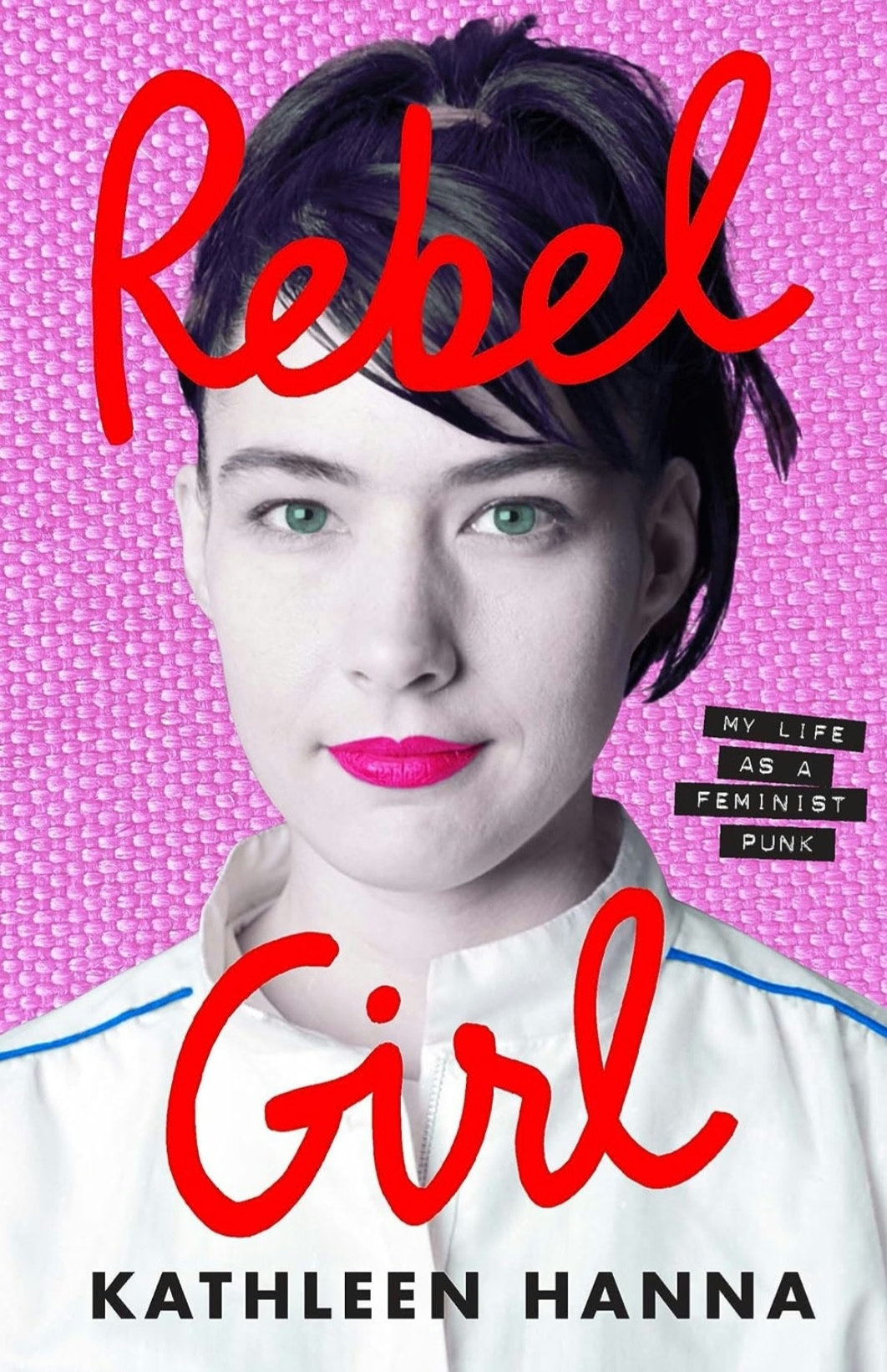
Kathleen Hanna's Rebel Girl: My Life as a Feminist Punk is a memoir that refuses to play it safe—which is exactly what you'd expect from the woman who screamed "Rebel Girl" into the face of 1990s misogyny. Published to immediate critical acclaim and hitting the New York Times bestseller list, this 400-page chronicle of Hanna's journey from troubled childhood through the riot grrrl movement delivers the raw honesty fans anticipated. Yet it also exposes a fundamental contradiction that will either fascinate or infuriate you: a woman desperate to reach vulnerable girls everywhere, who repeatedly chose artistic purity over the platform that could have amplified her message to millions.
Hanna doesn't hide from this tension. She documents it meticulously, which is both the book's greatest strength and its most maddening limitation.
What This Memoir Actually Covers
Rebel Girl spans decades of Hanna's life with surgical precision. The narrative moves chronologically from her chaotic childhood in Portland—marked by her father's mental illness and her mother's struggle to survive—through her formative years at Evergreen State College, where she encountered the artistic communities that would shape her forever.
The bulk of the memoir focuses on Bikini Kill's formation and rise, the explosion of the riot grrrl movement, and Hanna's subsequent projects with Le Tigre and The Julie Ruin. She writes extensively about her relationship with Ad-Rock of the Beastie Boys, her battle with Lyme disease, and her complicated feelings about the movement she helped create. Throughout, she weaves in encounters with Kurt Cobain, Ian MacKaye, Kim Gordon, and Joan Jett—cultural touchstones that ground her story in a specific moment in music history.
What makes this memoir distinct from typical rock memoirs is Hanna's willingness to examine her own complicity, her failures, and her contradictions. She doesn't present herself as a flawless revolutionary. She presents herself as a person trying to do good work while making decisions that often undermined that very goal.
The Writing: Intimate, Unvarnished, Occasionally Scattered
Hanna's prose style mirrors her music: direct, unapologetic, and occasionally repetitive. Short chapters—many just 3-4 pages—create a digestible rhythm that works beautifully in audiobook format (which many readers praised). She doesn't burden you with flowery description or unnecessary context. When she describes pain, humiliation, or joy, the language is spare and immediate.
The weakness in Hanna's writing emerges when she circles back to the same emotional wounds repeatedly. Her feelings about the punk community's gatekeeping, her frustration with being dismissed, her anger at male violence—these themes recur throughout the book with diminishing impact. By the third or fourth iteration, the reader begins to feel trapped in the same loop rather than experiencing narrative progression.
That said, when Hanna focuses on specific moments—a conversation with Kurt Cobain about depression, a sexual assault she experienced, the moment she realized she was sick with Lyme disease—her prose cuts like a scalpel. These passages justify the memoir's existence.
Where the Memoir Succeeds: Nuance Over Mythology
The most valuable aspect of Rebel Girl: My Life as a Feminist Punk is Hanna's refusal to mythologize the riot grrrl movement. She loved it. She was shaped by it. She also recognized its exclusivity, its cruelty toward women who didn't fit the aesthetic, and its tendency to police its own members.
This nuanced perspective is rare in music memoirs, which typically veer toward either hagiography or scorched-earth critique. Hanna holds both truths simultaneously: the movement was revolutionary and necessary, and it was also limited by the very insularity that made it feel safe.
Her account of specific incidents—the violence at shows, the misogyny within punk spaces, the way male musicians could behave with impunity—provides historical documentation that matters. These aren't abstract complaints. They're concrete examples of why the riot grrrl movement emerged as a necessary response to real, documented harm.
The book also excels at capturing the texture of pre-internet DIY culture. Hanna describes zine-making, tape-trading, and grassroots organizing with the specificity of someone who actually lived it. Readers too young to have experienced the 1990s underground music scene will find this historical detail invaluable.
The Central Frustration: Success Deferred
Here's where Rebel Girl becomes genuinely difficult to read, and where reader responses diverge sharply: Hanna spends enormous energy describing how she and her bands achieved enough success to attract intense scrutiny and pressure, but deliberately rejected the infrastructure that could have protected them or sustained them financially.
She was terrified of being labeled a "sell-out" by a punk community that defined success as suffering. So Bikini Kill remained perpetually underfunded, undersupported, and exhausted. Hanna contracted Lyme disease partly due to the physical toll of touring without adequate resources. She never earned a living wage from her music. She had no health insurance.
Meanwhile, Dave Grohl—who occupied the same Seattle punk spaces—moved into superstardom, earned fair compensation, and built a sustainable career. Hanna literally came up with the title for one of Foo Fighters' songs, yet watched from the outside as her peer reaped benefits she actively rejected.
The book documents this contradiction without fully resolving it. Hanna seems aware that her commitment to punk authenticity may have ultimately limited her ability to reach the vulnerable women she desperately wanted to help. Yet she doesn't quite bring herself to say: "I made a mistake." Instead, she frames it as an inevitable collision between artistic integrity and commercial success—a framing that feels incomplete.
This is where the memoir divides readers. Fans find Hanna's commitment to her principles inspiring. Critics see a talented artist who chose symbolic resistance over practical impact, then spent decades processing that choice.
What Doesn't Quite Land
The relationship narrative with Ad-Rock, while genuinely interesting, sometimes overwhelms the broader story. Hanna devotes significant space to this romance, but readers seeking deeper exploration of her creative process or her artistic evolution may feel shortchanged.
Additionally, the book's treatment of other women in her orbit occasionally feels underdeveloped. Hanna mentions conflicts with figures like Courtney Love but doesn't always dig into the complexity beneath the surface-level drama. The memoir works best when Hanna examines her own psychology; it's less compelling when she's cataloging grievances against others.
The final sections covering her post-Bikini Kill projects feel rushed compared to the detailed early chapters. The Julie Ruin and Le Tigre deserve more space, particularly given how these projects represent her continued evolution.
Who Should Read This Book (And Who Shouldn't)
Perfect for: Bikini Kill fans seeking the real story behind the legend. Feminists interested in 1990s activism and how grassroots movements actually functioned. Anyone who lived through or is curious about pre-internet DIY music culture. Readers who appreciate memoirs that don't shy away from the author's contradictions and failures. Music journalists and historians documenting the riot grrrl era.
Will frustrate: Readers seeking an unambiguous triumph narrative. People looking for juicy celebrity gossip without substantive reflection. Those expecting a detailed musical analysis or creative breakdown of Hanna's songwriting process. Anyone uncomfortable with extended discussions of sexual assault, mental illness, and chronic disease.
How It Compares to Similar Memoirs
If you've read Just Kids by Patti Smith, you'll recognize the same blend of artistic memoir and cultural history. Both books situate the author within a specific time and place while exploring how communities form around art. However, Hanna's memoir is angrier and less romantically nostalgic than Smith's lyrical account.
Compared to The Autobiography of Malcolm X, Rebel Girl shares the same commitment to unflinching self-examination and the willingness to critique movements the author helped create. Hanna, like Malcolm X, refuses the comfort of hagiography.
The book sits somewhere between music memoir (like Born to Run by Bruce Springsteen) and feminist polemic. It's neither pure storytelling nor pure argument—it's a hybrid that works most of the time and occasionally stumbles.
The Verdict
Rebel Girl: My Life as a Feminist Punk is absolutely worth reading, but not for the reasons you might expect. It's worth reading because Hanna refuses to give you the comfortable narrative you want. She won't let you make her a martyr or a failure. She won't simplify the riot grrrl movement into either a triumph or a tragedy. She sits with the mess, documents it thoroughly, and asks you to do the same.
The memoir succeeds most powerfully when it functions as historical documentation—a firsthand account of how DIY feminist activism actually worked in the 1990s, complete with all its contradictions and limitations. It's less successful as a redemption narrative or a straightforward success story, but that's precisely why it matters.
Hanna's honesty about her own choices—the ways she sabotaged her own success in service of punk purity—is uncomfortable to read. But that discomfort is the point. She's asking you to sit with questions about artistic integrity, feminist activism, and the costs of refusing compromise. She's not offering easy answers, and that refusal to simplify is what makes this memoir genuinely important.
If you want an inspiring story about a rebel girl who changed music and culture while maintaining her principles perfectly, you'll be disappointed. If you want a raw, complicated account of what it actually cost to be a feminist punk in the 1990s—and what it might have cost to refuse certain opportunities—this book is essential reading.