Category:
Book ReviewsRasputin: The Downfall of the Romanovs Review
Prices can sometimes be lower on bigger marketplaces, but this link helps independent bookstores and local reading communities.
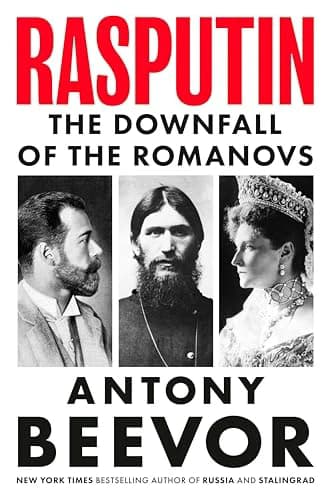
Antony Beevor's Rasputin: The Downfall of the Romanovs is a masterclass in historical myth-busting that arrives at a deliberately counterintuitive conclusion: one of history's most legendary figures was actually just a lecherous drunk who happened to mesmerize the wrong person at the right moment. This is not the Rasputin of popular imagination—the mystical Siberian sorcerer draped in supernatural intrigue. Instead, Beevor, the acclaimed master of narrative history, pulls back the dense fog of legend to reveal something far more mundane yet infinitely more damaging to an empire: a barely literate peasant who exploited a mother's desperation to save her son.
What This Book Actually Delivers
Beevor frames this work explicitly as "not a conventional biography" but rather an exploration of the space between truth and myth. That distinction matters because readers often approach historical books expecting definitive answers. What they get instead is something more intellectually honest: an examination of how Rasputin became Rasputin through the lens of those around him, particularly the Tsarina Alexandra.
The book draws heavily from Russian archives, featuring previously unpublished reports, interviews, and interrogations that have only recently become accessible. This scholarly foundation gives Rasputin: The Downfall of the Romanovs review-worthy credibility, even when Beevor's conclusions challenge established narratives.
The core argument is both simple and devastating: Rasputin contributed more to the collapse of the Romanov dynasty than any revolutionary or political force. Not through cunning manipulation or mystical powers, but through his ability to convince one traumatized woman—the Tsarina—that he alone could heal her hemophiliac son. That singular relationship, built on desperation and reinforced by isolation, poisoned the entire imperial household and accelerated Russia's descent into revolution.
The Writing: Accessible Without Being Shallow
One of Beevor's greatest strengths is his ability to make complex historical narratives feel like compelling storytelling. Rasputin: The Downfall of the Romanovs moves with genuine momentum despite its scholarly apparatus. Paragraphs are punchy. Scenes are vivid. The prose never collapses into academic jargon or pedantic detail-mongering.
This accessibility makes the book particularly effective in audio format, where Beevor's narrative drive keeps listeners engaged across hours of material. The audiobook performs admirably, though some listeners have noted pronunciation issues with Russian surnames—a minor but noticeable flaw that doesn't undermine the substance.
What Works Brilliantly
Beevor's decision to focus on Rasputin's influence rather than his biography is inspired. By examining how others perceived him, how rumors about him spread, and how his reputation became weaponized, the author captures something essential about how historical myths are constructed. Rasputin becomes less a character and more a mirror reflecting the desperation, corruption, and dysfunction of the imperial court itself.
The book also excels at contextualizing Rasputin within the broader collapse of the Romanov dynasty. Unlike more conventional biographies that treat their subjects as central to all events, Beevor shows how Rasputin was simultaneously crucial and almost incidental—a symptom rather than the disease. Tsar Nicholas II's unsuitability for power, the Tsarina's isolation and paranoia, the predatory sycophants surrounding the throne: these factors would have destabilized the empire regardless of Rasputin's presence.
The final section detailing Rasputin's assassination is genuinely darkly comic—a farcical series of failed attempts that reads like dark comedy. Poison doesn't work. Bullets don't stop him. The bungling incompetence of his would-be assassins almost redeems the narrative arc of his life, providing a finale that feels appropriately absurd for a man whose entire legend rests on exaggeration.
Where It Falls Short
Here's where honest criticism matters: Rasputin: The Downfall of the Romanovs is considerably shorter than readers familiar with Beevor's other works might expect. Several chapters feel rushed and summarized rather than fully explored. The imperial court's complexity deserves more space than it receives, particularly the dynamics between different courtiers and their competing interests.
The decision to stop at the February Revolution, with only passing mention of the Romanovs' execution, feels incomplete. Readers expecting a full accounting of Rasputin's legacy and the family's ultimate fate may feel shortchanged. The book's ending is somewhat abrupt, leaving certain narrative threads dangling.
For readers new to Russian history, the continuous stream of secondary characters—many appearing briefly with difficult-to-retain Russian names—can prove genuinely challenging. The book assumes a baseline familiarity with the late imperial period that not all readers possess. A genealogical chart or character guide would have significantly improved accessibility.
Who Should Actually Read This
Perfect for: History enthusiasts with prior knowledge of the Russian imperial period, readers interested in how historical myths are constructed, fans of Beevor's narrative approach to history, anyone who's read Robert Massie's Nicholas and Alexandra and wants a complementary perspective, audiobook listeners who appreciate engaging storytelling with scholarly substance.
Probably not ideal for: Readers encountering Russian history for the first time, those expecting a conventional biography of Rasputin, readers seeking a complete account of the Romanov family's fate, people who prefer lighter historical narratives without complex court politics.
The Verdict
Is Rasputin: The Downfall of the Romanovs worth reading? Absolutely—but with caveats about your existing knowledge of Russian history. Beevor delivers exactly what he promises: a rigorous, myth-busting examination of how one unremarkable man became a legend through the desperate needs of those around him. The book succeeds brilliantly at its stated purpose, even if it sometimes leaves readers wanting more depth.
Compared to Massie's dual biography of Nicholas and Alexandra, which provides broader imperial context, Beevor's book offers a tighter focus on Rasputin's specific role in the dynasty's collapse. It's complementary rather than redundant—a different angle on the same historical tragedy.
The prose is engaging, the research is solid, and the central argument is genuinely thought-provoking. The relatively brief length and occasional pacing issues prevent this from being a masterpiece, but they don't significantly diminish its value for engaged readers.
Final Score: 7.5/10 — A sharp, myth-busting historical narrative that succeeds at its specific purpose, though it occasionally leaves readers wanting deeper exploration and fuller resolution.