Category:
Book ReviewsPublic Access Afterworld Review: Brilliantly Weird
Prices can sometimes be lower on bigger marketplaces, but this link helps independent bookstores and local reading communities.
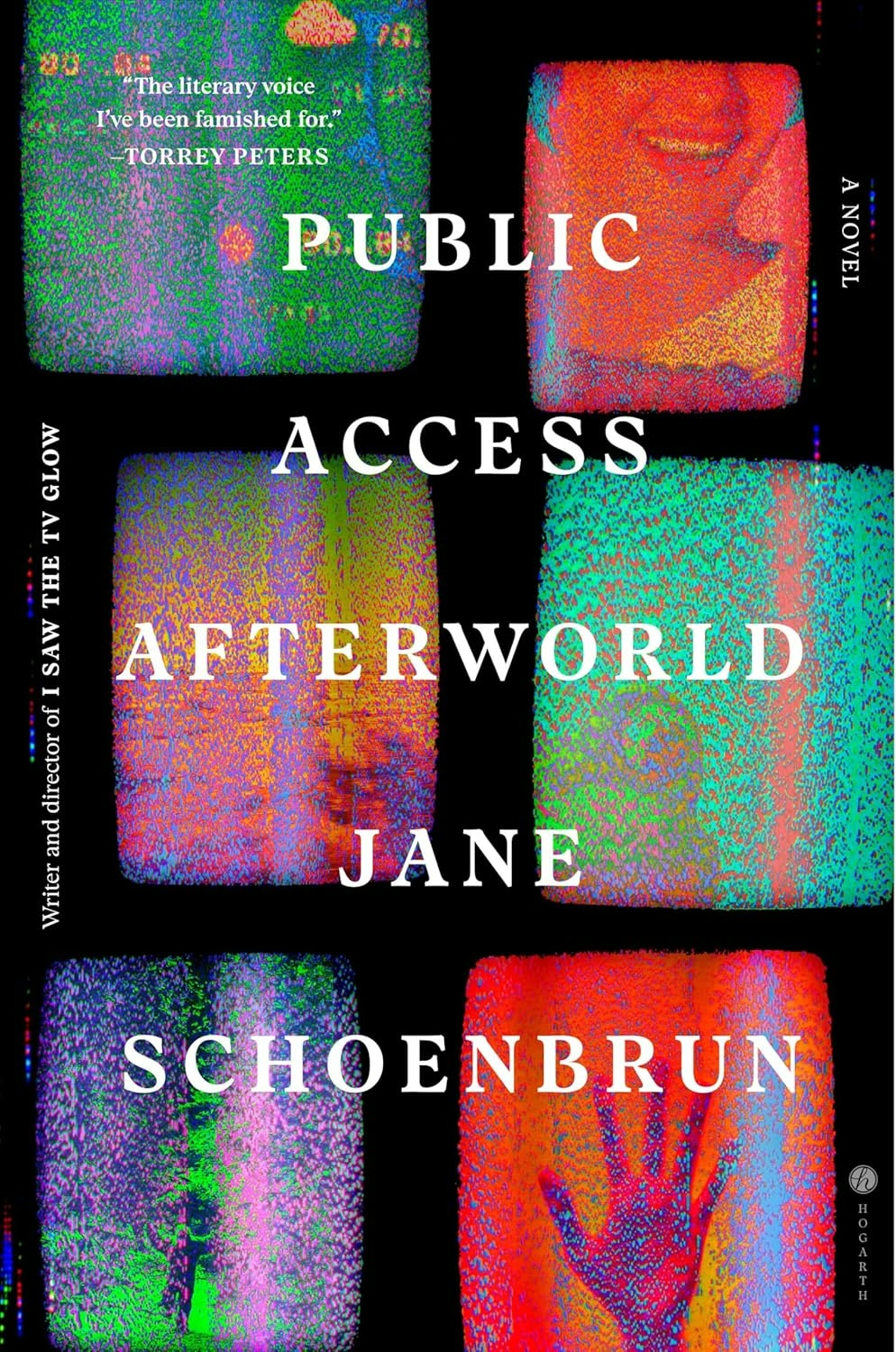
Jane Schoenbrun's Public Access Afterworld is a disorienting, ambitious descent into a fictional realm that exists in television static—and it's the kind of book that will either captivate you completely or drive you to abandon it halfway through. This debut novel from the filmmaker behind I Saw the TV Glow swings for the fences with a premise that feels genuinely fresh: a mysterious pirate TV network accessible only through the analog-to-digital transition, populated by victims and conspiracies spanning decades. The question isn't whether it's weird—it absolutely is. The real question is whether you're willing to surrender to that weirdness, or whether you'll resent the book for refusing to explain itself.
A Premise That Demands Attention
The novel opens with a striking image: Dallas weatherman Ray "Can You Say Sunshine" Davino references something called Public Access Afterworld during a rambling monologue in 1988, moments before he takes his own life on live television. This isn't a gentle entry point. From there, Schoenbrun jumps forward to 2009, where suburban teens David Sawyer and Erin Morrison witness something impossible in the static of their TV during the digital transition. Then we leap again to 2026, where Bethany Peters, a burned-out trans content moderator at a megacorp, begins encountering cryptic videos referencing the same phenomenon.
It's a structure that mirrors the fragmented nature of conspiracy culture itself—disconnected moments that might mean everything or nothing. This is where Public Access Afterworld distinguishes itself from typical speculative fiction. Rather than spoon-feeding readers a mythology, Schoenbrun trusts the audience to piece together what's real, what's metaphorical, and what's simply the paranoid pattern-matching of desperate people.
What Actually Works Here
The novel's greatest strength is its character work. Bethany Peters emerges as a fully realized protagonist—messy, paranoid, self-doubting, but ultimately compelling in ways that feel authentic to the digital age. She's not a chosen one; she's a exhausted moderator who stumbles into something larger than herself. The supporting cast avoids the trap of feeling like mere plot devices. David and Erin's relationship doesn't feel manufactured. The various conspiracy theorists and outcasts who populate the narrative have distinct voices and genuine stakes.
Schoenbrun's prose also captures something genuinely unsettling about how we experience media in the 21st century. There's a real horror in the image of endless content streams, of moderating atrocities for a wage, of being trapped between screens. The book understands that the true nightmare isn't necessarily an external threat—it's the numbness that comes from constant exposure to horror.
The thematic ambition is undeniable. By anchoring the narrative in television history—from the analog era through the digital transition to contemporary streaming—Schoenbrun creates a meditation on how media shapes consciousness, how communities form around shared viewing experiences, and how the American dream gets refracted through the lens of entertainment. It's Mulholland Drive filtered through Reddit conspiracy forums.
Where It Loses the Thread
Here's the honest part: Public Access Afterworld is a book that some readers will describe as a masterpiece and others will find fundamentally frustrating. The criticism isn't unfair. The novel genuinely does pile multiple ideas into its 600+ pages without fully resolving them. What exactly is Public Access Afterworld? A government experiment? A collective delusion? A supernatural entity? A cult? The book gestures toward answers without ever providing them definitively.
For some readers, this ambiguity is the point—it mirrors how conspiracy thinking actually works, how patterns emerge and dissolve in the static of incomplete information. For others, it feels like the author is dodging the fundamental work of narrative construction. There's a real difference between intentional mystery and narrative evasion, and Public Access Afterworld occasionally slides into the latter.
The pacing also falters. The middle section drags in ways that feel purposeful but exhausting. Some readers will interpret this as an intentional mirror of the tedium of content moderation; others will simply find it tedious. The repetitive use of full names with nicknames in parentheses—"Anthony 'Fisch' Fischer"—becomes genuinely distracting rather than atmospheric. These aren't minor quibbles; they're structural choices that either work for you or they don't.
The ending, while not unsatisfying, arrives abruptly. After spending significant time with these characters on their journey, the resolution feels compressed, leaving readers wanting more closure than the narrative provides.
Who Should Actually Read This
Perfect for: Readers who loved I Saw the TV Glow and want more of Schoenbrun's sensibility in prose form. Fans of David Lynch, Paul Thomas Anderson, and experimental storytelling. People interested in media criticism disguised as fiction. Readers who enjoy conspiracy narratives and don't mind ambiguity. Anyone who understands that "I don't understand what's happening" can be a feature, not a bug.
Probably skip it if: You need clear plot resolution and definitive answers. You prefer traditional narrative structure over fragmentation. You value straightforward pacing over atmospheric wandering. You find conspiracy culture more tiresome than fascinating. You want characters to explicitly explain what's happening rather than discover it alongside you.
The Verdict
Public Access Afterworld is genuinely worth reading if you're the right reader for it. This isn't a book for everyone—it's deliberately, unapologetically strange. But it's also genuinely ambitious in ways that contemporary fiction rarely attempts. Schoenbrun has created something that feels like a novel only this author could write, which is the highest compliment you can give a work of fiction.
The real question isn't whether the book is good—it objectively is, even for readers who find it frustrating. The question is whether you're willing to accept a novel that refuses to hold your hand, that trusts you to sit with uncertainty, and that finds horror not in jump scares but in the slow dissolution of meaning in an age of infinite content. If that sounds appealing, Public Access Afterworld is essential reading. If it sounds exhausting, you're probably right to pass.
Final Score
8/10 — A visionary, messy, deliberately challenging novel that demands active reading and rewards those willing to surrender to its logic.