Category:
Book ReviewsProfits, Prophets, Coaches, and Kings Review
Prices can sometimes be lower on bigger marketplaces, but this link helps independent bookstores and local reading communities.
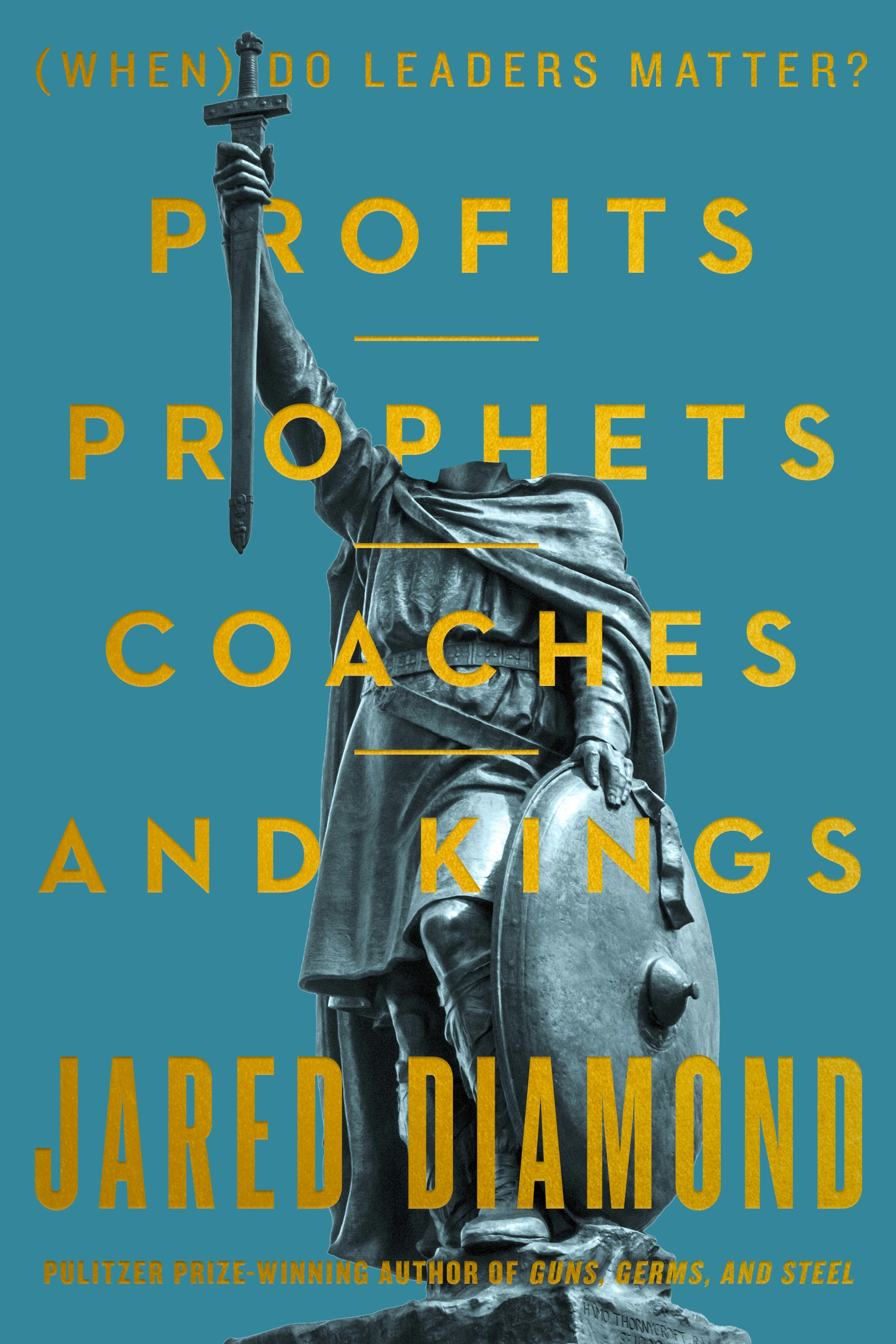
Jared Diamond's latest work, Profits, Prophets, Coaches, and Kings: (When) Do Leaders Matter?, tackles one of history's most compelling questions: can individual leaders genuinely reshape the course of human events, or are they merely passengers on forces far larger than themselves? After delivering the sweeping geographical determinism of Guns, Germs, and Steel and the cautionary collapse narratives of Collapse, Diamond attempts something more elusive here—a rigorous examination of leadership's actual impact across politics, business, sports, and religion. The verdict? Frustratingly honest, occasionally brilliant, and ultimately unsatisfying for readers seeking clear answers.
The Central Paradox
Diamond's fundamental insight is deceptively simple: leadership matters, but only under specific conditions. A leader's effectiveness depends on three interlocking factors—personal ability (charisma and organizational skill), timing, and contextual power. Dictators wield more unilateral authority than democratic leaders. Tech CEOs can reshape industries faster than university presidents. College basketball coaches operate in a more controlled environment than political figures navigating institutional constraints. This framework isn't revolutionary, and therein lies the book's central tension.
The real question isn't whether Diamond identifies these factors—he does, methodically. The question is whether spending 300 pages exploring this framework justifies the ambitious title. Some readers will find the nuance refreshing; others will feel the book oversells a relatively straightforward observation.
What Actually Works
The Botswana chapter stands as this book's undeniable triumph. Diamond's examination of Seretse Khama, the country's founding president, demonstrates how a singular individual can genuinely alter national trajectory. In 1966, Botswana ranked among the world's poorest nations. By the 1990s, it had become one of Africa's most prosperous economies. Diamond makes a compelling, evidence-based case that Khama's particular combination of integrity, vision, and political acumen—paired with the fortunate timing of diamond discovery and his willingness to navigate racial tensions during apartheid-era Southern Africa—created something genuinely irreplaceable.
This chapter works because Diamond doesn't simply assert Khama's importance; he demonstrates it through comparative analysis. He shows what similar nations with different leadership trajectories actually experienced. It's the "natural experiment" methodology at its finest—using history as a quasi-laboratory when controlled experiments remain impossible.
The business and sports sections maintain intellectual honesty by refusing to force a predetermined narrative. Diamond examines CEO effectiveness data and coaching records with genuine skepticism. Sometimes the evidence suggests individual leaders dramatically move the needle; sometimes it suggests they're essentially interchangeable with competent alternatives. This willingness to let data land where it lands—rather than bending findings toward a predetermined thesis—distinguishes this book from typical leadership cheerleading.
Where the Analysis Fractures
The Rachel Carson chapter exposes the book's central weakness. Diamond argues that Carson was essentially irreplaceable—that Silent Spring could only have come from her particular pen, and that environmentalism wouldn't have achieved similar momentum without her. Yet this claim crumbles under scrutiny. The scientific evidence against DDT was accumulating regardless. Multiple researchers were documenting ecological damage. The postwar environmental consciousness was already stirring in the cultural zeitgeist. Carson accelerated and focused these currents beautifully, but claiming only she could have sparked the movement inflates her singular importance.
This represents a recurring problem: Diamond sometimes overstates how cleanly his "natural experiments" actually isolate individual leadership effects. Historical situations rarely provide the controlled variables he needs. Confounding factors proliferate. The comparison framework, while intellectually clever, occasionally glosses over genuine complexity.
Moreover, readers seeking specific guidance on leadership development will find this book frustratingly abstract. Diamond analyzes why certain leaders succeeded in particular moments, but the book offers limited actionable insight for aspiring leaders navigating contemporary challenges. It's history and analysis, not a leadership manual—a distinction that matters for readers with different expectations.
The Intellectual Honesty Problem
Here's the uncomfortable truth: Diamond's refusal to provide a definitive answer to his central question feels both refreshingly honest and fundamentally evasive. The book's subtitle asks "(When) Do Leaders Matter?" but the answer remains largely indeterminate. Yes, under certain conditions, with particular abilities, in specific historical moments, leaders shape events. But quantifying that impact, predicting when it will occur, or identifying future leaders who will matter remains largely impossible.
This isn't necessarily a flaw. Intellectual honesty about the limits of our knowledge has value. But it also means the book doesn't quite deliver on its premise. Readers picking this up expecting Diamond to definitively resolve the great-man-versus-historical-forces debate will close it frustrated.
Writing and Accessibility
Diamond remains an exceptional writer. His prose moves efficiently without sacrificing clarity. He makes complex historical and biographical material genuinely engaging. The book never feels like a slog through academic abstraction. This accessibility is crucial—a less skillful writer tackling the same material would produce something far less readable. Diamond's ability to make historical analysis feel like conversation rather than lecture elevates the entire project.
Who Should Actually Read This
This Profits, Prophets, Coaches, and Kings review must be honest about audience fit. The book works brilliantly for readers who enjoyed Diamond's earlier works and appreciate his particular approach to historical analysis. History enthusiasts interested in biographical depth will find rich material. Readers skeptical of simplistic "great man" theories of history will appreciate Diamond's methodological rigor.
Skip this book if you want actionable leadership frameworks, prescriptive advice, or definitive answers. Skip it if you found Guns, Germs, and Steel overly deterministic and wanted Diamond to correct course rather than double down on systemic analysis. Skip it if you prefer narrative history to analytical examination.
Buy it if you're genuinely curious about how historians can isolate individual impact in complex historical situations. Buy it if you want to think deeply about contingency, timing, and the interplay between individual agency and structural forces. Buy it if you simply enjoy Diamond's intellectual company, even when you're arguing with him.
The Verdict
Jared Diamond's Profits, Prophets, Coaches, and Kings asks the right questions but settles for partial answers. The Botswana analysis justifies the book's existence alone. The intellectual framework—while not revolutionary—provides useful scaffolding for thinking about leadership effectiveness. Yet the book's refusal to decisively answer its central question, combined with occasional overreach in specific case studies, prevents it from achieving the ambition its title promises.
Is this book worth reading? That depends entirely on what you want from it. As a rigorous examination of when and how individual leaders influence history, it offers genuine value. As a definitive answer to its central question, it disappoints. Compare this to Malcolm Gladwell's Outliers, which offers more prescriptive frameworks but less analytical rigor, or to traditional biography that provides depth but less systematic comparison.
The book occupies an interesting middle ground—too analytical for casual readers, too inconclusive for those seeking definitive frameworks. That positioning isn't necessarily fatal, but it does limit the audience.
Final Score: 7/10 — A thoughtfully researched exploration of leadership's limits that achieves moments of genuine insight despite refusing to provide the definitive answers its premise promises.